Shapeshifters – Where Opacity Holds the Light
In Where Opacity Holds the Light: Shapeshifters, Decolonial Imagination and Institutional Transformation at Framer Framed, Head of Research at Framer Framed Emily Shin-Jie Lee reflects on how the exhibition Shapeshifters rethinks museological conventions, foregrounds opacity and care, and gathers artists whose practices challenge inherited colonial frameworks.
Written by Stephan Rheeder
The exhibition Shapeshifters: On Wounds, Wonders and Transformation (2025) brings together years of research, artistic collaboration and institutional self-reflection. Curator and researcher Emily Shin-Jie Lee reflects on how the team at Framer Framed and the exhibiting artists engages deeply with questions of colonial heritage, museological responsibility and the imaginative possibilities of decolonial practice. Developed in dialogue with the Pressing Matter project and shaped by a vast network of partners, the exhibition considers how histories of extraction, displacement and archival violence continue to inform the present, considering “shapeshifting” as both a conceptual and methodological tool — a way of attending to opacity, resisting fixed narratives and opening space for forms of return that exceed administrative restitution. Through the practices of artists who challenge display conventions, reactivate dormant objects and construct counter-archives, the Shapeshifters: On Wounds, Wonders and Transformation proposes a more attentive, relational mode of institutional care.
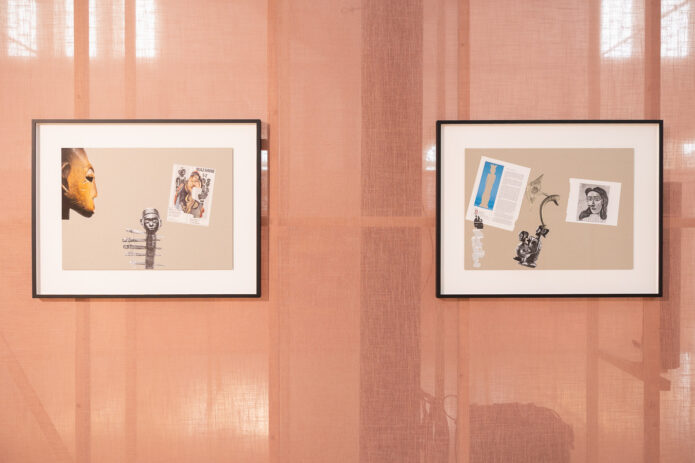
Kader Attia, Untitled (2025), presented at the exhibition Shapeshifters: On Wounds, Wonders and Transformation (2025) at Framer Framed, Amsterdam. Photo: © Maarten Nauw / Framer Framed
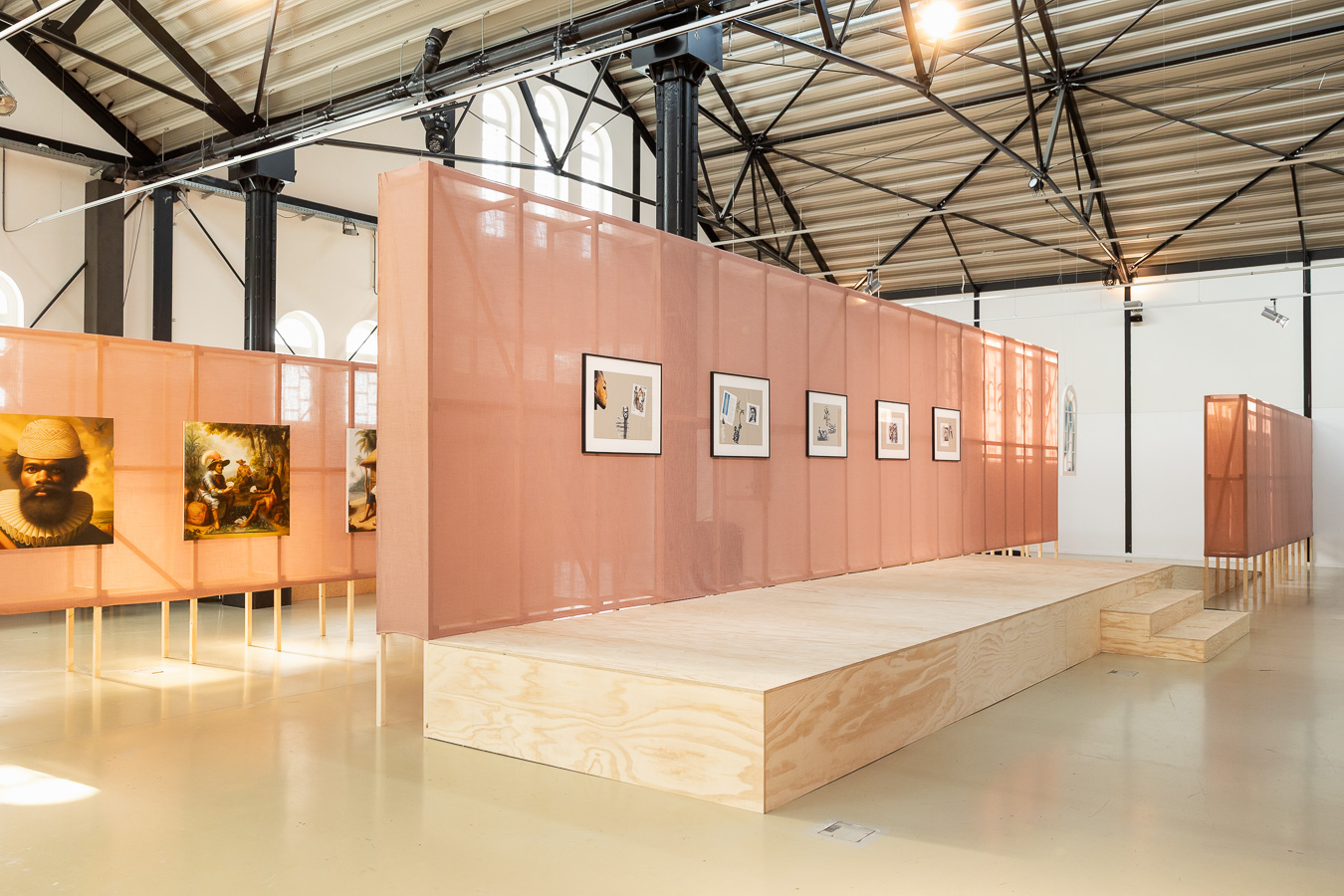
ART AFRICA: Shapeshifters unfolds within a porous architecture of translucent fabrics, wooden frameworks, and suspended objects that seem to hover between visibility and concealment. How did the spatial design inform the research team’s approach to themes of transparency, opacity, and institutional transformation?
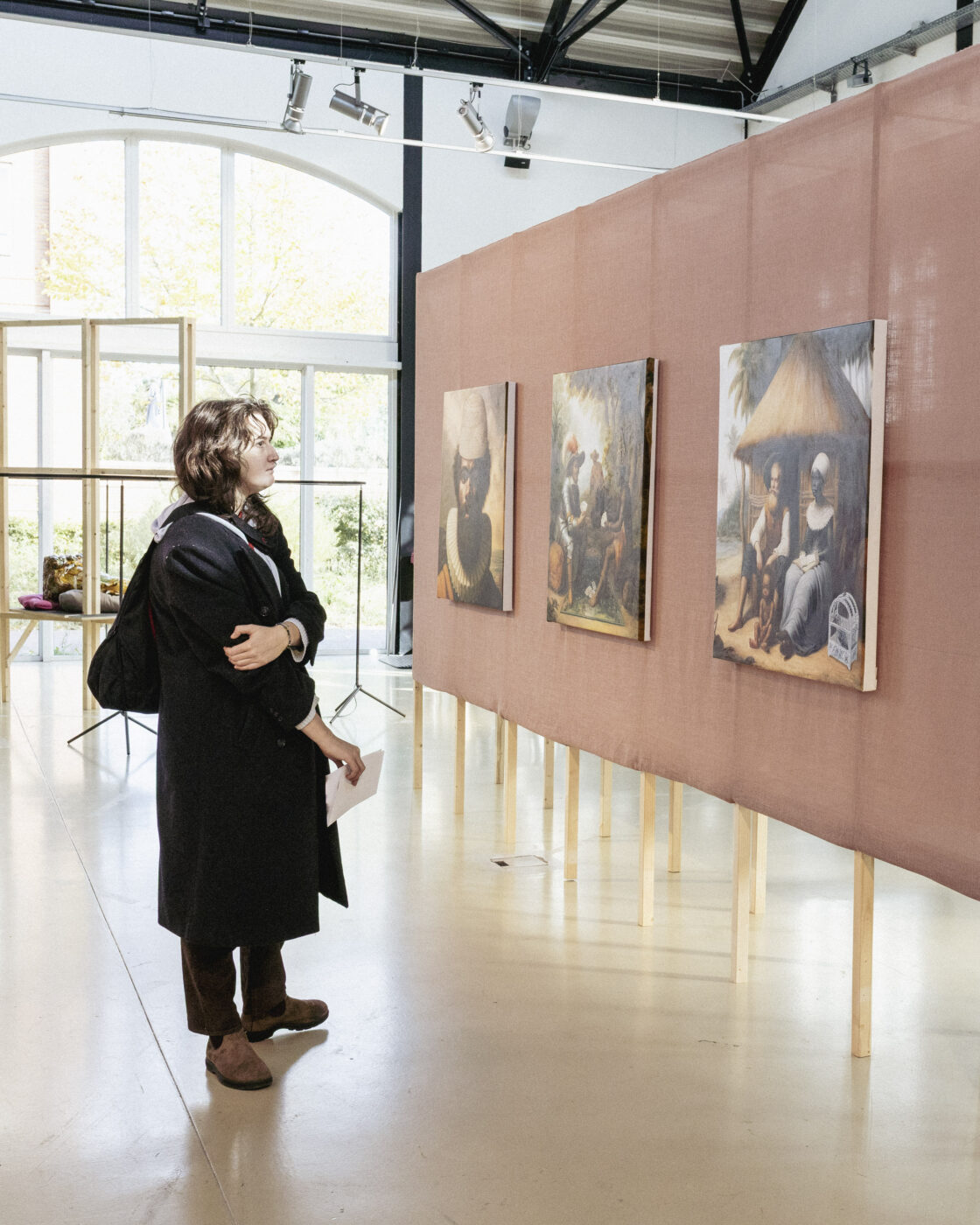
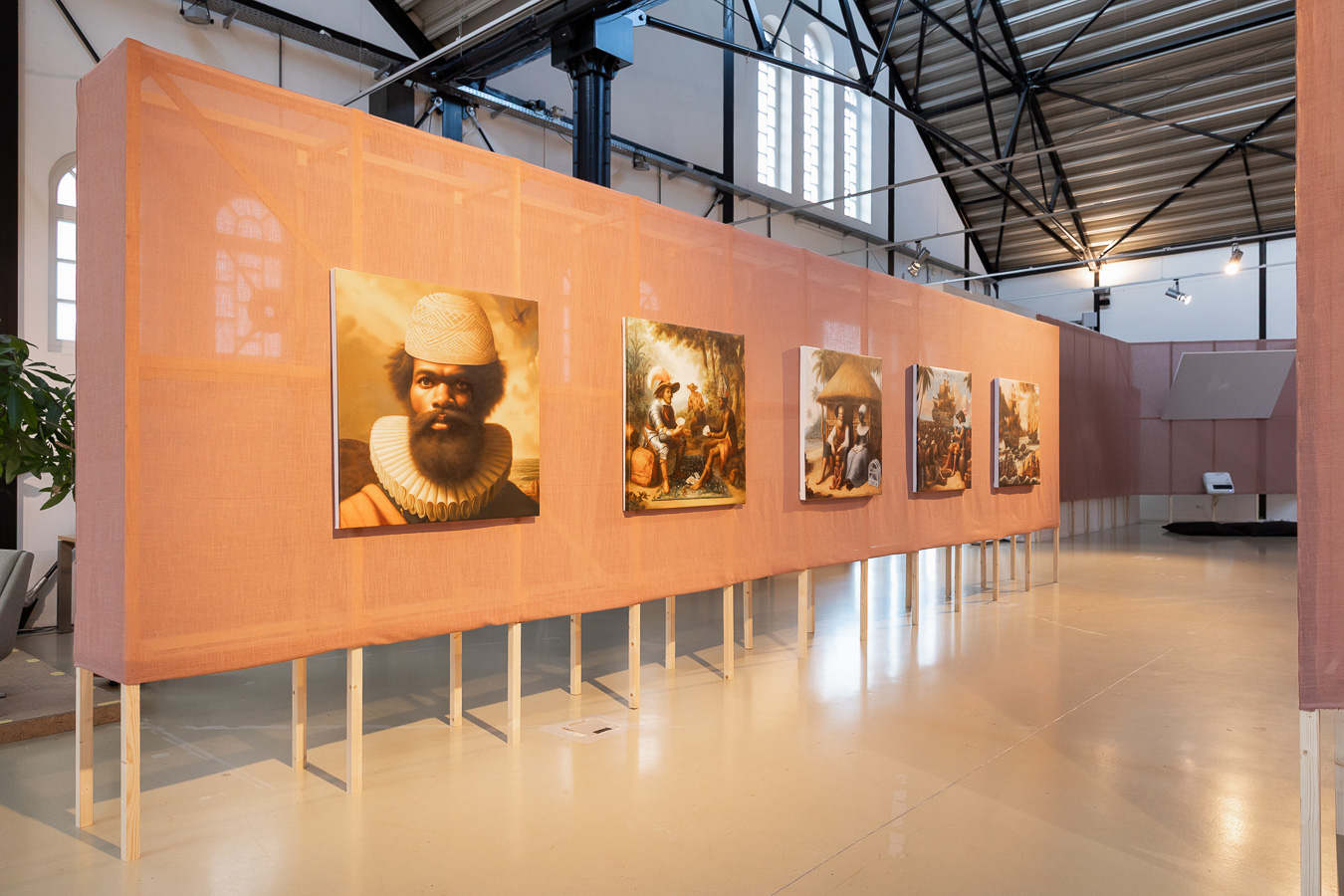
Emily Shin-Jie Lee: Exhibition design plays an essential role in the overall experience of an exhibition, which is why we like to involve exhibition designers to develop a scenography for the artworks and narratives that illuminate the ambience of a project. Shapeshifters: On Wounds, Wonders and Transformation followed the same process: after sharing the exhibition title, concept and artist list with our collaborators at Bureau LADA, the designers proposed to experiment with notions of (in)visibility inspired by the artists’ works and Édouard Glissant’s ‘right to opacity’, a concept that addresses how to confront colonial legacies while safeguarding the diversity of communities. This idea led to the development of earth-toned, semi-transparent textile walls that hover slightly above the floor, obscuring visitors’ bodies while revealing only their legs and silhouettes at a distance.
Another central element is the raised linear platform positioned in the middle of the gallery. This stage echoes the artworks, many of which require shifts in perception and embodied engagement. For instance, Kosisochukwu Nnebe’s A Palimpsest for the Tongue traces the banana plant’s migration and its ties to Blackness and racial capitalism by imprinting archival images on banana leaves. These images can only be seen when you look above, highlighting the intimate, embodied knowledge of the plant sustained by African-descended communities for centuries. Similarly, Leah Zhang’s BEELD features a suspended, tilted screen that requires viewers to look upward, mirroring the work’s inquiry into how an object becomes a religious icon. The raised platform also serves as a site for conversations and discursive programmes. Rather than offering immediate answers to questions of ownership or value, Shapeshifters aims to create a space that dwells within unresolved dilemmas, inviting continued questioning through public events, gatherings and collective reflection.
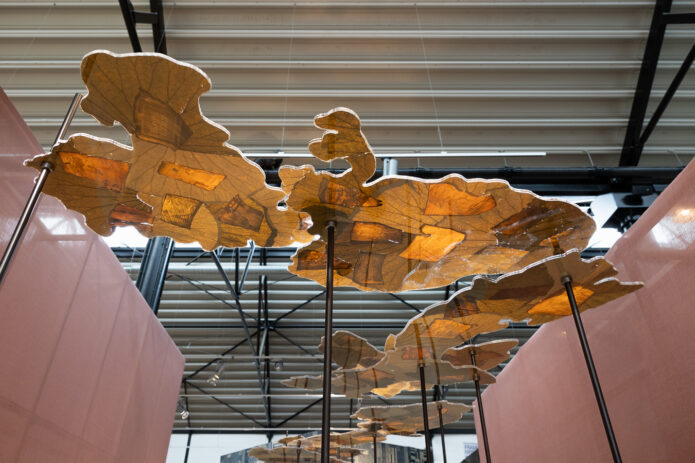
Kosisochukwu Nnebe, A Palimpsest for the Tongue, part of the exhibition Shapeshifters: On Wounds, Wonders and Transformation (2025) at Framer Framed, Amsterdam. Photo by Maarten Nauw / Framer Framed
The exhibition proposes “shapeshifting” not only as a metaphor but as a methodology — an act of becoming fluid within rigid structures. How did this concept influence the way research, curating, and display were intertwined across the project?
Our research for the project has been shaped directly by the artists and their practices. When the research team at Framer Framed were studying the artists’ works and meeting them in their studios, we noticed that many engage with themes of change, shifting positions and resilience – concepts that resonate strongly with Octavia E. Butler’s notion of the ‘shapeshifter’. In Butler’s storytelling, shapeshifters embody not only the capacity for transformation, but also an imaginative technology of resistance against colonial oppression. For instance, in their newly commissioned work Rethreaded Indies, Sammy Baloji and Cécile Fromont present a tapestry that offers a powerful response to the colonial ideologies embedded in the 17th-18th-century French Old Indies series produced at the Gobelins Manufactory. Drawing on archival and visual research, as well as critically engaging with both Kongo and European textile traditions, Rethreaded Indies reappropriates the historical form and technique which produced the heavily biased iconographies of the Old Indies. In a similar spirit, the works featured in Shapeshifters reject homogenising or universalising notions of identity and history, reclaiming stories that have long been framed through a colonial lens.
Apart from the artists who primarily guided our curatorial direction, over the years, Framer Framed has been fortunate to build networks and infrastructures for collaboration with numerous organisations and individuals, both in the Netherlands and internationally. In various stages of shaping Shapeshifters, this constellation of partners has contributed to the project’s critical depth and supported the realisation of our exhibited works. Their involvement makes more tangible the potential for affirmative transformation through connection and collective mobilisation across the field. In short, I would say that the notion of ‘shapeshifting’ corresponded to how we approached the project as a whole – an undertaking that is a constantly evolving and intertwined process of curatorial thinking and artistic creation.
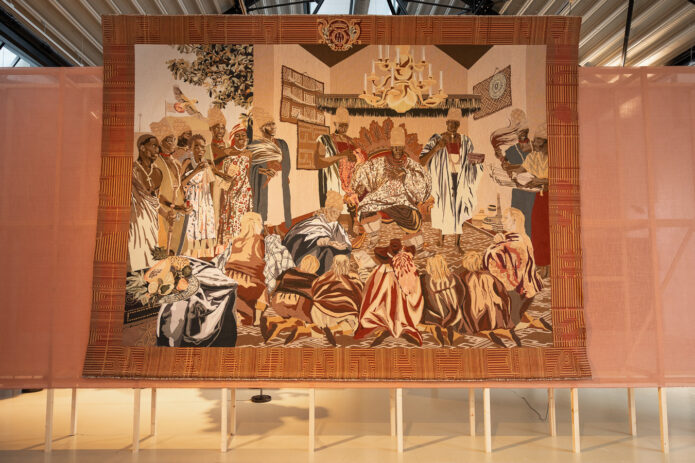
Sammy Baloji and Cécile Fromont, Rethreaded Indies (2025), as presented in the exhibition Shapeshifters: On Wounds, Wonders and Transformation (2025) at Framer Framed, Amsterdam. Photo: © Maarten Nauw / Framer Framed
Many works re-contextualise museum display traditions, combining vitrines, textiles, and archival materials in hybrid forms. From your research perspective, how do Shapeshifters rethink museological conventions of preservation and presentation, especially in relation to colonial collections?
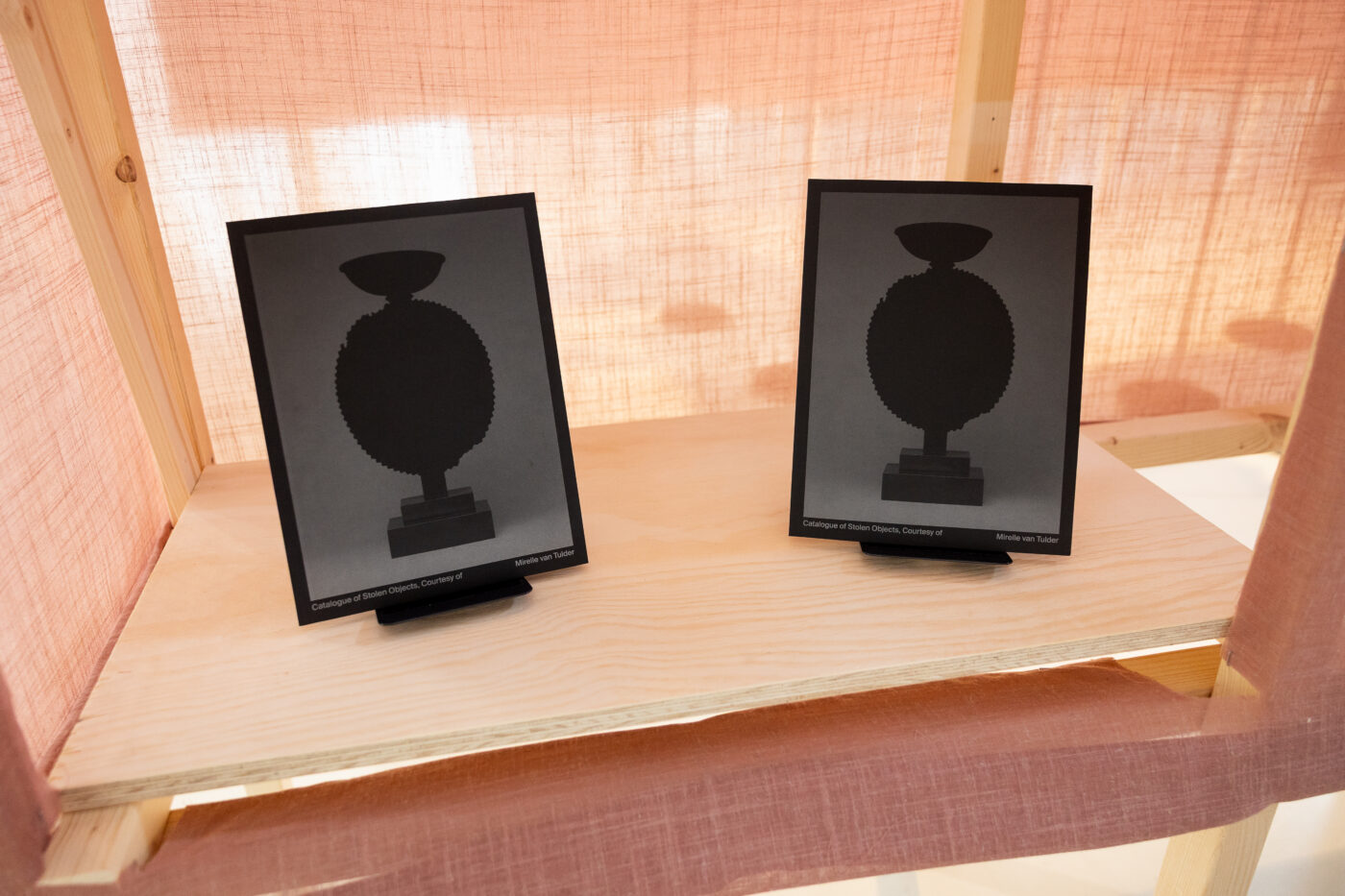
Many of the works in Shapeshifters illuminate how imperial technologies and their accompanying knowledge systems – especially within museological practice – have harmed countless cultures, while also demonstrating how art can open space for imagination, reclamation and remembrance. For instance, Mirelle van Tulder’s video Being Part European leads viewers into the Dutch National Museum of World Cultures, where more than 450,000 ancestral belongings remain inaccessible to the descendant communities who can no longer honour or activate them. Similarly, Anna Safiatou Touré’s The Faces Collection addresses the fetishisation of masks and the sacralising strategies of museum displays by creating clay impressions of miniature Congolese masks. These impressions offer both a critical view of the status of such spiritual objects within European institutions and an embodied reflection on the loss of knowledge surrounding their histories, leaving behind only fragments and traces.
While many of the works address histories that reveal profound violence and dispossession, the exhibition also foregrounds resilience and resistance against colonial museological and archival structures. The work of al-yené, a visual artist from the Sakha Republic, explores displacement and absence within Sakha cultural memory. Rather than seeking to resolve these gaps, she embraces their instability and incompleteness. Through layered testimony, archival imagery and animation, her film constructs a counter-archive that challenges official narratives and highlights the emotional and historical weight of what remains unspoken. Works like al-yené’s invite a renewed mode of engaging with history – one that begins from sites of loss, yet insists on the possibility of reimagining what might emerge from these unresolved spaces.
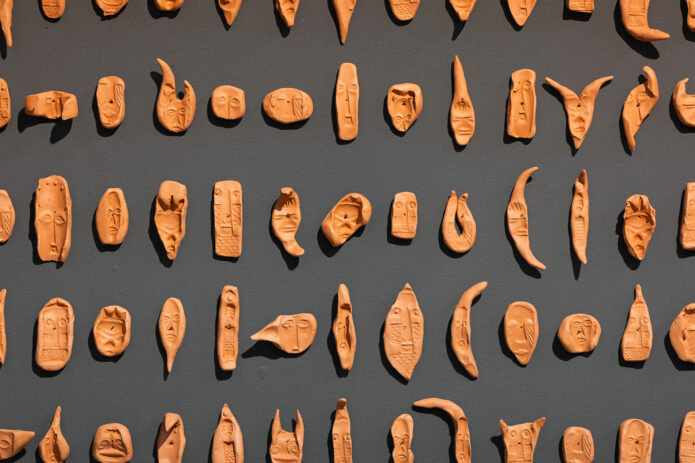
Anna Safiatou Touré, The Faces Collection (2025) from the exhibition Shapeshifters: On Wounds, Wonders and Transformation (2025) at Framer Framed, Amsterdam. Photo: © Maarten Nauw / Framer Framed
The scenography invites visitors to move slowly through layered spaces where sound, texture, and light create a meditative rhythm. How vital was this sensory dimension to the exhibition’s research goals, particularly its call to reimagine care and attention within institutions of knowledge?
Colonial visuality and temporality have long shaped how we perceive the world, making it crucial for us in this exhibition to foreground artists and works that propose alternative ways of sensing and relating to our surroundings. One example is Orbital Mechanics – Electric Dub Station by Antonio Jose Guzman and Iva Jankovic, which reflects on how colonial histories and migrations have configured our interconnected world. The installation combines indigo textiles – a technique historically entwined with the transatlantic slave trade – with hybrid soundtracks that merge electronic music, dub, punk and Senegalese drumming. For this exhibition, the artists reconfigured the work to allow visitors to walk into the installation, immerse themselves in its soundscape and experience the textile materials up close, creating a calibrated tension between feeling and knowing, the sensorial and the intelligible.
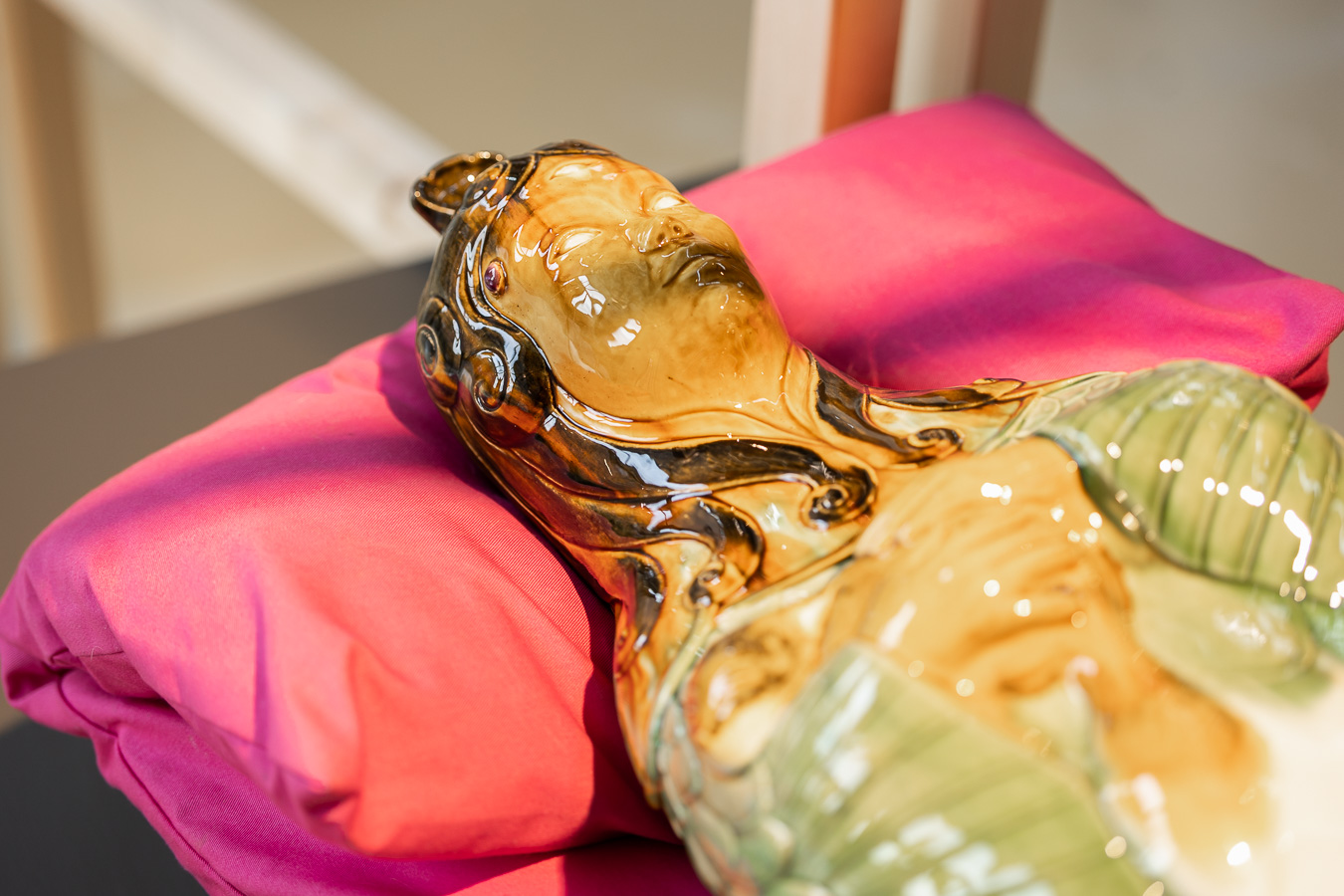
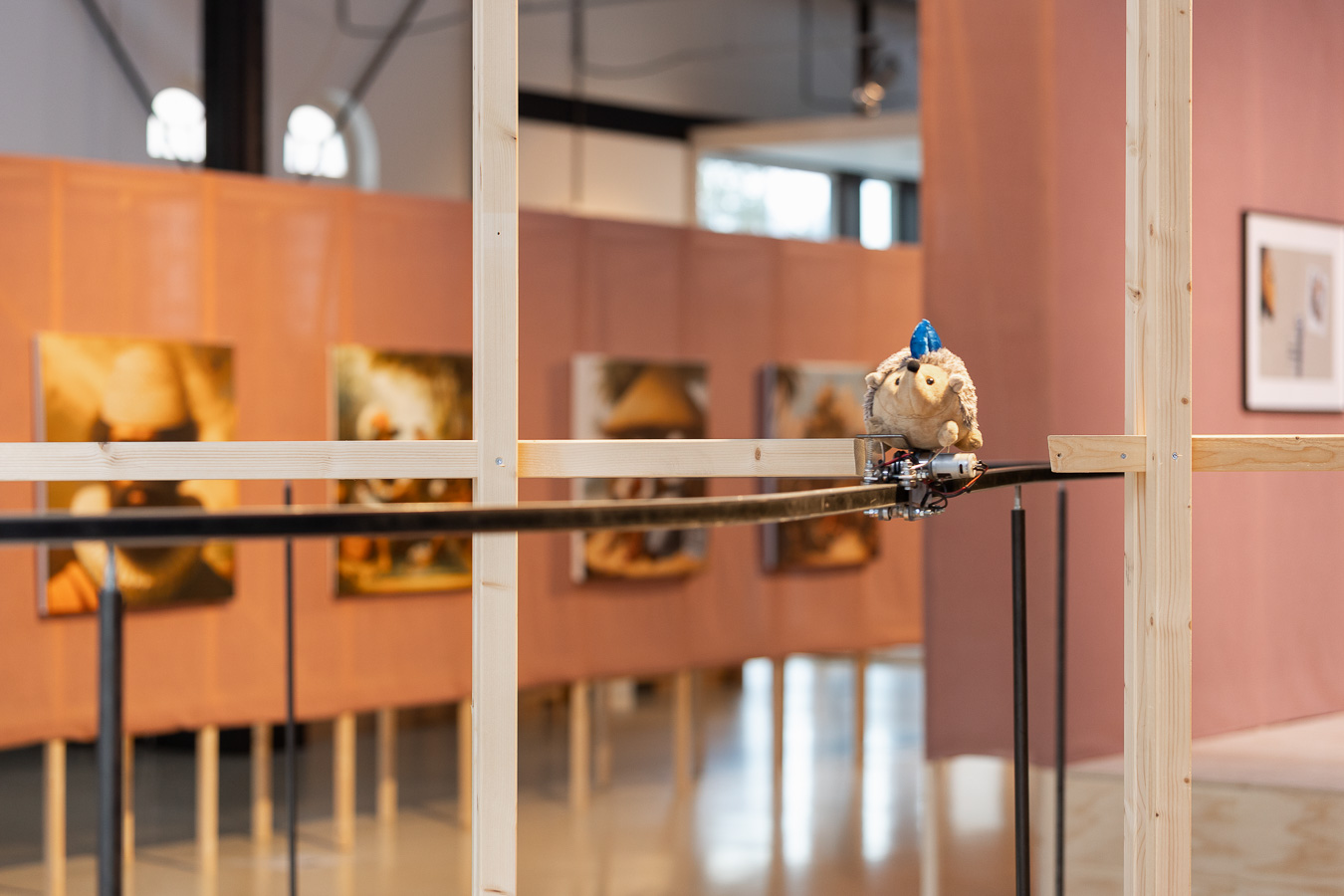
In a similar vein, Pei-Hsuan Wang’s mixed-media installation Origin Myth considers roots as multiple, meandering and transnational. A central gesture in the work is a small train carrying a hedgehog toy that circles around a set of ceramic objects inside a vitrine. The hedgehog playfully animates the display, interrupting the expected stillness of the ceramics. These objects – drawn from the collections of the Princessehof and the Fries Museum in the Netherlands – evoke the twelve-animal zodiac system found in various Asian cosmologies, with the artist’s own family signs (Rabbit, Dragon, Mouse, Dog) placed on the upper tiers of the vitrine. Through these gestures, Wang poetically re-narrates and reactivates objects that once lay dormant within institutional storage. Working closely with the artists, technicians, and museum conservators throughout this process has also reminded us that care and attention must extend beyond the final display – informing every stage of our practice and our relationships with one another.
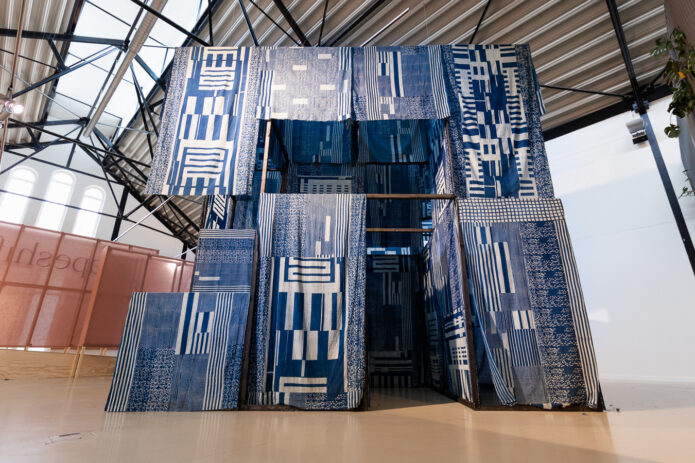
Antonio Jose Guzman and Iva Jankovic, Orbital Mechanics – Electric Dub Station (2024) from the exhibition Shapeshifters: On Wounds, Wonders and Transformation (2025) at Framer Framed, Amsterdam. Photo: © Maarten Nauw / Framer Framed
The exhibition was developed alongside the Pressing Matter research project, which examines ownership, value, and colonial heritage in museums. How did insights from that framework shape the ethical and theoretical underpinnings of Shapeshifters?
Pressing Matter: Ownership, Value and the Question of Colonial Heritage in Museums (2021-2025) was initiated by the National Museum of World Cultures (NMVW) and Vrije Universiteit Amsterdam (VU). As a societal partner, Framer Framed has closely followed – and been deeply inspired by – the artists involved in the project. These artists engaged directly with museum collections to develop compelling new works, later presented at the Wereldmuseum Amsterdam in the exhibition Unfinished Pasts. Shapeshifters was conceived in dialogue with Unfinished Pasts, while extending the conversation toward alternative and non-institutional approaches to forms of return that move beyond narrow definitions of restitution or repatriation.
During the opening week of Shapeshifters, we organised a symposium to bring together artists and researchers from both Pressing Matter and Shapeshifters to foster synergies and new constellations of thought. Discussions ranged from decolonial reparation and institutional responsibility to questions of community and care – central concerns for both projects and resonated with decolonial theorist Rolando Vázquez’s notion of decolonial aesthesis. In his article Aesthetic Restitution for the Joy of Life (included in our exhibition booklet), Vázquez reminds us that ‘the question of restitution is a question of justice and dignity’. Rather than understanding restitution simply as a matter of property rights, he frames it as a practice of joy and re-worlding – a commitment to radical imagination and to envisioning how the world might be otherwise.
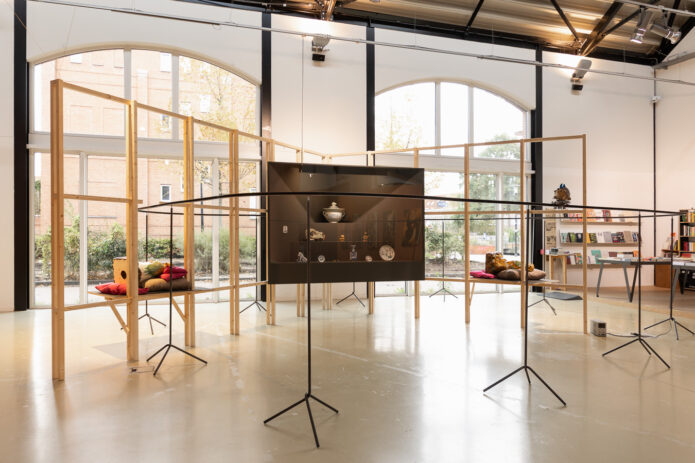
Pei-Hsian Wang, Origin Myth (2025) from the exhibition Shapeshifters: On Wounds, Wonders and Transformation (2025) at Framer Framed, Amsterdam. Photo: © Maarten Nauw / Framer Framed
Shapeshifters feels like a space of encounter rather than conclusion — a place where wounds, wonders, and repair coexist. What do you hope audiences will carry with them from this experience, and how might it influence the ways we think about institutions as living, changing bodies?
While decolonisation may appear to have gained momentum within European institutions and the broader cultural field, curating exhibitions on decolonial themes – or foregrounding these issues through artistic projects – does not mean we are exempt from colonial structures, nor does it signal that the decolonising work is complete. On the contrary, it requires us to examine how we remain implicated in these systems continually, and to learn from the artists, researchers, and activists who have long committed themselves to radical transformation.
For me, one of the most moving moments unfolded during the exhibition opening, when artist Martin Toloku performed Rejuvenate – Kaxoxo, a piece infused with ritualistic elements that summon an energy of care and healing transcending time and space. As he entered the room and moved through the crowd, a profound stillness settled; the audience seemed seized by an invisible force carried in with him. His work prompted us to reflect on what a museum space is – or could become – and on the cracks, folds, and renewed energy that can emerge within and between people and architectures.
Ultimately, we hope Shapeshifters nurtures further inquiry into these urgent questions and deepens awareness of the unfinished work of decolonisation – work that continues as communities across the world navigate spaces still shaped by colonial aftermaths. We aspire for the project to sharpen these complexities rather than resolve them, so that they may be carried forward and explored in new contexts and forms. Through ongoing partnerships, we also aim to test and build conditions that exceed existing institutional limits and to cultivate meaningful encounters across different communities.
Originally published on Art Africa Magazine website in December 2025.
Republished on the Framer Framed website with permission from Art Africa Magazine.
- Exhibition Hand-Out - Shapeshifters EN
Attachments
Global Art History / Colonial history / Museology / New Museology / Textile /
Exhibitions
Exhibition: Shapeshifters
A group exhibition examining how colonialism has shaped museums, archives and other institutions of knowledge
Network