
Performing Colonial Toxicity reist naar de Universiteit van Quebec in Montreal
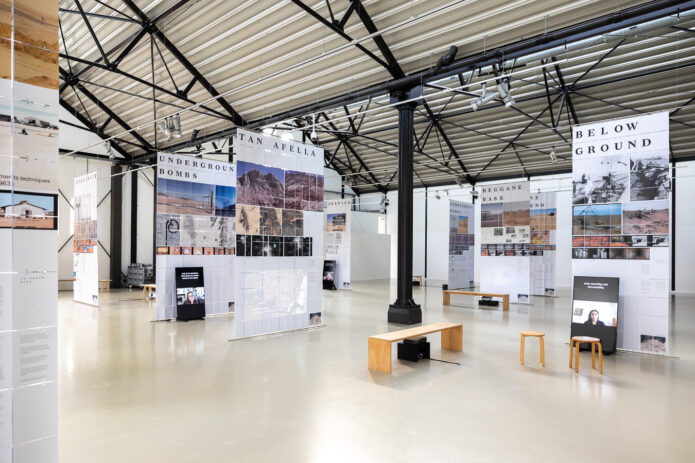
Performing Colonial Toxicity by Samia Henni is presented for the first time in French at the University of Quebec in Montreal Centre de design. This edition also marks the first complete presentation of the exhibition since its initial opening at Framer Framed in 2023.
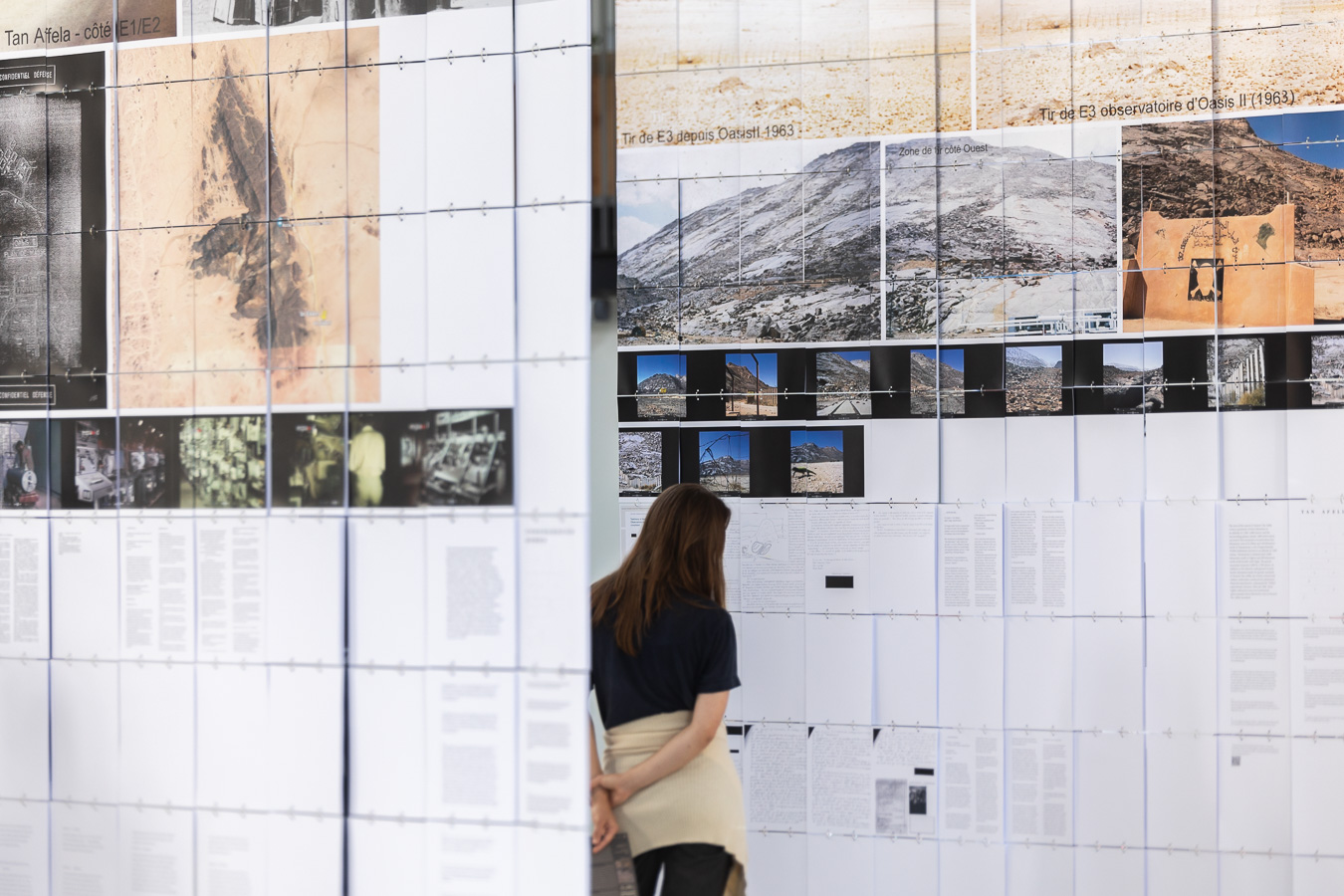
Performing Colonial Toxicity is an archival exhibition by architectural historian and curator Samia Henni, documenting France’s nuclear programme in Algeria during and after the Algerian Revolution (1954-62). Between 1960 and 1966, the French colonial regime detonated four atmospheric atomic bombs, thirteen underground nuclear bombs and conducted other nuclear experiments in the Algerian Sahara, whose natural resources were being extracted in the process. The Sahara region was contaminated with radioactive fallout, which subsequently spread across Algeria, North, Central and West Africa, and the Mediterranean, including Southern Europe. This has caused irreversible and ongoing contamination of living organisms, cells and particles, as well as the natural and built environments.
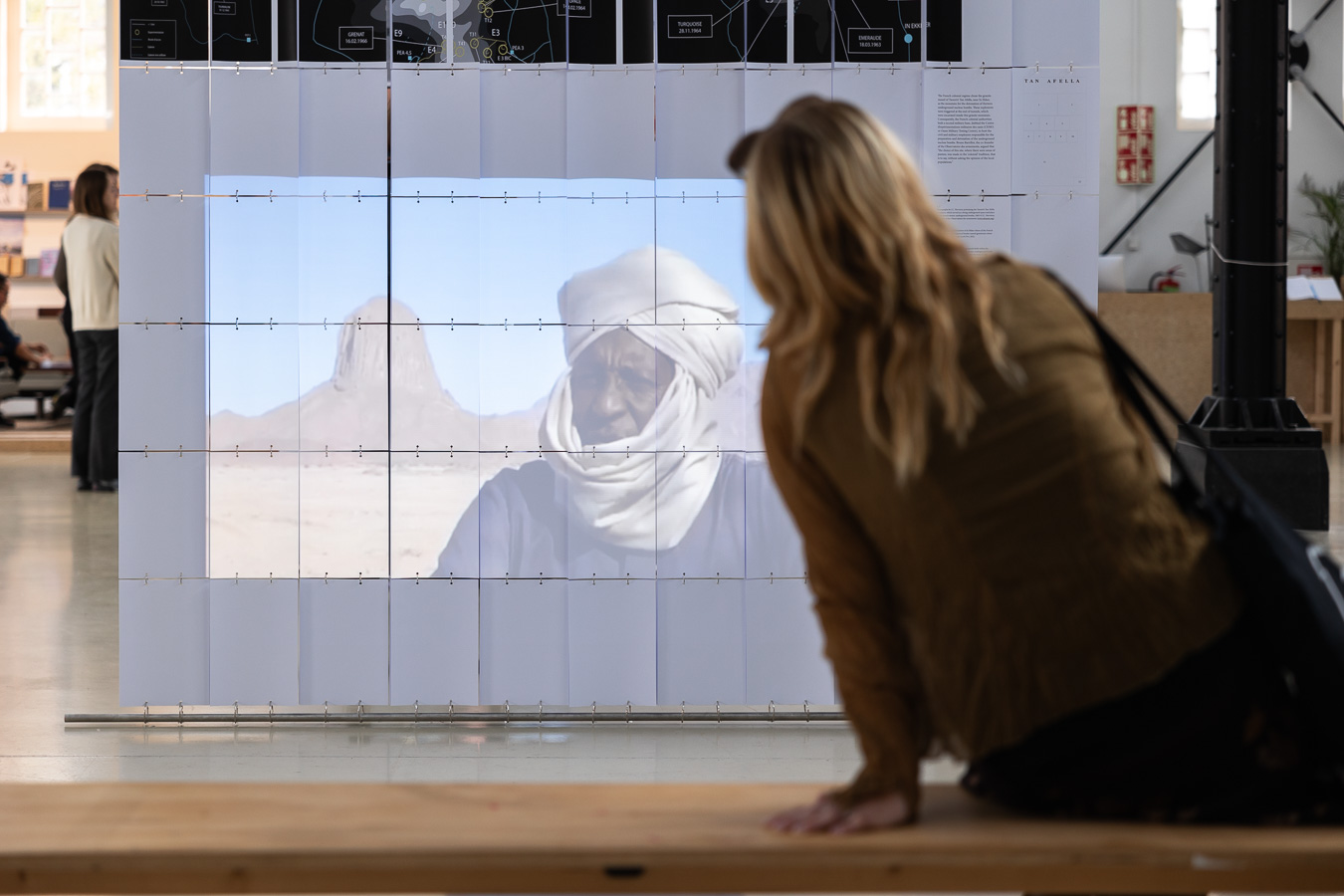
The presentation Toxicité coloniale : Architecture et paysage radioactifs français dans le Sahara at the University of Quebec in Montreal (UQAM) Centre de design offers new French translations alongside the original English text. In addition, translation are available in both French and English for videos, interviews, and other materials which appear in their original language (English, French, or Tamasheq). The exhibition is on show from February 19 to April 12, 2026.
“Showing this exhibition at the UQAM’s Centre de design is a necessary step, as it provides a space where research, teaching, and design practice converge. Samia Henni mobilises tools specific to architecture and design, including drawing, mapping, and spatial visualisation, to conduct a genuine investigation and forensic reconstruction of a subject long shrouded in secrecy. She reveals how the architect’s tools can do more than simply construct a building: they can also be used to understand and decipher complex historical and territorial events, to build knowledge, and to take a stand.”
– Patrick Evans, Director of UQAM’s Centre de design.
“Designing an exhibition and thinking through it constitutes a form of research and a way to engage a diverse audience. The exhibition has a dual purpose: first, to showcase the architectural and landscape production of radioactivity, as well as the irreversible and ongoing impact of this production and contamination; and second, to juxtapose these with powerful testimonies from victims of nuclear power. The exhibition also serves as a call for the declassification of institutional archives and the decontamination of sites around which Saharan populations still live. For all these reasons, I thank UQAM’s Centre de design for contributing to the international circulation of this exhibition.”
– Samia Henni, historian and curator of the exhibition.
More information of the project can be found in the exhibition companion guide.
Continue Reading
The publication Colonial Toxicity: Rehearsing French Radioactive Architecture and Landscape in the Sahara (2024) brings together nearly six hundred pages of materials documenting this violent history of France’s nuclear bomb programme in the Algerian desert. Meticulously culled together by the architectural historian from across available, offered, contraband, and leaked sources, the book is a rich repository for all those concerned with histories of nuclear weapons and engaged at the intersections of spatial, social and environmental justice, as well as anticolonial archival practices. Colonial Toxicity will be translated into French by Editions B42, the French edition is expected early 2026.
Colonial Toxicity selected as one of the ‘Best Dutch Book Designs 2024’
Every year Best Dutch Book Design celebrates the best products of the graphic industry in The Netherlands. Both the professional and student jury selected Colonial Toxicity as a publication which combined fantastic design and high quality printing and binding.
Colonial Toxicity selected as ‘The Most Beautiful Swiss Book 2025’
The publication Colonial Toxicity has been awarded the Most Beautiful Swiss Book in the competition of 2025.
Order
You can order the book through the Framer Framed webshop
International distribution
For international distribution to bookstores contact Ideabooks.
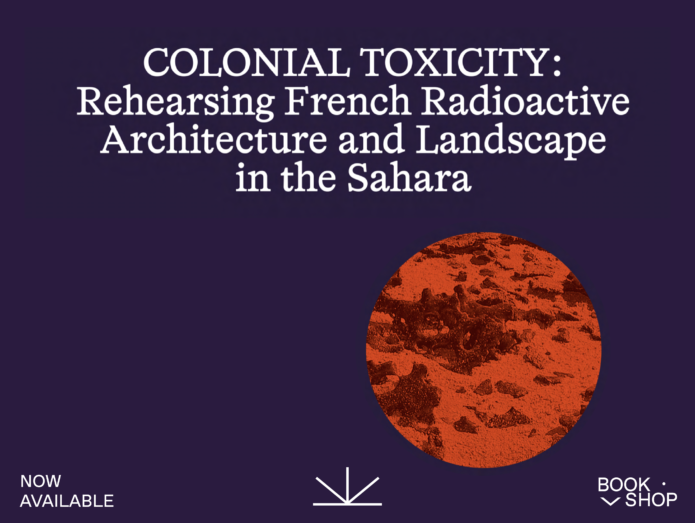
Colonial Toxicity, Book Cover
Credits
Performing Colonial Toxicity is a co-production of Framer Framed and If I Can’t Dance, I Don’t Want To Be Part Of Your Revolution.
The project was supported by Swiss Arts Council Pro Helvetia. Special thanks to the Observatoire des armements, Centre de documentation et de recherche sur la paix et les conflits; the Établissement de communication et de production audiovisuelle de la Défense (ECPAD); and to filmmakers Élisabeth Leuvrey and Larbi Benchiha with producer Farid Rezkallah for use of images and film excerpts in the exhibition; as well as to Prof. Dr. Roxanne Panchasi, Simon Fraser University for her support for the Tamasheq-to-French translation of Algerian testimonies.
The exhibition at Framer Framed was part of the two-year research project Performing Colonial Toxicity, commissioned by If I Can’t Dance, I Don’t Want To Be Part Of Your Revolution within the frame of Edition IX – Bodies and Technologies (2022-23). If I Can’t Dance is financially supported by the Mondriaan Fund.
Framer Framed is supported by the Ministry of Education, Culture and Science; Amsterdam Fund for the Arts; Municipality of Amsterdam; and VriendenLoterij Fonds.
Het levende archief / Ecologie / Koloniale geschiedenis / Omstreden erfgoed /
Exposities
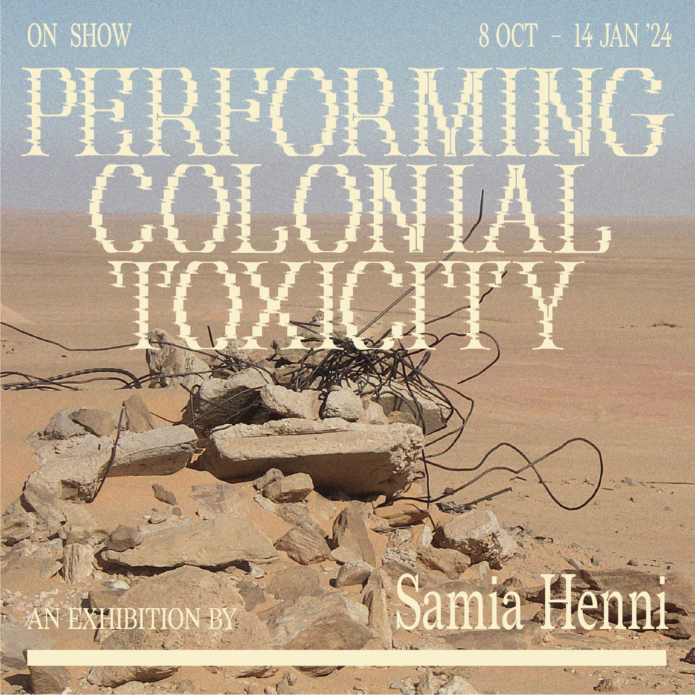
Expositie: Performing Colonial Toxicity
Een tentoonstelling van onderzoeker en architectuurhistorica Samia Henni, in samenwerking met If I Can’t Dance, I Don’t Want To Be Part Of Your Revolution
Netwerk