Curatorial Statement by Fabienne Rachmadiev on the exhibition Between Fires
Between Fires: Irradiated Imaginations and Anti-Nuclear Solidarities, curated by writer and researcher Fabienne Rachmadiev, traces the international and intertwined histories of nuclear infrastructures, colonialism and resistance, beginning in the Northern Kazakh steppe. Her curatorial statement from the exhibition hand-out foregrounds the temporalities and spatialities of nuclear colonialism across various geographies.
Text by Fabienne Rachmadiev
In the city of Almaty, Kazakhstan, in front of a Stalin-era socialist classicist building, with its pilasters and ornaments, stands another monument, easy to miss in contrast with the grandeur of the Writer’s Union residence. It’s a granite rectangle with an engraving depicting a Kazakh shaman and a Western Shoshone elder exchanging a peace pipe. This scene is the emblem of the Nevada-Semey anti-nuclear movement that gained extraordinary momentum in late 1980s’ Kazakhstan, then still the Kazakh S.S.R. Led by poet Olzhas Suleimenov, the thousands of protestors formed the largest anti-nuclear movement in history. They built on the work of scientists who had started gathering data as early as the 1950s to establish the environmental and health dangers of radiation, often at great personal cost.¹ More than 40 years of testing by the Soviet regime had released 17.7 megatons of radioactive material onto the northern Kazakh steppe around Semey (named ‘Semipalatinsk’ before independence).²
While the anti-nuclear movement in Kazakhstan was tied up with a struggle for independence, it also sought to connect with other people and places rendered nuclear test sites by imperial forces, one of them being the Nevada Test Site, home to the Indigenous Western Shoshone people. Their activism included collective rituals, such as exchanging a peace pipe and throwing stones into fire to dispel evil.³ One such purification ritual, walking through fire, saw hundreds of people march across the steppe between two bonfires. With this and other interventions, Nevada-Semey succeeded in ending Soviet nuclear testing and the closure of Semey’s Polygon test site in 1991.
After the end of the Soviet Union, Kazakhstan, Belarus and Ukraine, as heirs to the Soviet nuclear arsenal, signed the Budapest Memorandum: giving up their arsenals in exchange for safety guarantees. Behind these geopolitical, financial and militarised structures of the atom, lie the lifeworlds of those directly affected by the cycle of mining uranium to detonating and testing nuclear weapons. Kazakhstan’s nuclear history, while extensively studied within the context of the Soviet Union and the Cold War nuclear arms race, is not widely known outside of this narrative. As such, it is not often considered an example of nuclear colonialism.⁴
The secrecy surrounding nuclear infrastructure, which is classified as prohibited, often resorting to Cold War rhetoric and strategic ‘safety’ concerns, results in the obscuring of data and archives that are important for justice for survivors. Compounding radiation’s famed invisibility, the deliberate concealment of nuclear infrastructures thus serves as a double erasure – complicating solidarity and cooperation between affected people and territories. The Nevada-Semey movement, but also current initiatives such as the Nuclear Truth Project, sought and seek to undo this obscuring by emphasising solidarity between survivors, more often than not from Indigenous lifeworlds. Scholar Lou Cornum calls them the ‘irradiated international’: ‘Those whose lives are crossed by uranium and other radioactive weapons materials form a diffuse collective of families, communities, enemies, and strangers.’⁵
In her seminal work on Kazakhstan’s nuclear history, nuclear policy scholar Togzhan Kassenova opens with the consequences for humans (an estimated 1.3 million were affected by various forms of radiation and radioactive waste) and non-humans, wild animals, such as the Saiga antelope and the Argali (wild sheep), as well as domesticated ones.⁶ Kassenova notably centres the steppe itself, sacred to its inhabitants and the national imagination, but deemed ‘uninhabited’ by the Soviet military, which was searching for a suitable test site. The nuclear arms race with the United States had taken off; the first successful detonation of an atomic bomb at the Trinity Test site – affecting mostly Indigenous people and land, marked the beginning of a nuclear world.
Kassenova describes the steppe in detail: the river Irtysh flowing through it, and seasonal migration routes for the nomadic lifestyle adapted to its challenging ecology. She notes its beauty, its vastness, its many colours, the sacred meaning this landscape holds for those who call it home. She also underscores the region’s cultural importance with the city of Semey as the birthplace of many Kazakh artists, writers and other intellectuals. ‘People from the Semipalatinsk region wish their land to be known for its history and culture, for the richness of its flora and fauna, and not only for the hardships they faced.’⁷
*
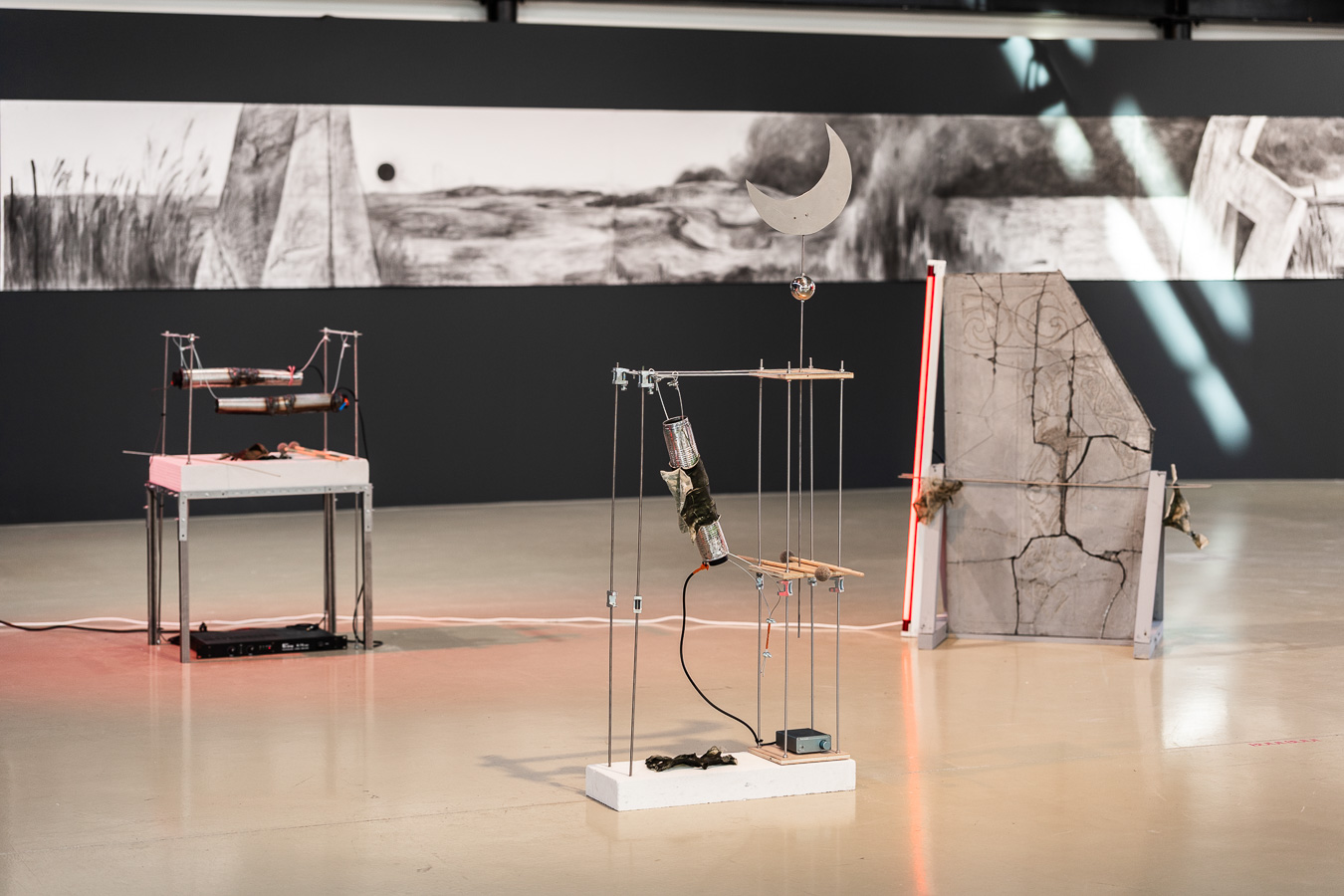
The exhibition Between Fires: Irradiated Imaginations and Anti-Nuclear Solidarities takes the irradiated steppe as the starting point for reflection on the intertwined histories of nuclear infrastructures, colonialism as well as resistance, and from there seeks to connect with other such visual, poetic, sonic and archival approaches. Two of the works commissioned especially for this exhibition deeply engage with the cultural importance of the Semey region, while considering what it means that the steppe has become irradiated. Nükte, by Äsel Kadyrkhanova, means ‘dot’ or ‘full stop’ in Kazakh, implying an ending. It is a point of fixture in a vast landscape such as the steppe, an anchor point from which to consider radiation, or a before and an after radiation. Combining auto-ethnography, memory and pencil-drawing, Kadyrkhanova traces the incognisability of the steppe after the dot. The collective buulbuul presents a performance installation titled The Burial of a Brown Goose, in which a story of human and more-than-human solidarity takes centre stage. Musical and oral traditions, so integral to Kazakh culture, convey care and friendship in a landscape that has seen colonial violence in the form of forced industrialisation, man-made famine and nuclear testing.
Another recent consideration of the enduring meaning and latent presence of radiation on the northeastern Kazakh steppe comes in the form of an immersive sound installation by Kamila Narysheva and Vicky Clarke. Narysheva undertook a challenging journey to the former test site, known as the Polygon, to experience for herself this space that has become so central to Kazakhstan’s transition into independence and that looms large in the collective imagination. The recordings of the site evoke a layered testimony of nuclear temporalities embedded in the materiality of the place, which gains an aliveness as if it is finally allowed to witness, too.
Whereas the Polygon in foreign media is often portrayed as a dystopian wasteland – attaching yet another colonial gaze to the steppe – these artists testify to both the need for remembrance of the horrors, as well as the need for love, commitment and enduring care for the steppe. To pledge not only for the survival of this lifeworld, but to pay respect to the knowledge, the joy and the beauty of the ‘eternal steppe’.
From this place, Between Fires reaches to other regional perspectives and landscapes that bear histories of the nuclear. Emilija Škarnulytė’s film installation Burial (2022) invites the viewer to take in the past, present and speculative future of the Ignalina Power Plant – a Cold War era construction in Lithuania. The immense architecture is undergoing a process of decommissioning, a moment of possible openings that the artist has transformed into an immersive journey, where sound informs sight as much as the other way around.
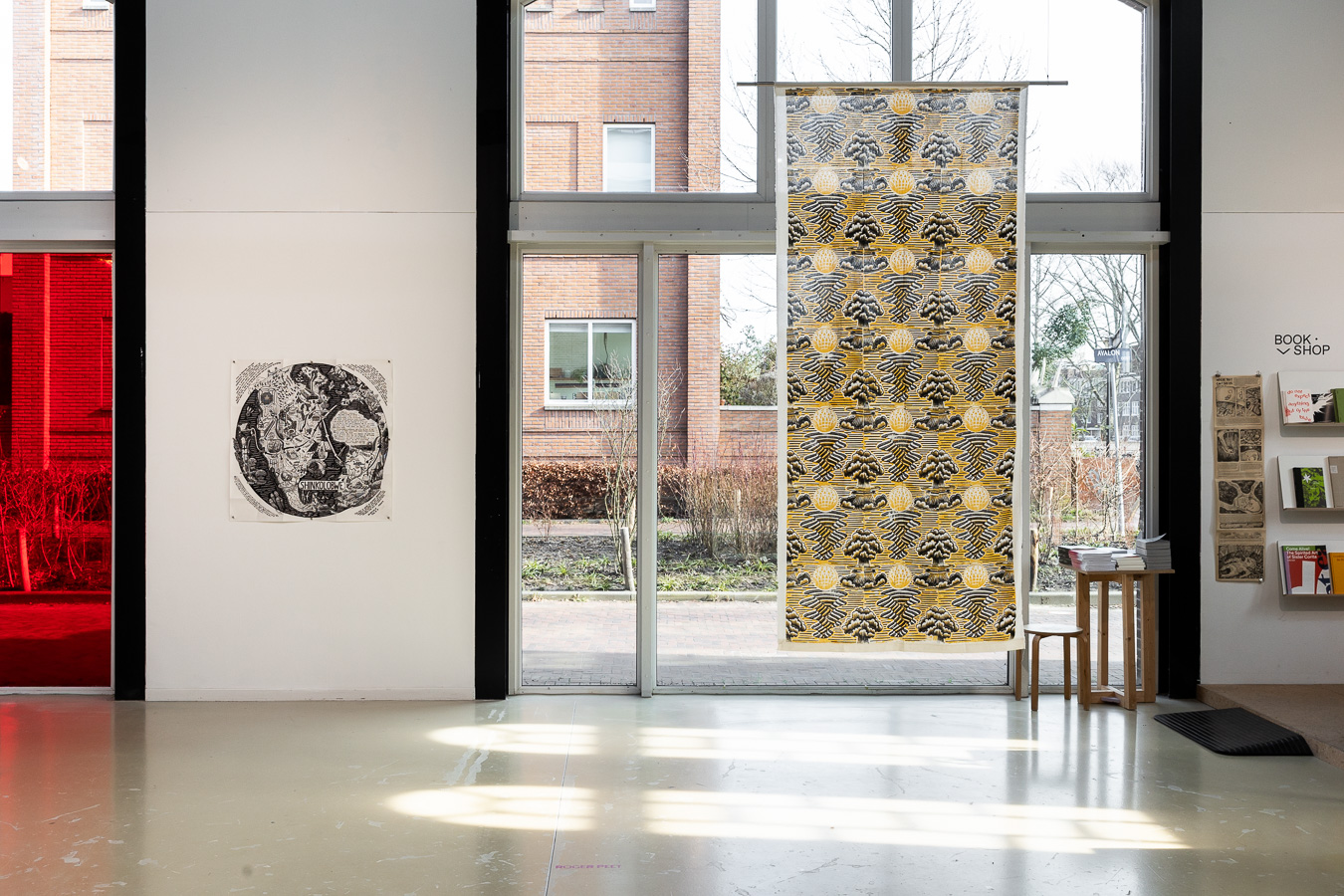
Roger Peet’s print Dig Up The Sun (2022) traces and connects the path, through time and place, of the atomic bombs that were dropped on Hiroshima and Nagasaki. Peet’s map covers a vast geography: from the uranium of the Shinkolobwe mine in the Democratic Republic of the Congo, through the Trinity Test Site in New Mexico, to numerous enrichment facilities, plants and docks before their detonation in Japan. It takes an extraordinary amount of infrastructure, resources and people to create a nuclear weapon. While the vastness of it might dazzle, Peet’s map is foldable; we have to grasp and carry these paths of violence and destruction in order to resist them.
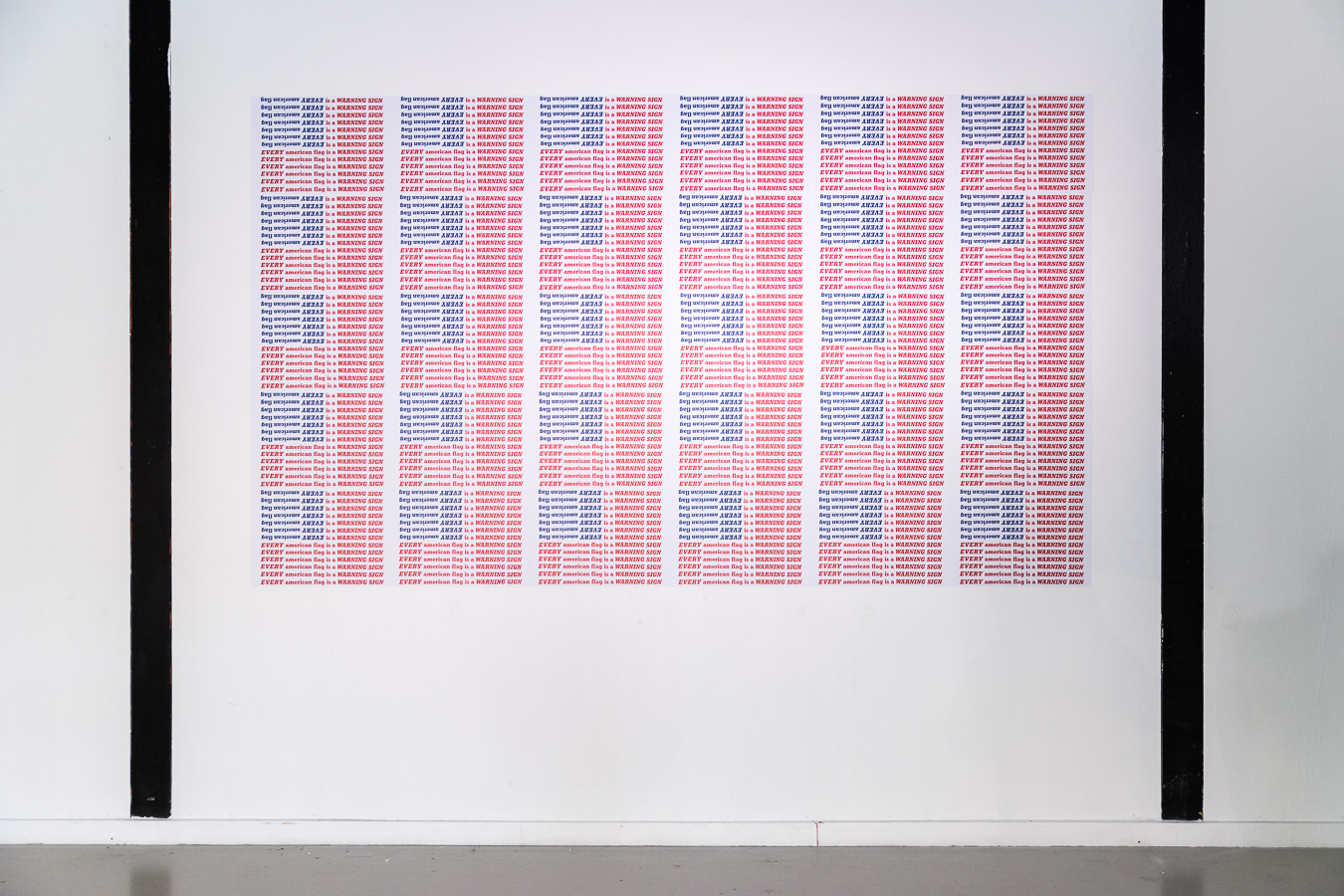
The origin of the atomic bomb, of the nuclear weapon, lies in the United States, and so Demian DinéYazhi‘’s work my ancestors will not let me forget this (2019) powerfully states, ‘Every American Flag is a Warning Sign’. An evident reality for those who have undergone the violence of the United States. DinéYazhi’’s use of colour references both Indigenous landscapes as well as the toxic glow from radioactive waste and the reddish hues of the waste from uranium mining.
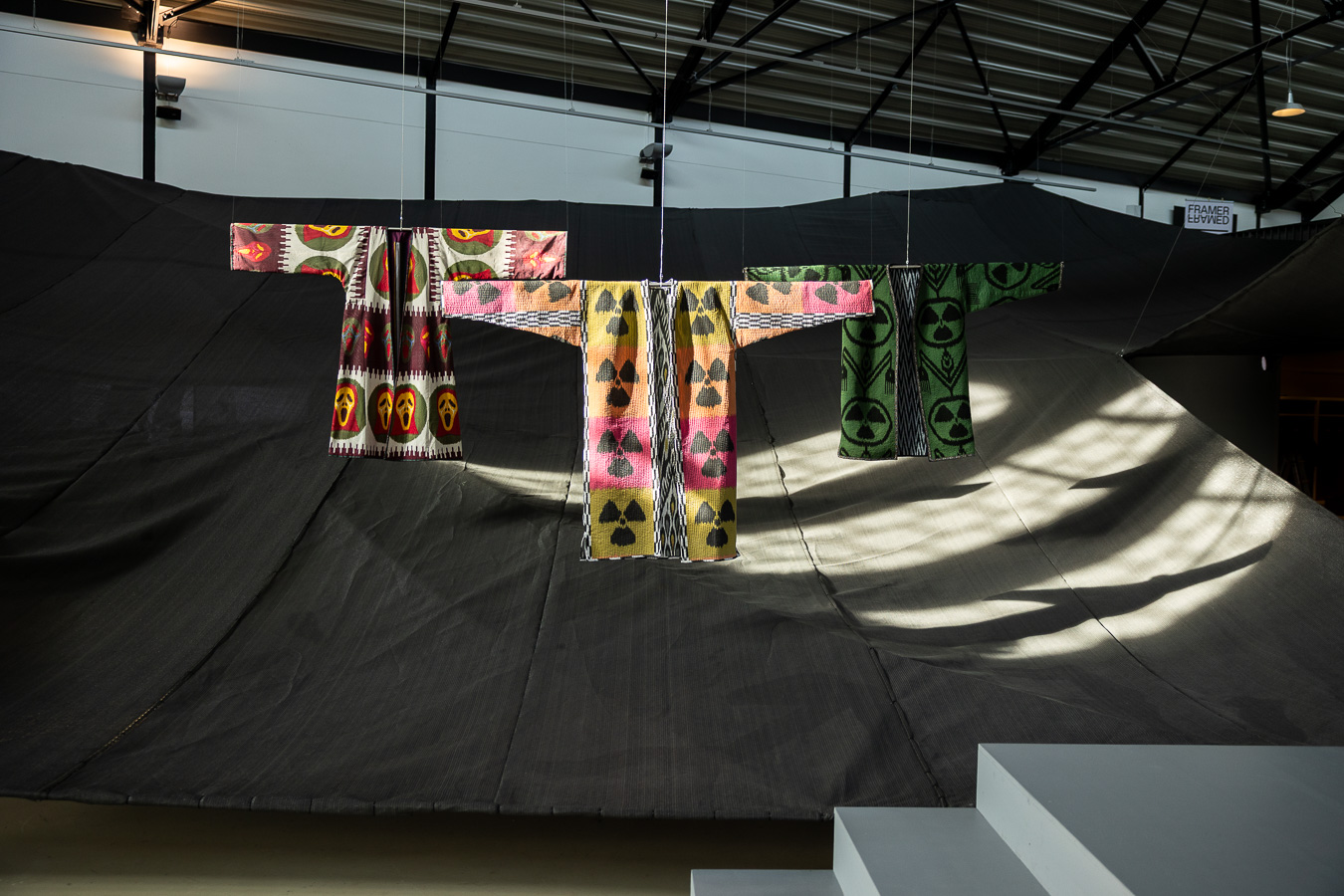
Another, more covert, ‘warning sign’ is woven into Dilyara Kaipova’s textile artworks, which combine traditional Central Asian weaving techniques, such as ikat, with imprints of nuclear toxicity hazard signs. Woven into chapans, they offer alarmingly beautiful reminders of what this tradition has seen and endured through the centuries. A chapan, meant to be worn, functions as a guard for radiation, or as an awareness of what radiation has already permeated.
Colour as a visible aftermath of invisible radiation, as well as suppressed practices around nuclear infrastructures, appear also in Inas Halabi’s We Have Always Known the Wind’s Direction (2023). In these frames, the question of the possible burial of nuclear waste in the southern West Bank haunts the landscape.
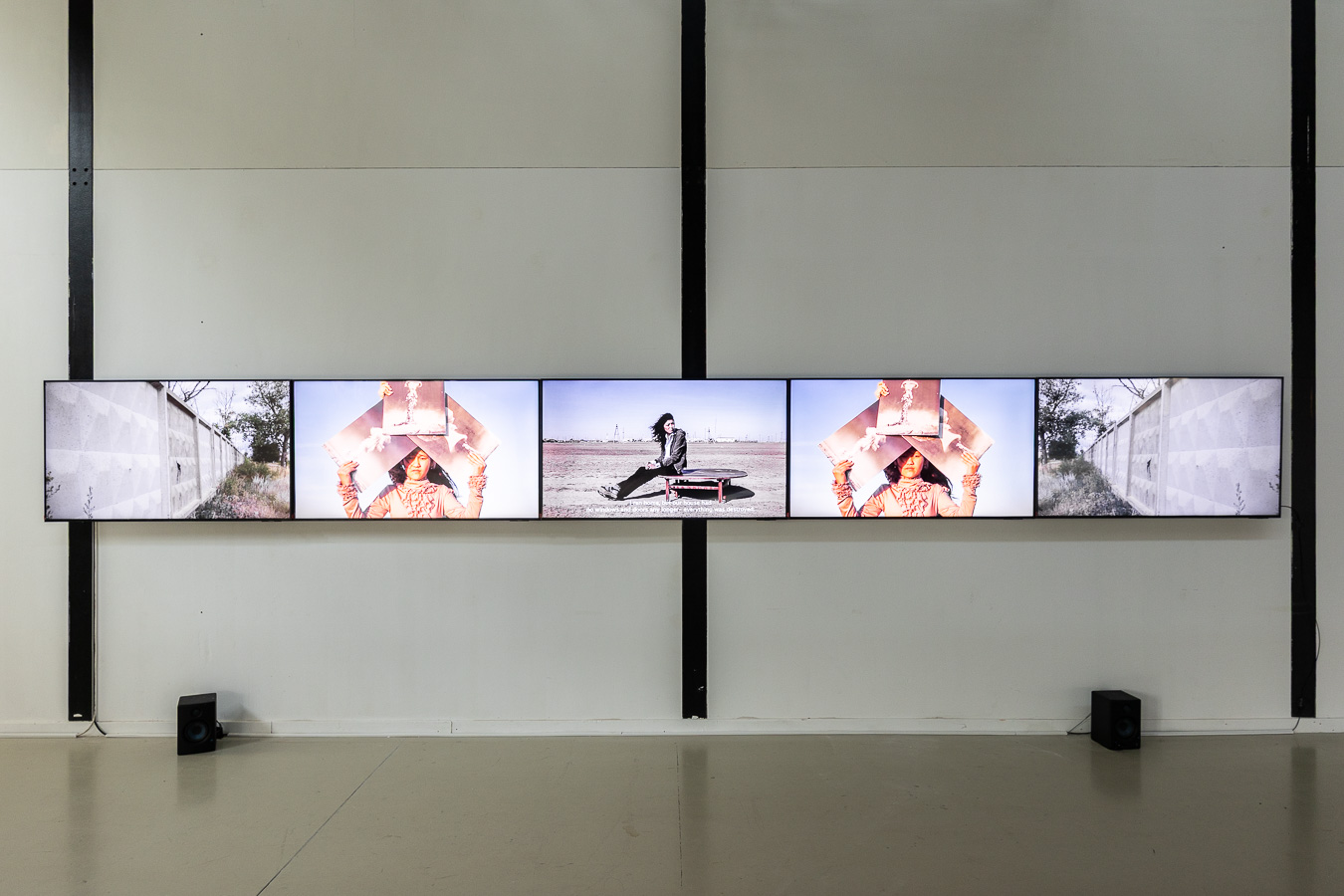
Returning to the nuclear legacy of the steppe, Almagul Menlibayeva reckons with the past, present and possible futures of the Polygon in the five-channel video installation Kurchatov 22 (2013). Speculative fiction is paired with survivor testimonies, an eerie soundtrack with scenes oscillating between myth and dream. Menlibayeva does not regard the nuclear history of the steppe as something of the past, instead she continues her engagement with the implications of radiation, most recently in the textile work ominously titled Thermonuclear Skin (2022).
Alongside these artistic contributions, two archival sections on anti-nuclear activism of the past, assembled by researcher Kamila Smagulova and the International Institute for Social History, show the ways in which communities have come together in struggles for the protection of their environments.
The inhabitants of these and other sites of extraction, detonation and containment are the primary victims, but these irradiated landscapes should not be viewed merely as ‘elsewhere’, nor confined to the past or the unreality of a dystopian future. The nuclear is a planetary condition, especially in an increasingly militarised world, where there is a renewed threat of regimes taking up nuclear weapons. As scholar Gabrielle Schwab writes in Radioactive Ghosts, ‘the very invention and use of the first atomic bomb and the haunting knowledge of its power to annihilate planetary life have generated a rupture in “the order of things” […] How can this knowledge not affect people in their entire existence?’⁸ Schwab calls this the ‘nuclear unconscious’. Even for those who live far away from test sites, in Imperial cores, the nuclear harbours potential for such vast damage, everyone is in some way entrapped within it.
What does it mean to live in such a nuclear world?
Fabienne Rachmadiev, 2026
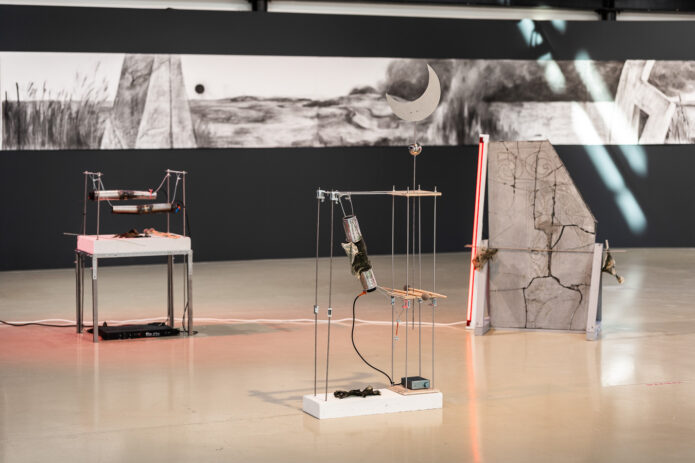
Installation photo of Between Fires – Irradiated Imaginations & Anti-Nuclear Solidarities (2026) at Framer Framed, Amsterdam. Photo: © Maarten Nauw / Framer Framed
Footnotes
1. To this day, Moscow has not released any of this data.
2. Roughly equivalent to a thousand bombs like the ones dropped by the US on Hiroshima and Nagasaki.
3. Rozsa, George Gregory. ‘The Nevada Movement: A Model of Trans-Indigenous Antinuclear Solidarity.’ Journal of Transnational American Studies, Vol. 11, No. 2, 2020, pp. 99-123.
4. Hennaoui, Leila, and Marzhan Nurzhan. ‘Dealing with a Nuclear Past: Revisiting the Cases of Algeria and Kazakhstan through a Decolonial Lens.’ The International Spectator, Vol. ahead-of-print, No. ahead-of-print, 2023, pp. 1-19.
5. Cornum, Lou. ‘The Irradiated International’, lecture given at Future Perfect conference, 7-8 June 2018 at Data & Society Research Institute.
6. Dogs especially were rounded up by the Soviets to use for their experiments.
7. Kassenova, Togzhan. Atomic Steppe: How Kazakhstan Gave up the Bomb (Redwood City: Stanford University Press, 2022), p. 4.
8. Schwab, Gabriele. Radioactive Ghosts (Minneapolis: University of Minnesota Press, 2020), p. 4.
Between Fires: Irradiated Imaginations and Anti-Nuclear Solidarities (2026) is curated by Fabienne Rachmadiev. The exhibition is commissioned and produced by Framer Framed and presented in partnership with Sonic Acts as part of Sonic Acts Biennial 2026.
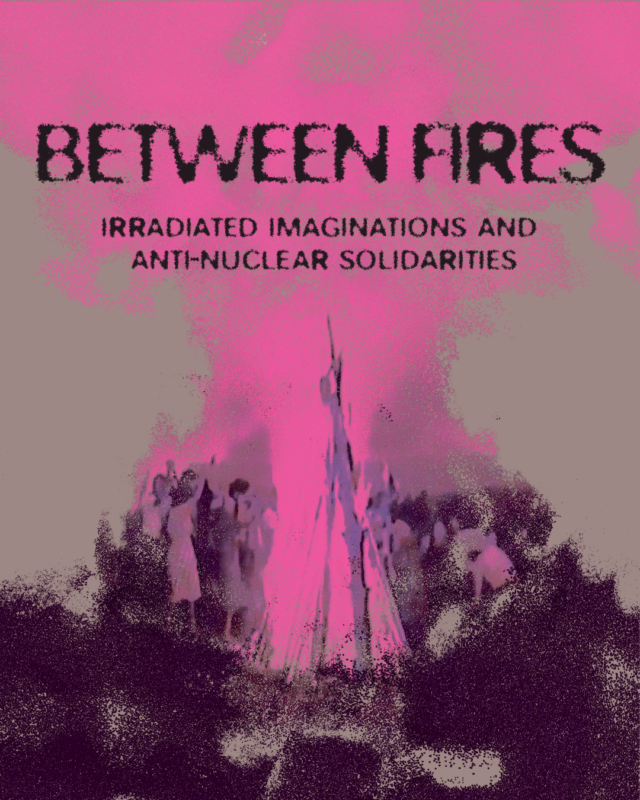
Graphic design inspired by the purification ritual in Karaul, Kazakhstan, 6 August, 1989, depicted in Nevada i Semipalatinsk (1989), dir. Sergey Shafir, Kazakhfilm.
Framer Framed is supported by the Ministry of Education, Culture and Science; Amsterdam Fund for the Arts; Municipality of Amsterdam; and VriendenLoterij Fonds.
Curatorial Text / Diaspora / Ecology / Extractivism / Colonial history /
Exhibitions
Exhibition: Between Fires – Irradiated Imaginations & Anti-Nuclear Solidarities
Curated by Fabienne Rachmadiev, the exhibition traces the intertwined histories of nuclear infrastructures, colonialism and resistance, presented in collaboration with Sonic Acts
Agenda
Artist Talk: Roger Peet – Dig Up The Sun
Conversation with artist Roger Peet about his work Dig Up The Sun (2022), which traces the passage of uranium from DR Congo’s Shinkolobwe mine through the infrastructure of the Manhattan Project
Opening Between Fires: Irradiated Imaginations and Anti-Nuclear Solidarities
Opening of the exhibition Between Fires, featuring a performance by buulbuul
Roundtable: Nuclear Histories and Protest Movements
A discursive evening on the role of art and culture in anti-nuclear resistance and solidarity movements
Film Programme at Het Documentaire Paviljoen: Gendered Lives in the Aftermath of Toxicity
A film programme and public lecture addressing the intergenerational impact and slow violence of nuclear colonialism from a gender-focused perspective
Screening at Het Documentaire Paviljoen: AMONG THE PALMS THE BOMB
Screening of AMONG THE PALMS THE BOMB, a film investigating the layered and unsettling histories surrounding the Salton Sea in Southern California
Network