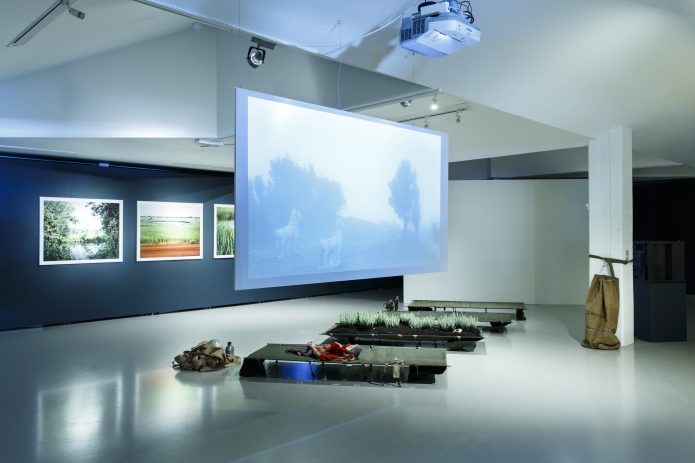
 Installation photo of the exhibition 'UnAuthorised Medium' at Framer Framed. Photo: (c) Eva Broekema / Framer Framed
 Curatorial Statement: Annie Jael Kwan on the exhibition UnAuthorised Medium
Exhibition UnAuthorised Medium brings together artworks by internationally established and emerging artists, who resist prescribing the frame of ‘Southeast Asia’ as homogenous. Annie Jael Kwal, curator of UnAuthorized Medium, reflects on (un)conventional archives as tools for remembrance, and discusses the various means used in this exhibition to (re)construct lost memories.
Text by Annie Jael Kwan
In one of my favourite books, The Year of Magical Thinking, Joan Didion’s personal treatise on mourning, she described how she held onto her husband’s shoes long after he died because she subconsciously believed that he might need them when he returned.
In a box within a box, kept on top of a cupboard, is an old brown shirt my father used to wear. I had ‘borrowed’ this shirt when I was a teenager. As I never returned it, I still have it although my father’s things have long since been discarded or given away after his passing. Re-reading Didion, I wondered why I have kept the shirt – surely, I did not think he would return? I did not. But in my version of magical thinking, if I held onto the shirt, I imagine I might recall every moment and be transported back to a different time.
Boxes within boxes, slips of papers tucked between cards and envelopes, photographs, little objects, bits of string, flecks of glitter…these personal archives exist in cluttered corners, attics, and basements of households across the world, as little totems and triggers for remembrance.
The longing to connect to a previous ‘state of origin’ is also manifested in the public realm of libraries, historical collections, municipal records, and archives, where the ardent desire to collect, collate, name, sort, categorise and index, is invested with the ambition that somehow the whole world and all its history can always be retrieved, grasped and managed. And yet such an endeavour is impossible. The chasm across time is unreachable, and the past can only be re-constructed via the lens of the present.
This sense of active construction is particularly evident in a region where local communities and knowledge have been erased and ruptured, as the result of decades of international and civil conflict, genocides, colonisation, ecological disasters, globalised development and international capitalism. When collective memory has been fractured by decades of ruptures, there are ‘ghosts’ in the archive. Where there are holes in our memories, we search for signs and reconstruct stories.
The featured artists in UnAuthorised Medium evoke the ‘ghosts’ – ‘glitches’ in the archive, interrogating our systems of knowledge by reclaiming the states of absences and slippages within categorical and extractive archival systems. They stir up these vivid apparitions and shadows through a range of artistic approaches. In doing so, they recuperate more nuanced accounts of subjective agency, and make apparent the form and act of construction.
The exhibition appropriates its title from Paul Sorrentino’s research paper, ‘The “Ghost Room”: Space, Death and Ritual in Vietnam,’ where he examines the áp vong, a Vietnamese ritual of invoking the ‘dead’. Visitors improvise a ceremony where the ‘dead’ are called up to resolve questions of inheritance, and to locate lost, loved ones during periods of war. The exhibition references this liminal evoking of those lost, suspended or forgotten. Even as the áp vong ritual does not utilise a professional medium, but having entered the ‘ghost room’, possession is channeled randomly via someone whose desire activates the process. The exhibition borrows this sense of wilful communal transformation. The exhibition space thus becomes a kind of oneiric space where the visitor may linger, dream a little, and allow themselves to become ‘mediums’ too, with the agency of interpretative mobility across spatio-temporal boundaries. They become active seekers in making meaningful connections between socio-cultural histories and artistic practices.
From the gallery window, the visitor may view the video projection of the peeling of skin from a body utilising acid fluid in Sung Tieu’s Memory Dispute (2017), where she reflects on the ambivalent political and personal legacies of colonial violence on land and skin. On entering the exhibition space, the visitor encounters the first horse from Boedi Widjaja’s Drawing on myth (2011) series, alongside a second video work and newspaper print from Sung Tieu, No Gods, No Masters (2017). The former is based on the story of a mythical horse in Bali whose decomposing body became involved in territorial demarcation. Widjaja invokes the imaginary beast through a series of dots and lines. The latter is an experimental project based on the so-called ‘Ghost Tape No. 10’, that was developed by the United States Psychological Operations in 1969 as a psychological weapon to be used on Vietnam. Together these works consider how the acts of making marks and unpeeling may be both destructive and constructive actions, depending on one’s point of view.
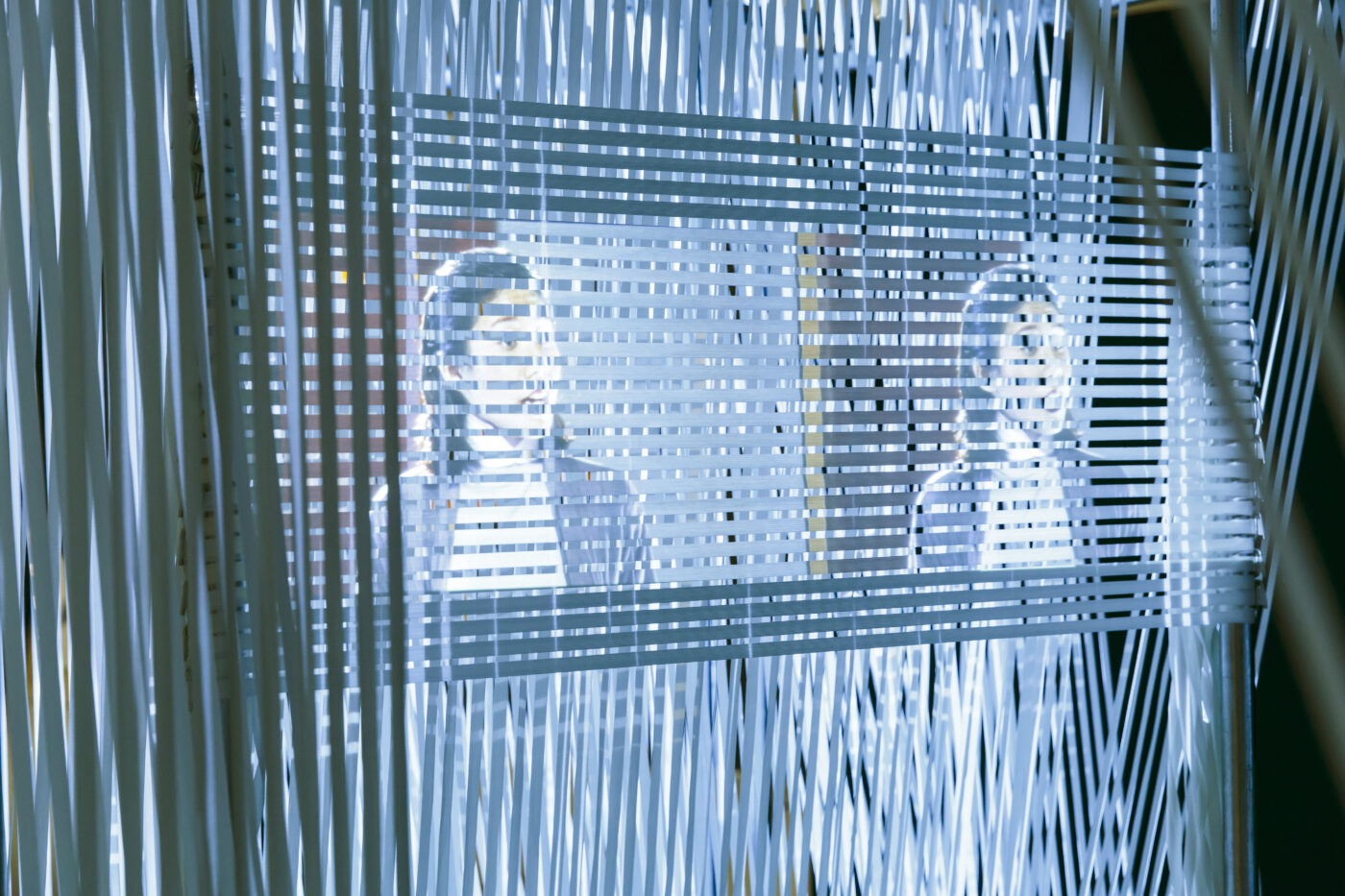
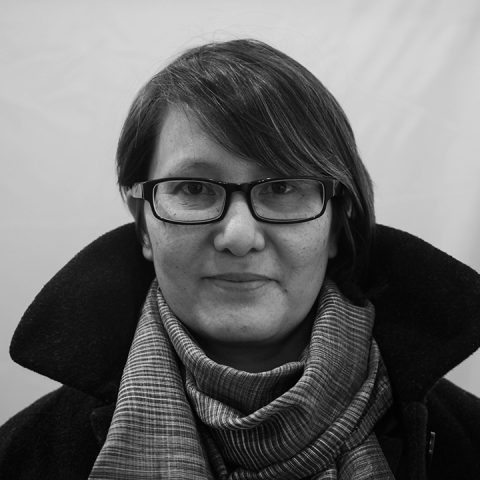
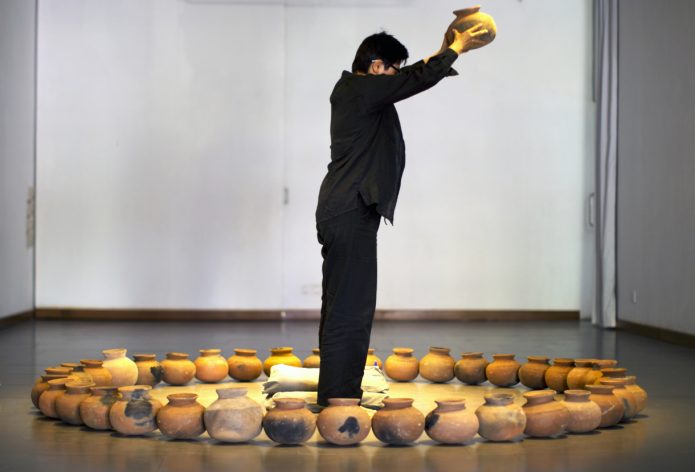
Perception and the act of perceiving are called into question in Amy Lee Sanford’s Scanning (2013), where the beam of the scanner both illuminates and obscures the handwritten letters sent to her mother from her father during the Vietnam War. Similarly, Vong Phaophanit and Claire Oboussier’s All that’s solid melts into air (Karl Marx) (2006)’s experimental film work brings together everyday images of Laotian life that interplay with text fragments that allow for a reframing of how the mundane is viewed. Erika Tan’s installation, The Forgotten Weaver (2017), explores the forgotten historical figure of a Malay weaver who was brought to the UK for the British Empire Exhibition in 1924, underlining the creative endeavour in acts of recollection.
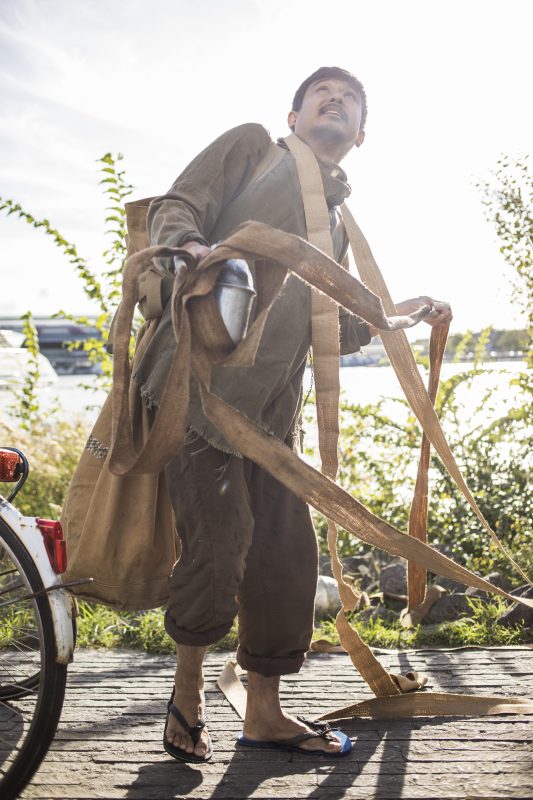
Where narratives are lost or covered over time, the artists seek to pay tribute and highlight these hidden stories. Vandy Rattana’s photographic series, Bomb Ponds (2009), acknowledges the hidden craters caused by the US bombing of Vietnam, leaving scars on the landscape that have since been filled and obscured with water or growth. In his video works, Monologue (2015) and Funeral (2018), Vandy pays tribute to his family, as well as thousands of others lost or forgotten, buried in unmarked graves around Cambodia’s rural areas. Noel Ed De Leon’s ‘Elements’ Series (2011-2018) draws attention to the Filipino tragedies during both World Wars and asks how objects left behind may leave traces that conjure up transitory lives. Sim Chi Yin uncovers the story of her paternal grandfather and the thousands exiled to China by the British, during the Malayan Emergency, and her photographic installation utilising paper printed with fading archival ink explores how documentation and visibility are mutable over time.
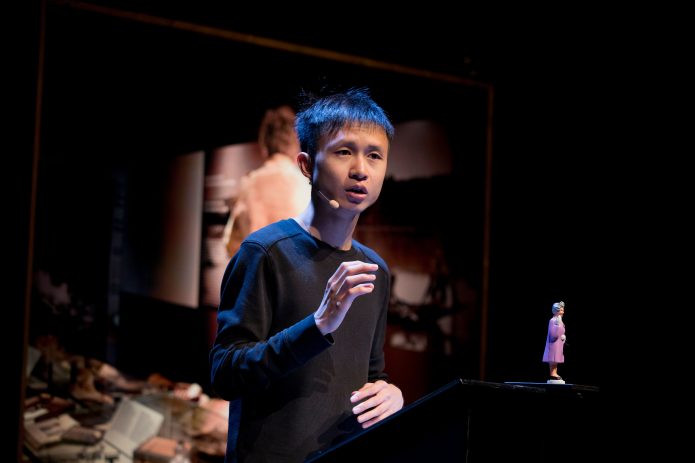
In the last section of the exhibition, the artists explore how stories and images are made, re-made and redistributed in the digital realm. Korakrit Arunanondchai’s Painting with history in a room filled with people with funny names 3 (2015) offers a musical and meditative journey through the personal, popular, fantastical and mythical, while Sau Bin Yap’s Person A / a person (2018) questions the proliferation of images on social media and the internet that collectively construct a portrait. Ho Rui An’s new work Great Fans (Assortment) (2018) playfully re-figures the trope of the ‘fan’ from the iconic 1956 film, The King and I, to underscore the abstraction of circulation in the globalised postcolonial era.
Commemoration should always end with a shared drink. In Tuan Mami’s video and wine-making project, In a Breath – Nothing Stands Still (2018), the visitor is offered a shot of rice liquor, made using local traditional techniques and the bark of indigenous trees that are fast becoming extinct due to mining excavations near his ancestral village. By drinking this homemade aperitif, you partake intimately of this ‘living archive’ of alternative knowledge that now persists in your embodied experience.
In Carolyn Steedman’s publication on the practice and writing of history, she expounds on how the archive is the repository of that which stubbornly remains,
This is what Dust is about; this is what Dust is: what it means and what it is. It is not about rubbish, nor about the discarded; it is not about a surplus, left over from something else: it is not about Waste…It is about circularity, the impossibility of things disappearing, or going away, or being gone. Nothing can be destroyed. The fundamental lessons of physiology, of cell theory, and of neurology were to do with this ceaseless making and making, the movement and transmutation of one thing into another. Nothing goes away…
As an UnAuthorised Medium of the exhibition, the visitor body is also constantly rebuilding and deconstructing its epithelial cells. Approximately 30,000 or so scales of skin is shed every minute. Like atrail of crumbs in the labyrinth of humanity, skin cells and hair fall everywhere and leave a kind of human dust of genetic information.
Even you standing here, you’re adding to this ongoing archive.
Annie Jael Kwan, 2018.
SUPPORTED BY Dutch Ministry of Education, Culture & Science, Amsterdam Fund for the Arts, Tolhuistuin, Prince Claus Fund, National Arts Council Singapore, YAA (Young Art Support Amsterdam), Outset Netherlands, Mercedes Zobel, Nell Sully, Sandra and Marlof Maks
SPECIAL THANKS TO
Andrea Fam, Wang Tingting, Elena Wong
IN MEMORY OF
Khadija Saye, Mary Mendy & David Kwan
Curatorial Text / The living archive / Contested Heritage /
Exhibitions
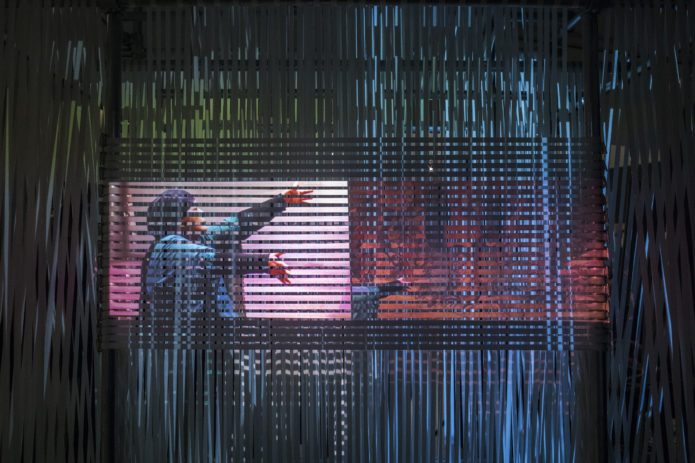
Exhibition: UnAuthorised Medium
A group show curated by Annie Jael Kwan
Agenda
Finissage weekend UnAuthorised Medium: Intense Visitations
Performances and presentations in the closing weekend of exhibition UnAuthorised Medium.
Symposium: UnAuthorised Medium - Return and Repatriation
Symposium as part of the opening weekend for exhibition UnAuthorised Medium.
Opening: exhibition UnAuthorised Medium
With curator Annie Jael Kwan and participating artists Noel Ed De Leon, Sau Bin Yap, Erika Tan, and Sung Tieu.
Network
Vandy Rattana
Artist
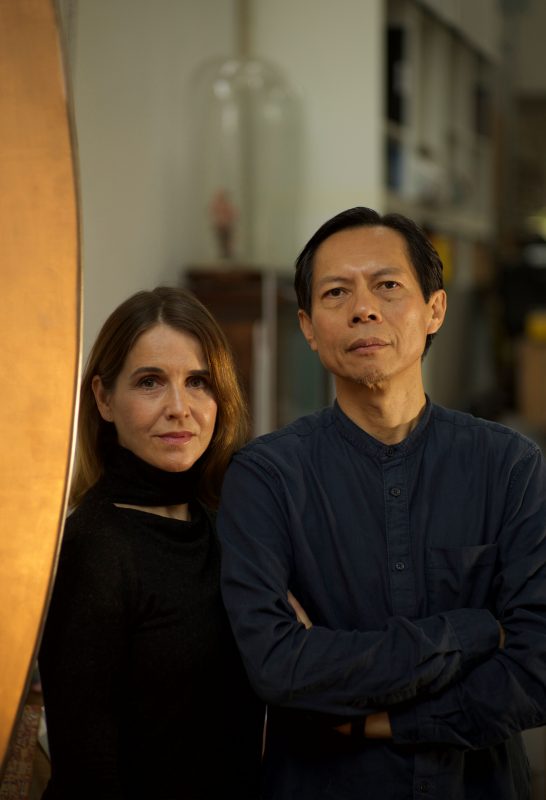
Vong Phaophanit & Claire Oboussier
Artists
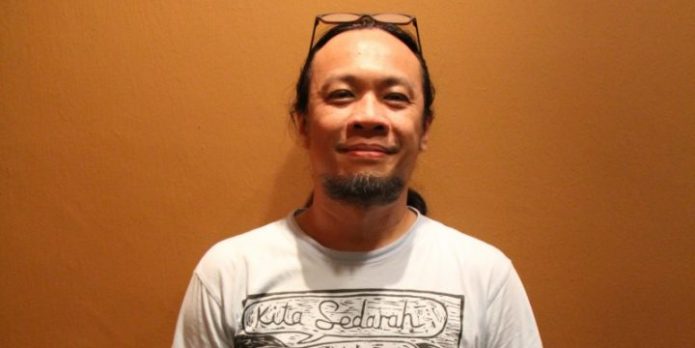
Sau Bin Yap
Artist
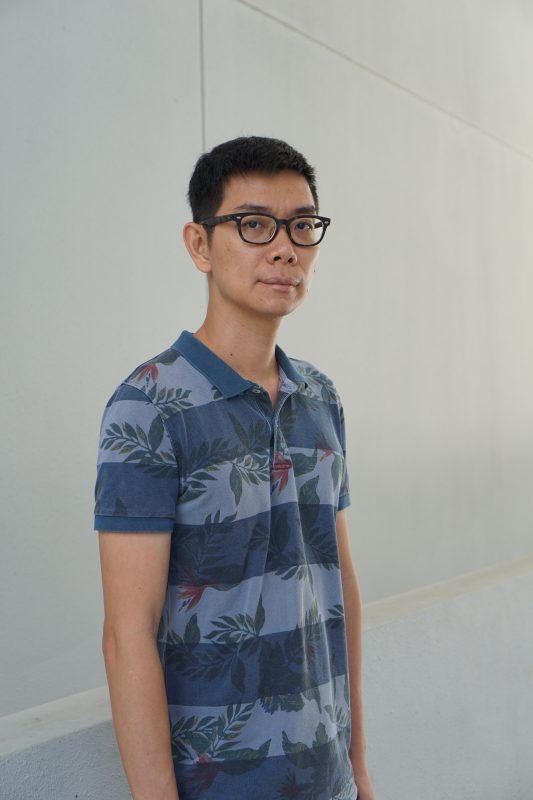
Boedi Widjaja
Artist
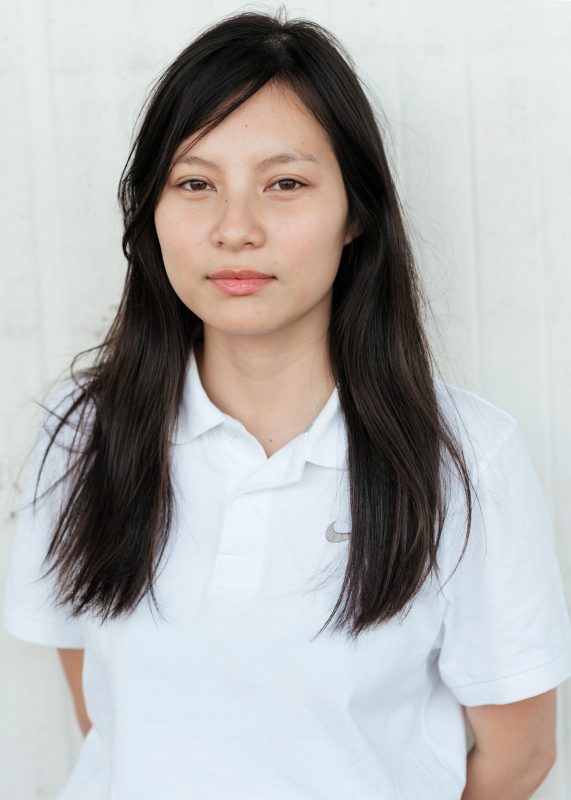
Sung Tieu
Artist
Erika Tan
Artist
Amy Lee Sanford
Artist
Ho Rui An
Artist
Noel Ed De Leon
Artist
Korakrit Arunanondchai
Artist
Annie Jael Kwan
Curator, writer and researcher