

Curatorial Statement: Vincent Van Velsen on the exhibition Ancestral Blues
Exhibition Ancestral Blues brings together works of The State of L3 art collective. Vincent Van Velsen foregrounds identity in the same breath as history, ancestry, cultural exchange, and societal influence. The exhibition’s immersive nature makes visitors active in their speculation, prompting questions about how they think about themselves and others.
Text by Vincent van Velsen
Ancestral Blues. The Return to the State of L3 (2015) is an exhibition of the Amsterdam-based chapter of the art collective The State of L3 that has been developed in collaboration with curator Vincent van Velsen. The exhibition explores the encounters and exchanges between different cultures. All artists in the collective are bound by an interest in the transformative power of the arts through intellectual and artistic cultural exchange and especially in how historical references and connections shape identities. The subject matter in the exhibition revolves around the experiences, senses and narratives gathered from the experiences of Amsterdam, which is where all the artists are based.
Ancestral Blues, the title of the exhibition, is based on the ancestral lines that have brought the different members of the collective to their current location. The concepts of roots and culture are mediated through histories, which are made explicit in many of the presented works. The blues in the title of the exhibition carries many connotations that reflect The State of L3, including the transformations brought about by transatlantic forced and voluntary migration. For example, Blues as a musical genre, is a fusion of traditional African and European folk music that, together with many other influences, allowed groups and individuals moments of freedom and self-expression. The trance-like rhythms of the Blues are defined by a highly melancholic ambiance that often deals with the troubles experienced by the African American people.
Like the Blues, the colour blue has been related to moments of subversion in both mythology and religion. For example, the ‘blue hour’, or twilight zone, is a period of about forty minutes, that occurs twice a day, in which the sun-light is broken up to become a blue haze. These two points in time are moments in which dominant power structures can be challenged and transformed. The State of L3, like the blues, centres on cultural exchange. Both the art collective and the exhibition are concerned with connecting cultures and experiences in an urban environment. These influences now come together in the exhibition space of Framer Framed in Amsterdam.
The idea of so-called ‘para-spaces’, the concept of simultaneous dimensions that are used by afro-futuristic writers, is embodied by the consecutive positioning of the art works: one first arrives at the exhibition by encountering La Puerta – the door – through which one literally enters the exhibition, but also metaphorically the artwork’s conceptual space. Once in, one will experience several close encounters: such as the installations of RaQuel van Haver, Femi Dawkins, Antonio Jose Guzman and Raul Balai.
Abre la puerta! The introductory work to the exhibition, meticulously documents cultural interaction in an urban landscape. In the music video by Femi Dawkins aka Jimmy Rage, the animated figures metaphorically depict different characters that together enter the port towards the inner world of the main protagonist. Interacting cultures are personified in this piece. After their entry, they can be found again in his inner being where they dance together within a cityscape and float around in infinite space, groping the possibility of a Sun Ra reference to an existence in far away eternity.
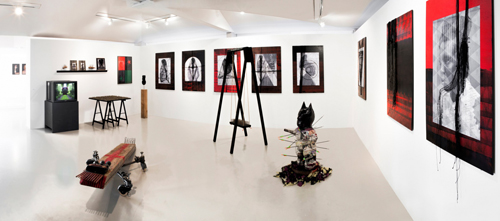
The idea of exchange in the inner city is also a main theme in the practice of RaQuel van Haver. The works, this time, are not shown as autonomous pieces in a white cube space. Instead, Van Haver forces the visitor to directly confront the works from centre stage. The somewhat intimidating grand paintings with images of masked people relate in many ways to the demands of society, which forces one to fit in, often demanding us to wear a ‘social mask’. The chosen masks also relate to the ancestral background of the people concerned. The paintings are all based on people who reside in the South-Eastern parts of Amsterdam. This uncompromising confrontation in Gathering of them MaSsmen is in many ways an overwhelming experience.
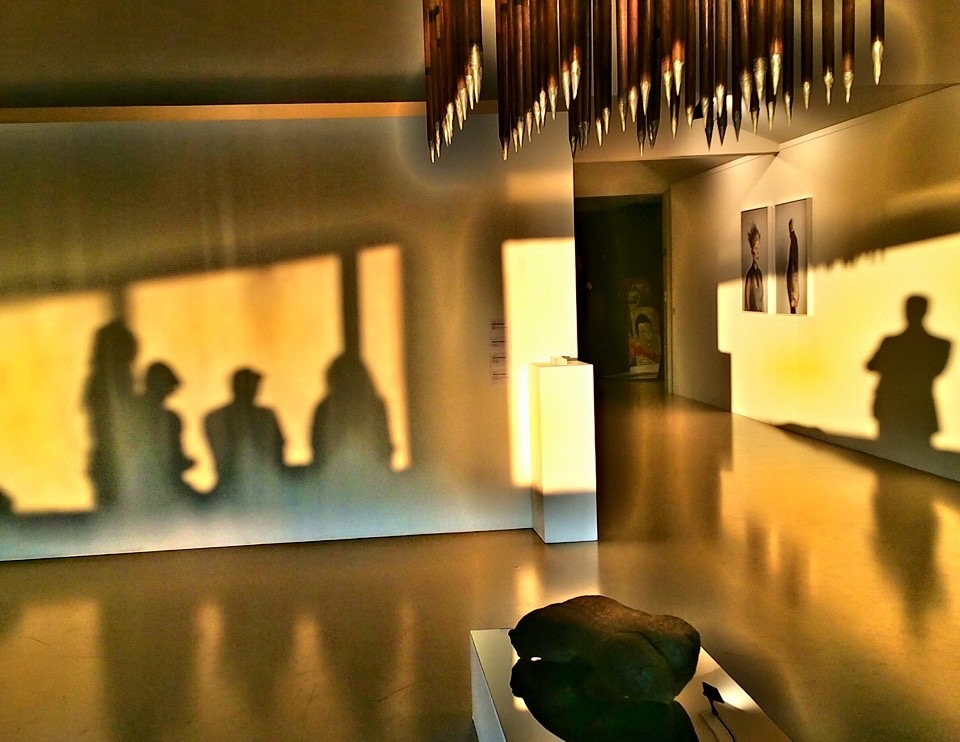
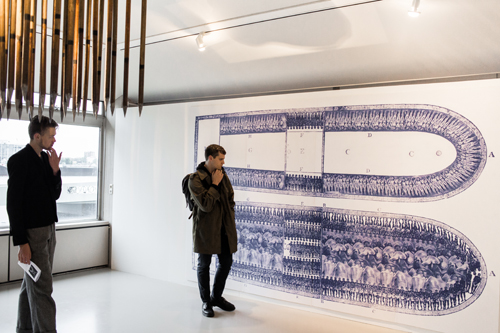
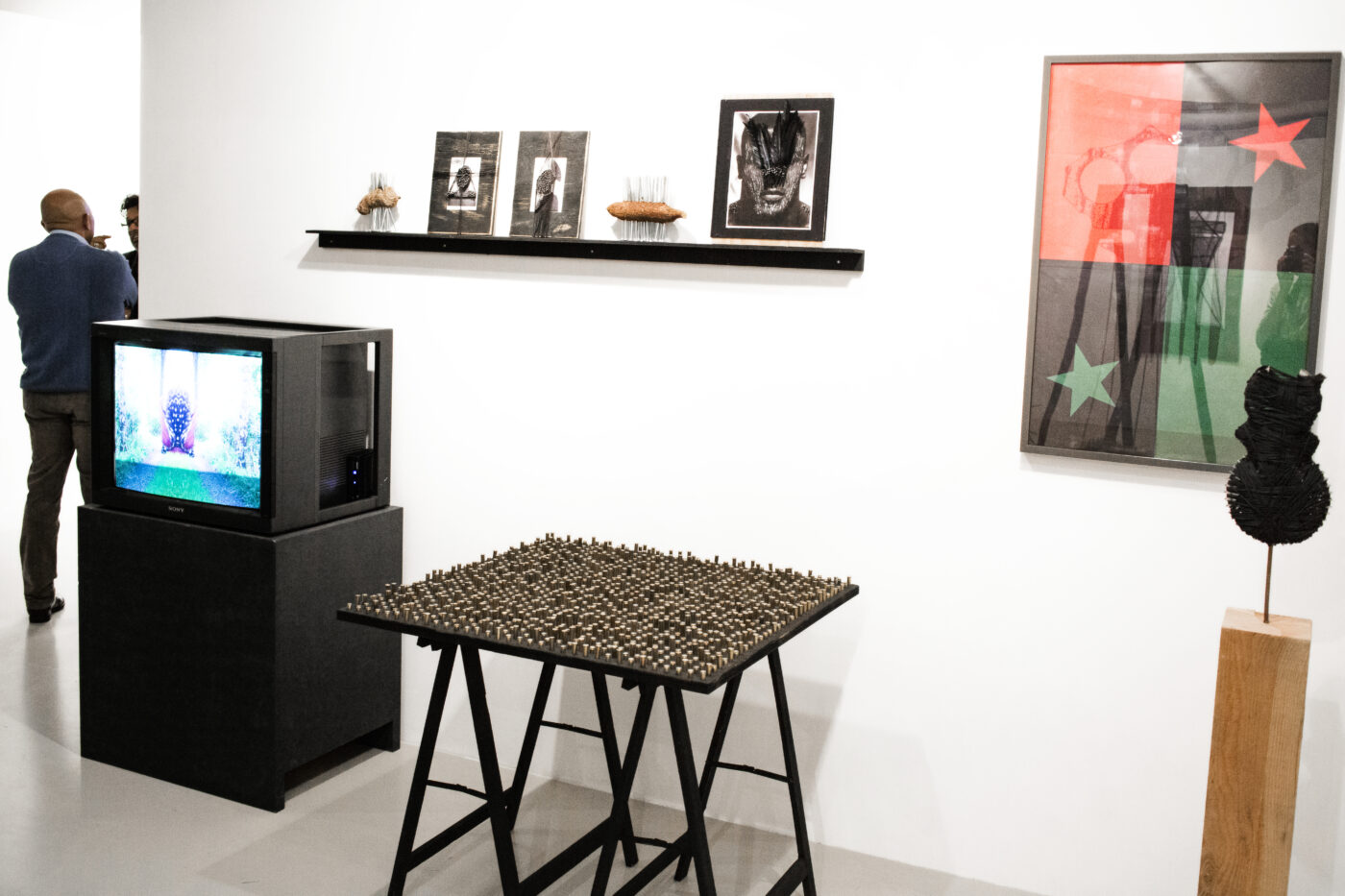
Abstract of the Evidence, by Femi Dawkins, interacts with historical facts. The artwork’s arrangement recalls the Brookes print, a famous 18th-century drawing of a slave ship. Here, Dawkins has replaced the abstract figures present in the Brooke’s version, with actual people and bodies; with faces which symbolizes the fact that slaves also had countenance, characters and souls. In this way, the former abstract notion of these human beings is replaced with actual people. The blueprint directly interacts with the waters outside the exhibition space as these are the very waters from which the VOC and WIC departed for their endeavours around the world. The other part of the work consists of an ‘African’ sculpture, without head or limbs. When one takes a closer look at this sculpture, a mirror provides an encounter with one’s own face. The spears above then come into play, as through the mirror their position is inverted and thereby inserted into one’s front and back. This double speering relates to the concept of double consciousness in which one is constantly apparent of the judgement of others. At the same time, the spears could also be read as pencils, which then become metaphor for the writing that infused history with the marginalisation of certain groups in society. On a daily basis, history haunts them; constantly reminding them of the past, these writings also play a part in their present reality.
Femi Dawkins, Abstract of the Evidence (2015), on show at Framer Framed, Amsterdam. Foto: Marlise Steeman
Sharp objects also return as reflections of identity where tattoos are concerned. Today tattoos have become quite common among the general public, yet tattoos used to mark societal outsiders and outcasts. This manner of scarification also relates to certain customs that are perceived as ‘African’ traditions. Despite all these diverging connotations, tattoos are practiced in many areas around the world and thereby can also be seen as mutual heritage. Fleur Ouwerkerk deals with the subject and the way decorative elements can change perceptions. This means that, in her work, she interacts and plays with the possibility of acquiring new identities by using different forms of dress or decorative objects. These elements are either applied directly on the skin (tattoos), are worn (clothing), or are applied on printed photographs (drawing). The diverging references of these tattoos reflect the layered connotations of surface signifiers that reflect cultural backgrounds. In general, the works show the malleable and transformative possibility of appearance by means of dress and drawing.
Transformation is also a main aspect in the works of Amanda Koelman. Her interest revolves around ways of making sense of the world in addition to spiritual meaning. The presented works bear a range of spiritual elements that are assimilated in a mismatch of visual references. The transition in life and death as well as resurrection is seen in the triptych ANASYRMA on display, which seems to have stepped out of its frame. The chosen medium connotes religious art and at the same time sculptural objects. In the western world today, new age spiritualism forms a way of buying into different spiritual heritages. Koelman’s work could be seen as a critical representation of such practices. However, the artist conveys the matters in an honest and genuine manner; not in order to acquire commodities, or save to her soul, but to evoke spiritual meaning.
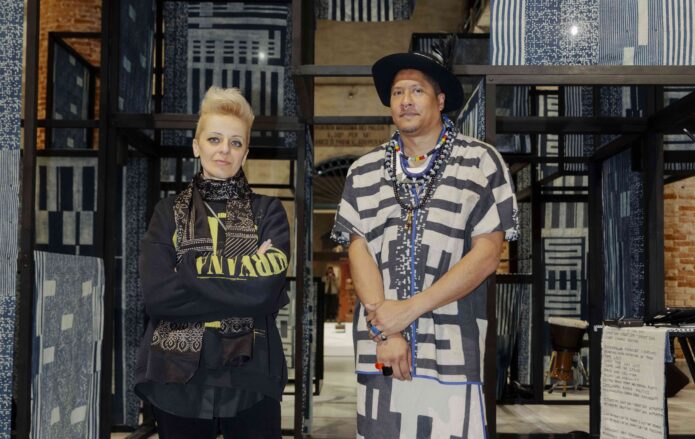
Such commoditised and industrialised practices can also be found back in the work of Antonio Jose Guzman. In his installation Damascus: The End of Fortress Europe he shows buckets that carry visual references to ‘Africa’ but have been designed and manufactured elsewhere. Global marketing mechanisms transform buckets into commodities, used and appropriated as cultural capital. Guzman also traces this idea of distant relatives in the possibility of choosing one’s identity. For example, Guzman deals with the black diaspora, instead of his other, and equally present, personal ancestral lines of the European Jews or Panamanian natives. The still existing presence of Congolese cultural heritage and music in Panama is one of the main starting points for his research – and this presentation. The concept of connections can be literally found back in the threads that are connected with the nails and pictures of scarification (among other subjects). Both these elements are commonly related to the African fetish objects and in their own realm function as protective bodies. Guzman materialises connections through threads and uses religious, heathen and spiritual elements alike.
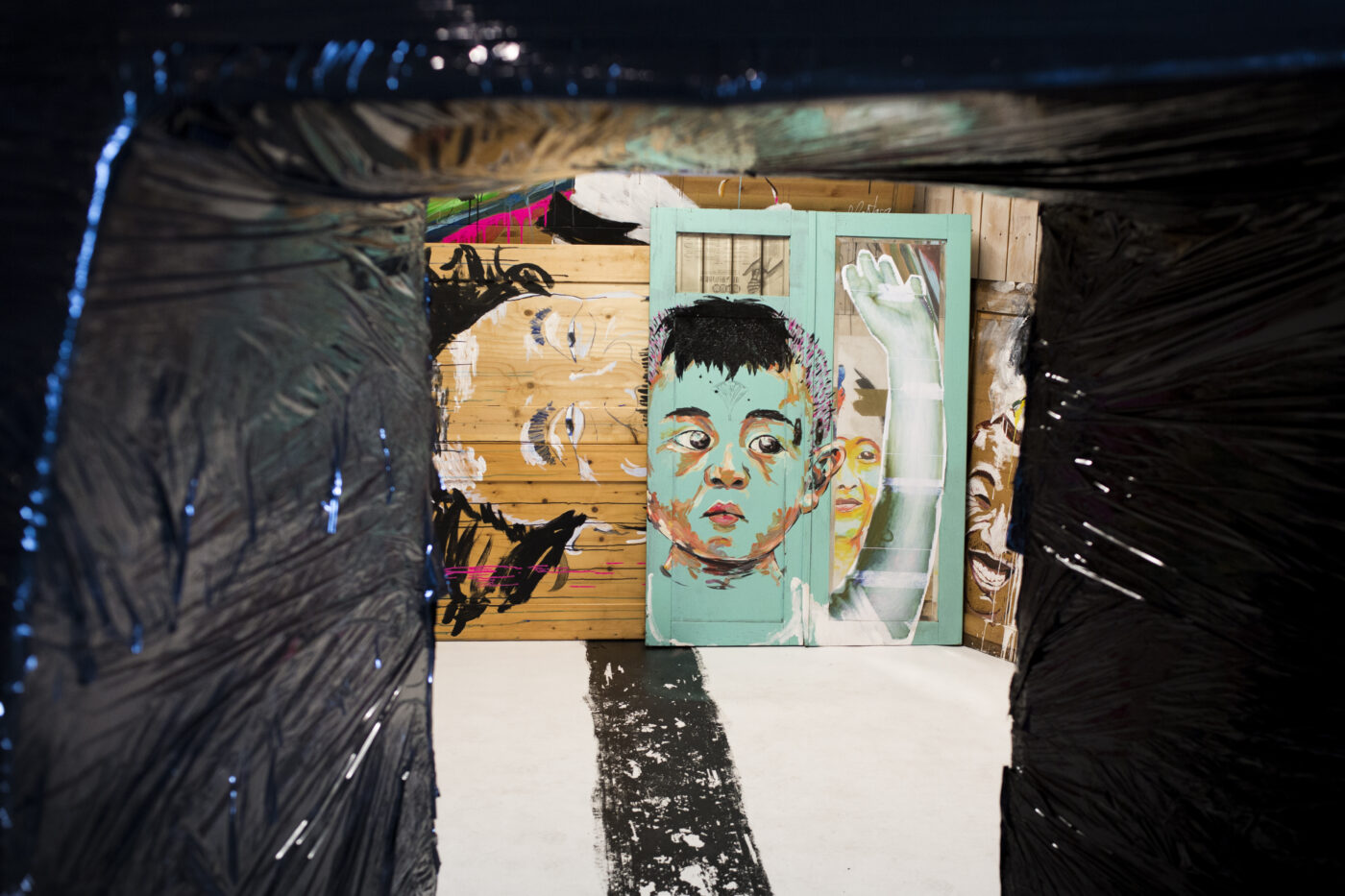
In his installation Five Bats (五福) Raul Balai explores stereotypes concerning Chinese culture. In this culture protection comes from Fu, Lu and Shou. These ‘three stars’ (Sanxing) are the personified ideas of Prosperity, Status and Longevity. Related, the Five Bats themselves – Luck, Longevity, Wealth, Health and Peace, Good Morals and Good Death – form the five pillars of a prosperous life. Following his personal ancestral blood lines, Balai discovered that he was partially of Chinese descent. This fact made him reflect on an external entity that is subject to stereotypes on a more than regular basis. The installation displays the different images that are apparent in the Western concept of China: mathematicians, nerds, milk powder for babies, Ai Wei Wei and alleged consumption of cats. Insiders and outsiders of a culture perceive these images different, which was translated in the significant difference between the inside and outside of the installation. Here, Balai challenges conventional perceptions by visualising them; as he comments on the way this expresses how the inner and outer perception of a culture, country and people diverges.
The seemingly conflicting conceptual frameworks of cultures are important to The State of L3; and art in general. Nonetheless, in this exhibition, various worlds collide and coalesce. By tracing ancestry lines, relating to histories, constituting cultural exchange, addressing transformations, and looking at current realities, the exhibition Ancestral Blues. The Return to the State of L3 aims to pave the way for a shared understanding and a common future.
Vincent van Velsen, 2015.
- Amsterdam FM - Radio interview about Ancestral Blues
- The State of L3 - Contemporary Arts and Film Collective
Links
Curatorial Text / Caribbean / Diaspora / Shared Heritage / Colonial history / Migration /
Exhibitions
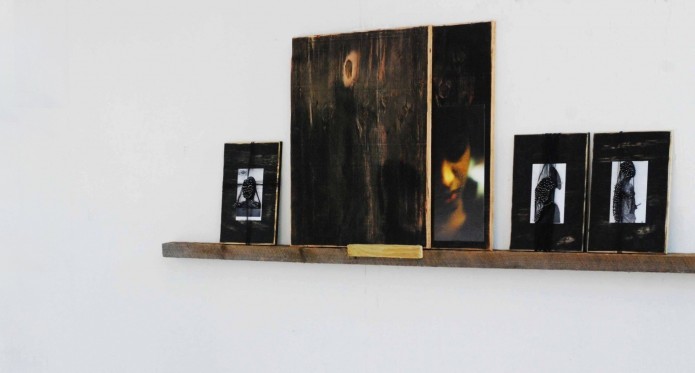
Exhibition: Ancestral Blues - Return to the State of L3
A research on a hybrid Transatlantic culture curated by Vincent van Velsen
Agenda
Diasporic self: sound as lingua franca
The closing event to the exhibition 'Ancestral Blues'.
Network
Vincent van Velsen
Art critic and curator
Antonio Jose Guzman
Artist
Raul Balai
Artist
Amanda Koelman
Artist
Fleur Ouwerkerk
Artist
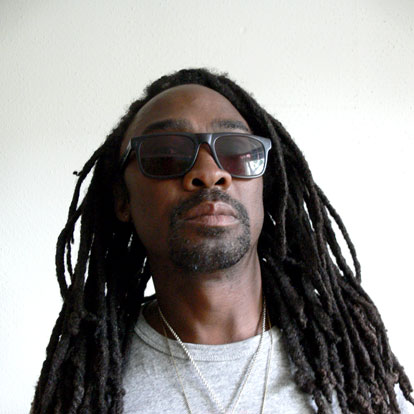
Femi Dawkins
Artist