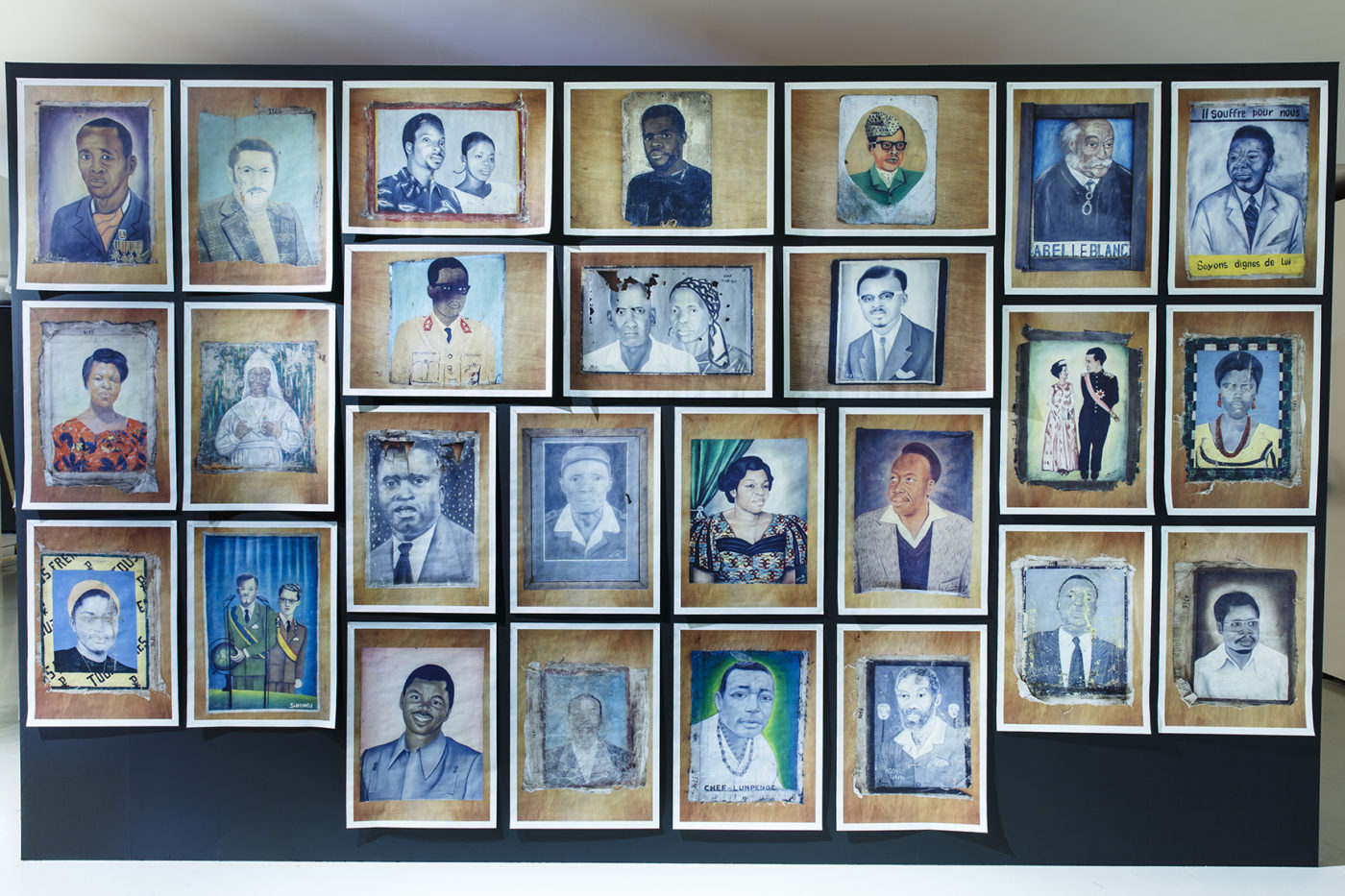
 Installatiefoto 'A Blueprint for Toads and Snakes' (Amsterdam, 2018). Foto: (c) Framer Framed / Eva Broekema
 Curatorial Statement: Vincent van Velsen on the exhibition A Blueprint for Toads and Snakes
Artist Sammy Baloji’s exhibition A Blueprint for Toads and Snakes commemorates the painful history of exploitation and cultural formation in Congo by means of pre-existing and new works. In his curatorial statement, curator Vincent van Velsen foregrounds Baloji’s research-based practice, particularly his use of archival imagery and cultural artefacts to reconstruct and reinterpret fragmented histories.
Text by Vincent van Velsen
The exhibition A Blueprint for Toads and Snakes presents the work of artist Sammy Baloji, whose practice deals with the cultural, social, architectural and industrial heritage of his home country, the Democratic Republic of the Congo (DRC). With a background in photography, Baloji has developed a research-based practice in which archival material and cultural artefacts inform his work. By way of his art, he explores the histories, present-day realities and contradictions inherent to the formation of Congo in general, and its south-eastern province Katanga in particular: the resource rich region which contains staggering amounts of mineral deposits. In some peculiar coincidence, over the past centuries every time an international demand for a specific material occurred, Congo turned out to possess significant amounts of it, whether it be ivory in the Victorian era, rubber when the inflatable tire was invented, copper in industrial times, uranium during the Cold War, alternative power during the oil crisis of the seventies, and coltan in the current days of mobile communication.¹ The colonial project together with the exploitation of these resources has marked the country and its people continuously. The exhibition presents a combination of preexisting and new works, which as a point of reference share the effect of the Belgian colonial project; and the lingering impact of large-scale mineral exploitation on the geography, infrastructure and socio-cultural structures of Congo.
Chura na Nyoka
Central to the exhibition is the theatrical play Chura na Nyoka (The Toad and the Snake). It was commissioned by the Belgian colonial regime and written in 1957 by the Congolese and Katanga native Joseph Kiwele (1912-1961). Kiwele created cultural incentives that supported syncretism and the forced adaptation of cultures. From his biography, soft power and methods of subtle influencing can be inferred. The background of Kiwele and his oeuvre, as well as the socio-historical context and several attributed meanings regarding the content of the play, are described by Maëline Le Lay further on in this publication. Kiwele’s play Chura na Nyoka tells the story of a toad and a snake, who are unable to maintain a friendship due to their inherent biological differences. Sammy Baloji links its metaphorical message of racial segregation to the blueprint and urban planning of the ‘native city’ of the mining capital Lubumbashi. He perceives Chura na Nyoka as an indicative part of a more elaborate Belgian endeavour to gain and maintain its power through a divide and conquer politics, in which educational and cultural formation collided with an imposition of lifestyle through ‘civilising’ and urban planning. As part of these politics, theatrical plays were performed by children: what is learned in the cradle is carried to the tomb. In addition to theatre, there was an array of church-related groups – including the Choir of the Copper Cross Garden which is featured in the film of the same name by Sammy Baloji – to educate and entertain simultaneously. The message that could be derived from both Chura na Nyoka and the urban planning of Kamalondo (Lubumbashi’s indigenous quarter), which also implied several ideas of ethnic segregation, was ‘a social engineering of society via the built environment and cultural imposition’ that explicitly suggested that ‘toads’ and ‘snakes’ do not belong together, while birds of a feather flock together.²
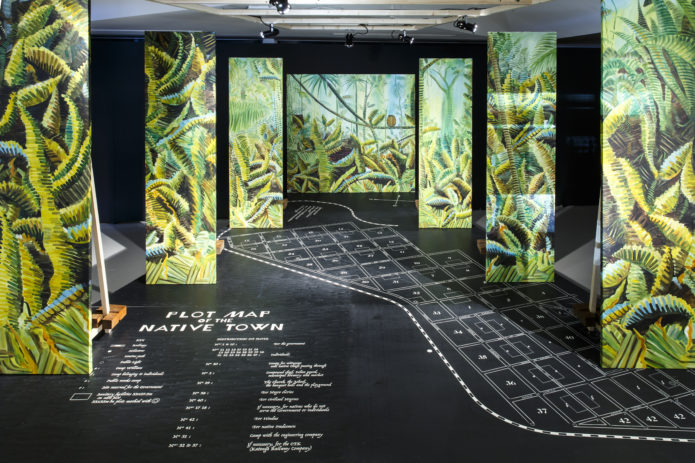
A Blueprint for Toads and Snakes at Framer Framed, installation view. Foto: (c) Eva Broekema / Framer Framed
Kasaïan commemoration
Congo consists of numerous larger and smaller ethnic groups which were set up as one nation by means of the Belgian colonial project.³ When Congolese Independence was achieved relatively suddenly on June 30, 1960, the tension between the different regions and ethnic groups surfaced. Consequently, the province of Katanga proclaimed its own independence on July 11, 1960 with Moise Tshombe as its prime minister. This separation, which is known as the Katanga Secession, was explicitly supported by Belgium in both diplomatic and military ways. The secession was accompanied by inter-ethnic conflicts in which a strong Katangan identity resulted in the expulsion of non-indigenous people – specifically Kasaïans. This same phenomenon occurred during the unstable years (1990-1993) prior to the fall of Mobutu (1996). Many families of Kasaïan origin were pursued, looted and driven out of Katanga. However, these violent expulsions have passed by fairly undocumented.
Sammy Baloji aims to create a commemoration of these events and their complex and grim history, by presenting a selection of historically laden paintings that were left or sold when people had to flee their homes. He personally archived the paintings that are part of a collection brought together by researchers from the University of Lubumbashi and Father Leon Verbeek, under the guidance of Africanist Bogumil Jewsiewicki. The entire collection mainly consists of popular paintings and family portraits, of which Baloji photographed around 200, focusing on the latter.⁴ Preserved under modest conditions, most of them have become close to irrecoverable. By photographing and consecutively displaying reproductions of these paintings, Baloji not only attempts to rescue this archival imagery from disappearing into oblivion without a trace, but more importantly he reinscribes them and thus (re) writes a recent history that went grossly undocumented.
The portraits are placed around the theatre stage for Chura na Nyoka, the main piece in the exhibition, designed by scenographer Jean Christophe Lanquetin. The stage contains a map depicting the urban plan of Kamalondo and its street names that refer to different ethnic groups. The sound which surrounds the physical stage, allows for the text of Chura na Nyoka to be heard in the exhibition space, but also to metaphorically echo through the streets of Lubumbashi. The city-plan is surrounded by a depiction of the forest in the tradition of the Hangar School – specifically referring to the distinct personal technique of Congolese painter Pili-Pili Mulongoy.⁵ This mixture of different elements with references to art, history and archival material is illustrative to Sammy Baloji’s working method. The installation brings together elements of the colonial project leading up to the later ethnic conflicts – specifically cultural formation and urban planning – and its victims, the Kasaïan people. Combined, they make the theatre a somewhat bitter representation and commemoration of Lubumbashi’s recent history. Baloji renders visible both the physical and intangible traces of the Belgian colonial endeavour, which centred on prestige, control and wealth at the cost of the Congolese population. He shows how it was followed by a post-colonial period in which the Belgian influence was still explicitly present and the Congolese had to deal with its heritage and aftermath: an unstable basis for a society – and one with lethal consequences.
The blueprint
In the second part of the exhibition, Baloji shows a blueprint of the ‘native city’ of Lubumbashi. This work is based on the original document, which shows how the residents had to make way for the creation of a new urban structure, hence, the land was expropriated. Goal of this new plan was the so-called cordon sanitaire – a neutral buffer zone inscribed in the landscape, in order to effectively separate the European and Congolese population.⁶ Related, migration flows started due to the demand for labour in Katanga and the constant reclassification of the Congolese territory by the Belgian regime. Groups that had traditionally lived in certain regions were either driven out, or confronted with new residents. This resulted in ethnic tensions. However, this largely remained subcutaneous in the colonial era, only surfacing during periods of changes in power structures. Baloji has tackled this process of expropriation, along with the deprivation of control over the environment by the original residents, in his earlier film Pungulume (2016).⁷
This time Baloji zooms in on how such expropriation of land was designed, by means of an original blueprint for the process; which he combines with the abstract image of a mineral. He connects this to how the disappearance of a character from a theatre stage is depicted within the theoretical treatment of scenography. Here, the artist implies a disappearing act in abstraction: as one is withdrawn from sight, the other emerges out of the symbolic blue. It is as much an interchange as an exchange: the body is swapped for the raw material. Through all this, the city that was built – in large part to accommodate the Congolese mining employees – metaphorically functions as a theatre stage: it is merely a backdrop to economic processes. The ways in which the exploitation of people and soil plays a role in daily life is also presented in Sammy Baloji’s documenta 14 film, Tales of the Copper Cross Garden. Episode 1 (2017) in which the processing of copper is visualised as a choreography of black workers’ bodies, as they transform raw material into a product for the global market. This process serves as a metaphor for the colonial endeavour in which church, state and corporations joined forces to mould the Congolese population into a docile workforce. The pivotal role of the Church in reshaping Congolese society is also reflected in the film’s soundtrack, which consists of syncretic ecclesiastical music composed by the above mentioned Joseph Kiwele.⁸ He was again acting on instructions by the Belgian colonial administration, who ordered a musical piece that would fit both the codes of the Catholic ecclesiastical masses and the Congolese musical tastes and traditions.
Church education
In the reshaping of Congolese society through the Church, the aspect of education cannot be left unaddressed. Schools were part of the first mission posts, and thus inherently entangled with the Church. The education material in these schools was, evidently, created by the Belgian settlers. This meant that the knowledge passed on to children in regard to their own country and population was for a large part based on ethnographic research by Europeans, in which the various inhabitants of Congo were described within a framework of separation and division. Moreover, the population and the people’s identities were much more fluid and diversely structured than was comprehensible from a Western perspective. There were inherent prejudices in the descriptions, as well as misunderstandings and faulty perceptions. This created stereotypes and implied hierarchies that were described and disseminated through textbooks for the educational system, and thus passed on to the Congolese schoolchildren. The education contributed to the fashioning of identities and daily interactions and supported the segregational impositions.
In summary, education, cultural formation and urban planning made way for the ubiquitous project of shaping Congolese society according to Belgian preferences, then resulting in post-colonial conflicts. It is one thing to make a blueprint and plan a colonial city, yet, as Lagae and Boonen mention in their essay on the urban planning of Lubumbashi, it is quite another to govern one. In the same vein, the blueprint for toads and snakes might have been drawn and imposed, yet its outcomes surpassed anything colonial imagination could have foreseen. The snake’s venom still seems to be running through the Congolese society.
A Blueprint for Toads and Snakes emphasises the ways in which cultural foundations were constructed, and their continuing influence on ethnic tensions, urban segregations and mineral extraction. As pointed out above, over time the Belgian colonial government implemented different effective strategic cultural and spatial ethnic segregation methods combined with meticulously planned divide and conquer politics. Consequently, the Katanga region has suffered from several ethnic conflicts, serving both national and international forces. Sammy Baloji critically reflects on the different chapters of this history, which from the initial blueprint all the way through the metaphorical creation of Toads and Snakes, have given form to history; still haunt the present, and have laid the foundations for the allegorical stage on which the future is taking shape.
Footnotes
1. David van Reybrouck, Congo: The Epic History of a People, 2010
2. To elaborate on social structures: The church introduced the nuclear family. As a result, more extensive and traditional family relationships and lifestyles dissipated. Through the introduction of money and fixed employment, tribal structures and structures of solidarity eroded slowly but surely. Congolese civilians no longer depended on the soft structures, but on their employer and by consequence on the colonial administration. They no longer lived in villages with their peers, but in the planned city, either alone (bachelor workers: ‘célibataires’) or with one woman and their children (small workers’ families). This influenced the basic relationships that had traditionally shaped identity and structured daily life. Similarly, when voting was introduced the young people obtained equal rights and say, while previously the power of judgement and knowledge was based on age and ancestry. These broad array of measures, impositions and influences caused radical and, above all, lasting changes in societal structures. Also, the positive valorisation of the former societal and cultural values was effectively destroyed. This included ways of living, language, dress, and technical knowledge that were devalorised while simultaneously introducing new ways of appreciation via Church-provided education.
3. The borders had come about through the bluff poker of Leopold II during the Berlin Conference (1884-1885). He ingeniously used the colonial quest and contest of the larger European powers for his personal gains. Portugal, France and Germany perceived Leopold in an opportunistic and sceptical fashion and for strategic reasons, they more a less ‘gave’ Congo to a monarch of whom they had little to fear, as this (largely unknown) part of Africa that became Congo, lay strategically between their own spheres of influence. It became a free state for trade, hunting and shameless self-enrichment – a situation Baloji previously addressed in Hunting & Collecting (2016). Only after severe international pressure – including King Leopold’s Soliloquy (1905) by Mark Twain, a widely distributed pamphlet against the brutal regime in the private colony – did Leopold II give in and transfer the ownership of his Congo Free State to the Belgian State.
4. The pictures on display in the exhibition should not be considered a collection. Most of the works are not even paintings in the Western sense of the term. These portraits all were (re)made from photographs. Congolese languages refer to it as an ‘image’. In the Swahili spoken in Lubumbashi the word ‘picha’ (from the English ‘picture’) is used. A photograph is also called picha. The painting’s presence may, as is often the case, indicate belonging to an ethnic group. For example, the depiction of a presentation celebration for twins (‘mwa mbui’) is specific to Kasaïans from Katanga. And more generally speaking, being from a Congolese village would likely be emphasised through a painting of a village scene. A painting has no value as an art object, but carries a high personal value. What people are looking for is what the painting represents, the image. In stable times such paintings are merely acquired through a commissioning process, which indicates there is no real art market, as paintings are not resold: thus scarcity or authenticity are not considered a premium. However, a market did occur when the Kasaïans were expelled: they were selling their entire household, including paintings, as they could not take these objects with them. In his selection from The Verbeek collection, Baloji has focused on portraits only because there is a relation between photographs and paintings in the process of self-representation as human being and owner. By making a commission of a self-portrait to hang in his/her house, there is a sense of marking a presence of ownership in ones interior. In the Katangese post-colonial context, painters had assisted citizens to fulfil citizens’ wishes for self-representation, that carried similarities to the way white colonial houses contained paintings and photographs of kings, queens, important and famous people, or family members.
5. In Lubumbashi (then still Elisabethville), the French naval officer and amateur painter Pierre-Romain Desfossés set up the Academy for Indigenous Art, also known as Atelier du Hangar in 1946. Instead of asking Congolese artists to imitate European styles of painting, Romain-Desfossés encouraged the painters to freely use their imagination and draw inspiration from their own traditions and the world around them. He brought together people who before had been involved in murals, encouraging them to transpose their wall-drawing activity to the canvas. The Frenchman was interested in the procedures and motifs that the Lubumbashi painters introduced and wanted to overcome the perception and conception of culture that only respects Western paradigms. Here, Bela, Pili-Pili Mulongoy and Mwense Kibwanga individually developed a distinct personal technique and signature mode of working. Some of the hunting scenes painted by these artists are only available nowadays through photographic archival footage. Later, the term popular painting came about. It concerns works by a group of young artists who emerged in late 1970s Kinshasa and defined themselves as ‘popular painters’. Most of them had worked as sign painters, and had made comics before – alike Baloji. Instead of imitating the European painting rules and being limited to the topics that were deemed proper for colonial subjects (nature, animal life, and religion) the popular painters drew their inspiration from daily life in Kinshasa and explored politics, society and worldly events. Their brightly coloured, candid paintings often incorporate humorous or satirical texts reinforcing their critical message. The value of popular paintings is defined by their visual power and its ability to initiate the performative part i.e. the extent to which they perform their intended function: to prompt reflection, debate, and discussion. They critically comment on historical and contemporary culture, economic, political and social developments; the messages they convey are instructive, pedagogic and sometimes moralising. (Bambi Ceuppens, Sammy Baloji, Bogumil Jewsiewicki, and Dirk Huylenbroek, Congo Art Works: Popular Painting, 2016)
6. The created cordon sanitaire was previously the subject of Sammy Baloji’s work Essay for Urban Planning (2015). This piece includes aerial photographs of the current situation in Lubumbashi and shows that even today the piece of land concerned is still largely free of buildings. It alludes to the effective colonial segregation policy that still is actively present in culture (Chura na Nyoka, Christianity), urban planning (Lubumbashi’s Kamalondo quartier) and daily movement.
7. In Pungulume we see a chief enumerate his ancestors from whom he derives his heritage, lineage and thereby traditional control over the territory. However, in practice he lacks this control, as the land is in private foreign hands. The international companies are allowed to sell the land and its resources without any (possible) intervention by any Congolese citizen, let alone that any benefits would be gained by Congolese civilians from such transactions.
8. As an évolué, Joseph Kiwele had an elevated position in which he served as an intermediary between the government and the native people. He also was Minister of Public Instructions for the Katanga Region during the Secession.
SPECIAL THANKS TO
Sammy Baloji, Jean Christophe Lanquetin, Estelle Lecaille, Alix de Massiac, Nicole Schweizer
SUPPORTED BY
Galerie Imane Farès, Ministry of Education, Culture and Science, Amsterdam Fund for the Arts, Tolhuistuin.
Colonial history / Ecology / Extractivism / The living archive /
Exhibitions
Exhibition: A Blueprint for Toads and Snakes
A solo exhibition by Sammy Baloji
Agenda
Finissage: A Blueprint for Toads and Snakes
With Sammy Baloji, Georges Senga Assani and Heleen Debeuckelaere.
Curator tour: A Blueprint for Toads and Snakes
A tour by Vincent van Velsen.
Network
Maëline Le Lay
Researcher
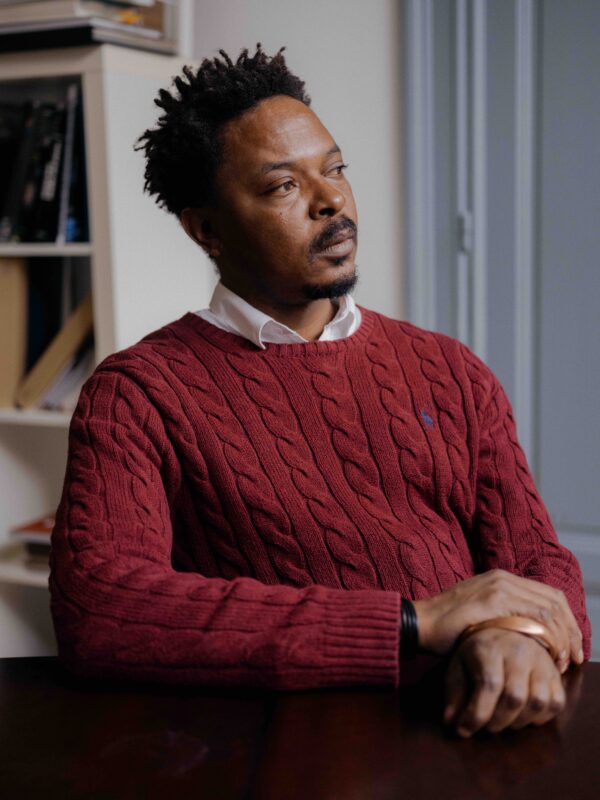
Sammy Baloji
Artist
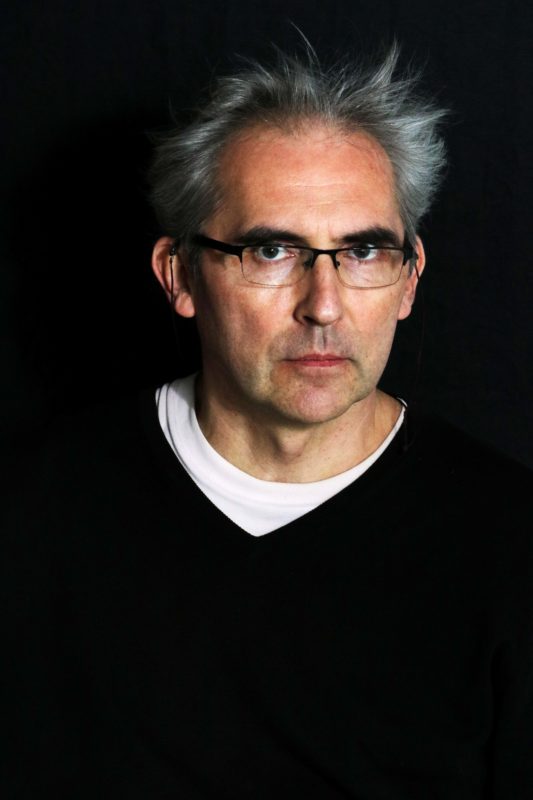
Jean Christophe Lanquetin
Artist and scenographer