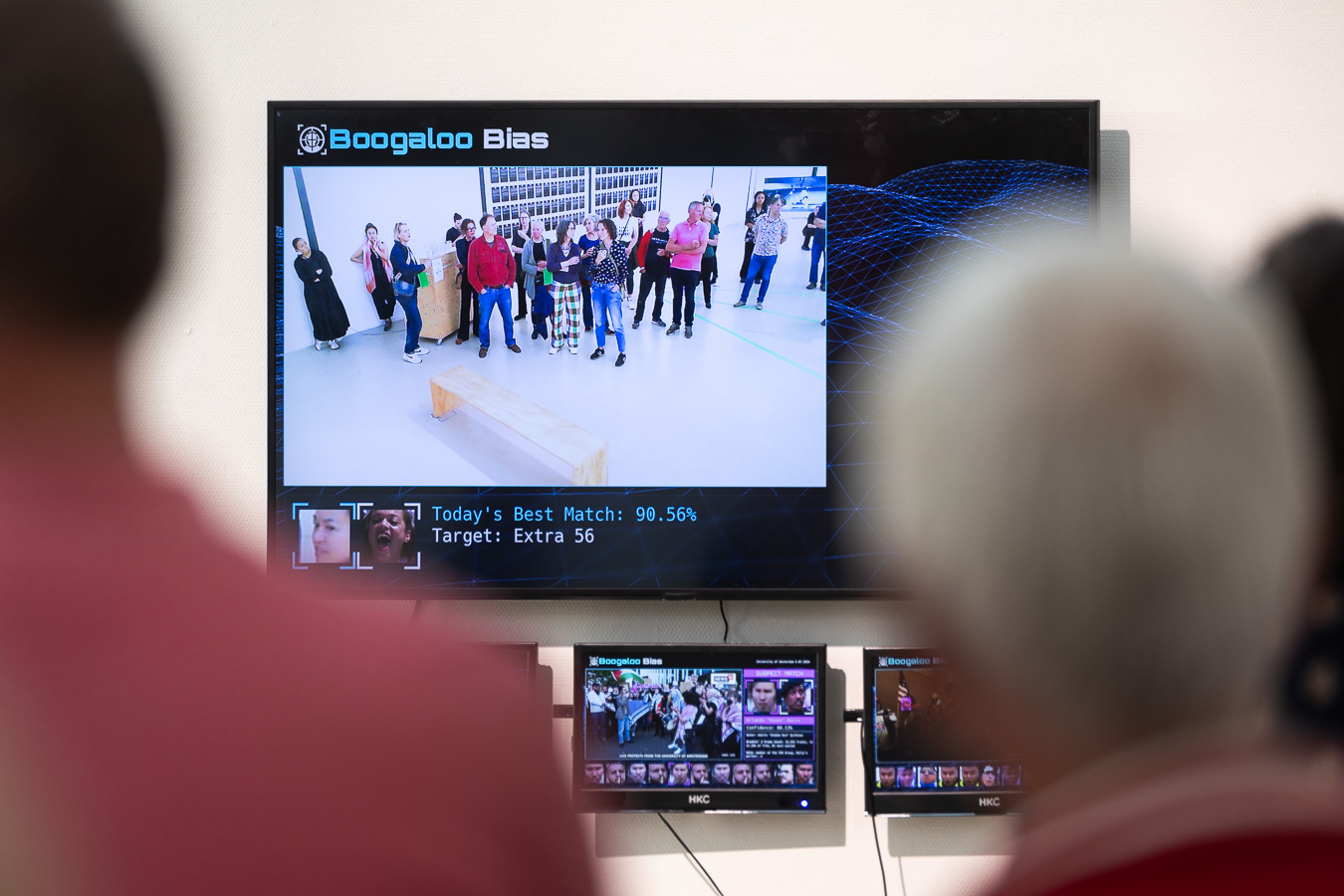
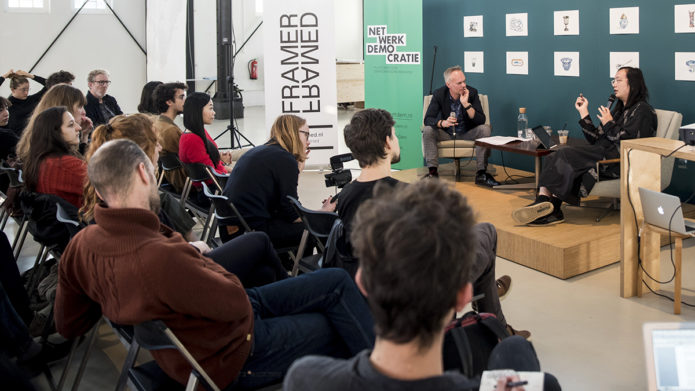
 Boogaloo Bias by Jennifer Gradecki & Derek Curry in the exhibition, Really? Art and Knowledge in Time of Crisis (2024) at Framer Framed, Amsterdam. Foto: © Maarten Nauw / Framer Framed.
 Towards Digital Independence
Our daily digital lives rely heavily on a small group of ‘Big Tech’ companies. In the Netherlands, Microsoft, Amazon, and Google are estimated to manage around three-quarters of all stored data. Their influence extends far beyond data storage. Big Tech often shapes how we participate in society through the communication and productivity tools that many depend on. The cultural sector can lead the way in finding solutions by exploring and developing new technologies in-house – tools designed around self-management and privacy, where data remains under our own control.
In the coming period, Framer Framed will focus on developing open data platforms for (cultural) organisations, enabling them to share their activities with the public without relying on commercial platforms. Increasingly, platforms are adopting a new organisational principle, often referred to as federalism, in which data is stored and shared under their own management, on their own servers and according to their own terms – allowing users to regain control over their data. Bits of Freedom has also published a step-by-step guide to support this transition
At Framer Framed, inclusivity, justice, autonomy and transparency are core values, both online and offline. We aim to create ‘in-between spaces’ where people feel safe to meet, share and reflect – places that build bridges between different worlds and identities. Digital autonomy is central to this mission. Public organisations must have control over their own technology, infrastructure and data. Since 2014, Framer Framed has been putting these principles into practice: we manage our own server, use open-source software such as Nextcloud for documents, calendars and messaging, and have recently implemented a self-hosted email and video conferencing system. Within the organisation, we encourage the use of alternative search engines and have been using Matomo as an open-source analytics solution since 2025.
To further strengthen these values, Framer Framed has appointed a Digital Autonomy Coordinator starting 1 February 2026. Paul Jongsma, one of the founders of XS4ALL and a longtime independent practitioner through Webtic, has long championed open-source principles. He will now bring his expertise to Framer Framed.
Not all of our objectives are immediately achievable or feasible. While we have already taken significant steps toward developing an independent digital back-office and ICT infrastructure, our public engagement still depends heavily on commercial platforms like Instagram. To address this, we are implementing a phased approach to familiarise ourselves with the Fediverse. Simultaneously, we are promoting knowledge exchange within the sector and with the public, helping everyone gradually become comfortable with decentralised, privacy-conscious networks. In addition, we maintain an annual plan for Privacy, Shareability, Autonomy, and Transparency (PDAT), which establishes specific objectives for each policy period.
Paul Jongsma, an internet pioneer from the very beginning
Paul Jongsma has been programming since his secondary school days, growing up alongside the evolution of computers and, later, the internet. In 1992, he co-founded XS4ALL, and in 1995 he launched Webtic, a two-person internet consultancy. Since then, he has championed open-source solutions to make information widely accessible for diverse clients. Paul was part of the early promise and optimism of the internet, yet he has always recognised the importance of protecting privacy and ensuring accessibility. If you’d like to find out more about Paul, read ‘De hackers die Nederland veranderden’ (The hackers who changed the Netherlands) by Maarten Reijnders, about the history of XS4ALL, or watch Andere Tijden, ‘De oorsprong van internet’ (The origins of the internet).
PublicSpaces and Framer Framed
In 2025, Framer Framed joined PublicSpaces. The guiding principle is ‘working together for a digital public space’. Stefan Wharton, Head of Communications & PR: “Our affiliation with PublicSpaces comes from a shared belief that digital spaces, just like physical public space, must be strengthened by public values. We see how the internet is becoming increasingly dominated by a small number of Big Tech companies. These parties have unprecedented economic and infrastructural power, making public organisations and citizens increasingly dependent on their services and conditions. Their revenue models are often based on the collection of personal data, which leads to a shift in control from the user to the provider. Framer Framed would rather build a digital infrastructure that protects our audience and our partners and offers space for autonomy and collective ownership. PublicSpaces offers us a network of like-minded institutions that are developing and promoting alternatives together, so that we as a cultural sector can become less dependent on commercial tech giants and retain more control over our own digital spaces.”
Framer Framed and Netwerk Democratie
Framer Framed’s commitment to digital democracy and open source did not come out of the blue. These principles stem from years of involvement in the open source movement by Cas Bool and Josien Pieterse – the founders of Framer Framed. Since 2011, these ideas took shape within the organisation Netwerk Democratie, of which Josien Pieterse was co-founder and co-director alongside Mieke van Heesewijk.
Netwerk Democratie and Framer Framed had already found common ground through joint programmes such as Up/Root Democracy, which explored methods of (digital) extractivism that undermine the rights of people and other entities, and a programme centred on the open-source democracy pioneer and Taiwanese Minister of Digital Affairs, Audrey Tang. In 2023, Netwerk Democratie was dissolved by its then-director Tessel Renzenbrink and part of its legacy was transferred to Framer Framed.
Since then, Framer Framed has organised a fellowship with the Department of Political Science (Challenges to Democratic Representation programme) at the University of Amsterdam (UvA), which is funded from a budget provided by Netwerk Democratie. Following the fellowship of Winnie Herbstein and René Boer in 2025, Radna Rumping and Pennie Key will be artistic research fellows in 2026. The remaining budget managed by Framer Framed will be allocated to developing tools for digital autonomy, and where possible the outcomes will be shared with the sector.
Citizenship / Democracy, Digital Commons & Digital Autonomy / Politics and technology / Political Climate /
Agenda
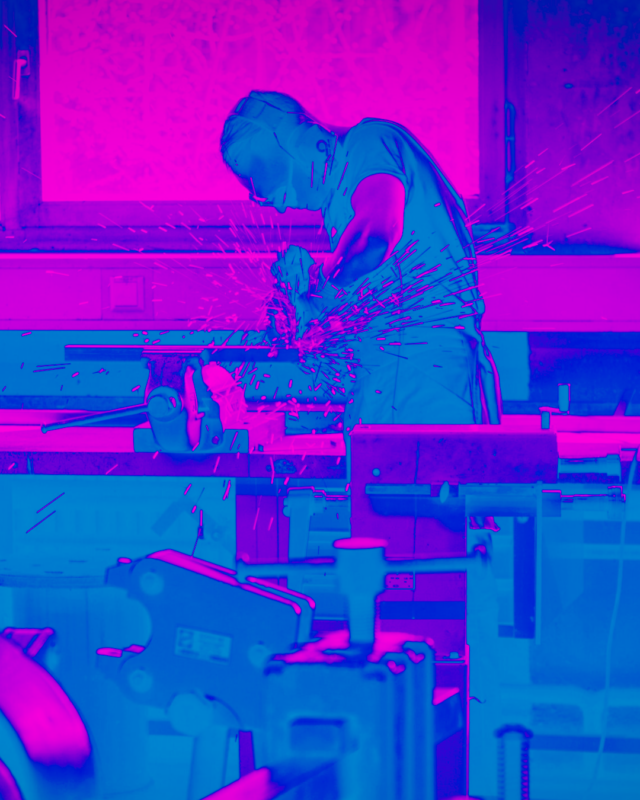
Workshop Post-Tyranny Tech & Digital Independence
Workshop session by Post-X Society focussed on digital autonomy in the workplace
Magazine
Politics and technology / Art economy /
Democracy, Digital Commons & Digital Autonomy / Citizenship / The living archive / Politics and technology / Social Practice /
Digital Afterlives: the legacy of Network Democracy at Framer Framed
Politics and technology / Democracy, Digital Commons & Digital Autonomy / Art and Activism /