 LIMBO exhibition and workshop space. Photo: Maarten Nauw / Framer Framed
 Errant Journal: Enabling and Obstructing Flow through Creative Co-creation by Fabian Holle
A Personal Journey of Transformation
The moment that most significantly triggered my journey of critical self-reflection was when I started to do drag and engage with the (activist) queer community. Before this, I always felt a bit out of place while I was trying to fit in as much as I could. I was a soft-spoken, nerdy child and secretly wanted to do ballet like my sister. I never told my parents, because my father wanted to make me into a ‘real man’ by sending me to judo classes. He was born in Indonesia during the War of Independence in 1946. In 1962, he came to the Netherlands to seek refuge from the violence of that time, which has been described as ‘having genocidal overtones’. ¹ Indo-Dutch people are known for their assimilation into mainstream Dutch society, which feels like something I inherited generationally. Assimilation implies that ‘newcomers are seen and see themselves first and foremost as members of the indigenous society.’² My Indonesian heritage was never really talked about. I always considered myself to be Dutch, even though it was quite normal to be called ‘pinda’; a racist slur that translates to peanut, which everyone, including myself, simply accepted.3 When I was nine years old, I started doing theater instead of ballet because I was scared that my father, as well as the rest of the world, would think of me as girlish. I thus conformed to more societally accepted gender norms. A year later, my mother passed away; my father was out of the picture, so I grew up in several foster families separated from my sisters. As a foster child, I then tried to adapt to the norms and values of each new family. This was evident in simple things: having to adapt my sense of (being on) time, because for some families being two minutes late was a problem while for others it was not; having to change showering habits; adapting to different types of humor; different habits of watching TV, having dinner, types of food, and so on. Reflecting on it now, I realize how different contexts hold a lot of power and influence over the way one engages with the world. As a teenager, I was not aware of this impact, I just felt very different and simply tried to fit in. When I was seventeen, I went to theater school hoping to find similarly spirited people. After graduating, I made a living as an actor, but still felt out of place. I then felt more comfortable working with choreographers, a bit closer to my childhood wish of doing ballet. Eventually, I felt the most sense of belonging with people who also somehow struggled to fit into mainstream society when I started engaging with the Rotterdam queer community. My process of rethinking and relearning was fully activated when I met and learned from queer activists, thinkers and community organizers. I became more aware of, and started to critically question, some of my taken for granted assumptions. I learned more about (gender) nonconformity, accepted my own gender fluidity, and learned about the importance of safer spaces. I wanted to contribute in a way that suited me and decided to study sociology. Eventually my journey led me to being part of a research project on engaged scholarship and refugee inclusion as a PhD candidate.Currently, within this research on co-creation through art practices, my life has been transformed through learning together with queer, trans, lesbian, gay and gender nonconforming people with refugee experiences.
Engaged Scholarship
Oftentimes, social science is purposefully distant from the communities they research. This is due to dominant norms in academia of objectivity and neutrality. In such research, participants are not considered as partners or friends. Some forms of such conventional research could be experienced by research participants as exploitative or extractive, because they are asked to share their (oftentimes painful, traumatic) stories as data for the research without it being reciprocal. This may lead to research fatigue and disengagement because within ‘research that does not yield tangible benefits, members of marginalized communities may even grow resentful of researchers and [often reasonably] perceive them as self-interested outsiders who only care to benefit their career.’⁴ Engaged scholarship challenges these research norms by focusing on co-creation with participants emphasizing reciprocity and relationality. In LIMBO we collaborate and find ways together that are mutually beneficial in terms of knowledge and resources. We aim to connect different situated knowledges and lived experiences with academic knowledges in inclusive ways, which is one way of defining engaged scholarship.
LIMBO is a creative research collaboration between Refugee Academy (expertise lab within the Institute for Societal Resilience at VU Amsterdam), the art institution Framer Framed, and queer refugee community organizers and artists.⁵ LIMBO is a weekly workshop series for and by queer/refugee/migrant community organizers and artists with the aim of creating a safer space for queer people with a refugee background to share stories and create content. The workshops up until the time of writing included: rope play & consent with Maha Youssef; story creation with Rochita Loenen-Ruiz; poetry with Lamin Barrow; biographical drawing with Parisa Akbarzadehpoladi; fimo clay with Jerrold Saija; clowning with Mala Badi; defiance dolls with Sarah Naqvi; safer space ritual making with Sarah Tazit; and collage, photovoice, food & stories with Alaa Ammar. I sometimes (co-)facilitate workshops, and oftentimes provide the ‘warm up’ which includes a conversation about consent and listing our intentions for a safer space. This list of intentions was developed by the group in past workshops, and during the warm ups we ask whether intentions need to be changed or added. After several weeks of private workshops, we opened and exhibited the creative content publicly, celebrating with music, food and performances. The opening event was co-organized by Mama Kil and Sehaq Queer Refugees Group and took place on March 27, 2022. LIMBO is co-organized by Noa Bawits and Sajad Salmanpour, and part of my research on (community) engaged scholarship. This PhD research is part of a larger comparative study led by professor Halleh Ghorashi in which refugee inclusion through engaged scholarship is examined and compared in the contexts of South Africa, the United States and the Netherlands.⁶

LIMBO exhibition and workshop space. Photo: Maarten Nauw / Framer Framed
LIMBO
The approximately thirty current members of LIMBO vary in age, cultural background, citizenship status, spiritual/religious beliefs, gender identity and sexual orientation. Due to academic rules concerning anonymity we cannot name everyone participating, which feels counterintuitive because LIMBO is co-created by everyone involved. The creative works connected to this text are made by LIMBO co-creators. A few participants are studying at art institutions, some work in the arts, and for some LIMBO was their first experience with art (practices), and an institution such as Framer Framed. The workshop series as well as the opening event were considered meaningful and important by participants. On multiple occasions participants expressed that there are no safer spaces for queer people with a refugee background to express themselves through creativity and stories outside of LIMBO. Because this specific group faces multiple challenges due to their gender, sexuality and refugee background, LIMBO is an urgent and necessary space to practice sharing (parts of their) stories in ways they see fit. This is, among other issues, to avoid tokenization and to counter dominant societal tendencies of perceiving refugees as victims.⁷ Therefore, we focus on forming relations based on trust, emphasizing consent, communication and democratic decision-making. Besides collaborators, we also became friends. We start workshops eating soup together, spend time drawing, writing or other creative activities proposed in the workshops. Meanwhile, we share stories that are connected to these creative practices. Stories that are oftentimes intimate, vulnerable and emotional.
LIMBO refers to in-betweenness, to liminality, a place of (sometimes permanent) transition.⁸ Refugees embody a liminal (sometimes permanent) transitional state due to being in between their former and current context.⁹ One is no longer from the origin country and, considering the Dutch context, also never really embodying ‘Dutchness’. In a new context one cannot take anything for granted and is somewhat forced to be reflexive because social norms, values, rules and laws are, or might be, different. This may apply to simple things, such as how to do the dishes, as well as to complex bureaucratic processes. Due to this forced reflexivity, Edward Said, as well as Zygmunt Bauman, have argued that being in-between is a place of creativity and originality. In fact, they argue that intellectuals have to think in exile: ‘technically an exile – one that is in, but not of the place.’¹⁰ The assumption is that full immersion in one’s context goes hand in hand with blind spots, making it difficult to be critically reflexive. Similar to refugeeness, queerness can also be considered liminal. Queerness is fluid and in-between, or outside, gender and sexual binaries. Queerness is questioning, challenging and resisting elements of the status quo. It aims for social justice and is thus future-oriented with a focus on becoming (which is more active), as opposed to an identity with a focus on being (which is more passive).¹¹ Queerness is perhaps most obvious in the bending or blurring of gender norms in what Judith Butler calls the heterosexual matrix, to which I would add ‘cisgender’.¹² Queer people are creative in blurring, blending or bending social norms to a certain extent. Gloria Anzaldúa argues that queers are ‘supreme crossers of cultures’.¹³ Considering liminality in queerness and refugeeness, I thus see huge potential for creativity and critical reflexivity.
However, within this in-betweenness, not fully fitting within a dominant category, deviating from multiple societal norms like heteronormativity or Dutchness, queer refugees experience many challenges. Being in limbo also means experiencing feelings of being stuck and hitting metaphorical walls. As an engaged scholar, I can write and reflect about such experiences. However, solutions and/or societal changes are outside my direct influence and always in the future. In terms of aiming to be mutually beneficial, one of the questions in LIMBO is, what can we do now? How can we make the present more bearable? How can we create a kind of relief from this daily reality of running into barriers?
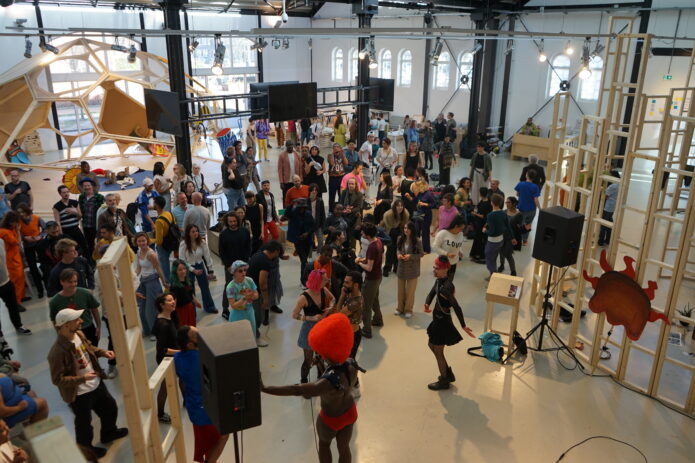
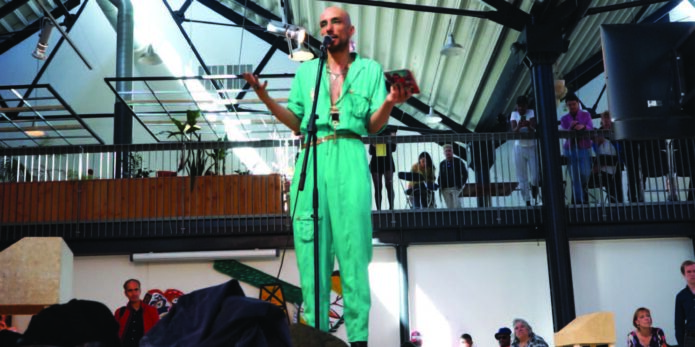
Opening performance by LIMBO, in collaboration with Sehaq Queer Refugees Group during the project DIT – Do it together (2022) /at Framer Framed, Amsterdam.
Creative Co-creation
Through a variety of creative workshops, we aim to find moments of relief while approaching and presenting one’s experiences in their complexity. Creative works are playful, sensuous, more sensorial forms of knowing. Art practices can take the form of internal reflections that make experiences, hopes and ideas visible (or audible) to the outside world. One can see art as an intuitive kind of language in contrast to, let’s say, Dutch or English. For people with a refugee experience, for whom Dutch or English is oftentimes a third or fourth language, art can be liberating because it has the potential of crossing language barriers. In LIMBO we cross language barriers in various forms, from drawing and clowning, to photography. Even though, there is a lot of diversity and varying degrees of engagement within the group, the stories participants share are different yet interconnected because certain challenges are experienced collectively. I also participate in the workshops with my own personal background, and share stories and complexities of my own queerness and migration heritage. Working together from such different levels of engagement can be argued as a form of symbiotic co-creation.
Symbiotic co-creation, or ‘[s]ympoiesis, is a simple word; it means ‘making-with’. Nothing makes itself; nothing is really autopoietic or self-organizing.’¹⁴ Taking a sidestep to the biological sciences, in the book Staying with the Trouble, Donna Haraway reflects on an article ‘A Symbiotic View Of Life: We Have Never Been Individuals’. The article describes how no organism can be defined as individual, outside of perhaps one specific bacteria, because all organisms, including humans, are symbiotic mergers of at least two different species, which include fungi and algae. The article concludes with ‘We are all lichens.’¹⁵ Anna Lowenhaupt Tsing writes that ‘[w]e are contaminated by our encounters; they change who we are as we make way for others […] Everyone carries a history of contamination; purity is not an option.’¹⁶ Everybody is thus a multiplicity, quite literally a symbiosis of a wide range of interdependent bacteria, cells and organisms. Multiplicities are ongoingly assembled and transformed by encounters along the way, not only on the biological level, but I would argue, in line with Deleuze and Guattari, also on the level of thought.¹⁷ Contaminated by actions, surroundings, ideas, people are transformed in conversations and encounters with others. In thinking symbiotically, I see creative co-creation as not being hierarchical, but rather sideways, as relational and horizontal, interdependent, contaminated and transformed by (unlikely, unexpected, unexplored) encounters.
Micro Emancipation
LIMBO is a symbiosis and amalgamation of different influences, and partially inspired by the work of Maggie O’Neill, a scholar in the UK, who combines art and biographical research. She refers to her work as critical theory in practice: ‘[k]nowledge […] produced forcing us to abandon instrumental rationality and reach towards a more sensuous understanding that incorporates feeling involvement as well as cognitive reflection.’ O’Neill thus claims that it is important to not only focus on understanding through the mind and intellect, but to also include knowing on different levels, knowing through feeling, through experiencing, through sensing. O’Neill further claims that her work ‘involves creating a “potential space”, a reflective/relatively safe space for dialogue, images and narratives to emerge that approach the world and research in a different way, facilitating understanding.’ ¹⁸ That is what we do in LIMBO. We come together in a creative surrounding, to reflect, create, and share stories amongst ourselves first, and if, or when, we feel ready, we open up and share stories in different forms of creative media to a larger audience. The underlying assumption is that through such encounters, while staying reflexive, there is potential for micro emancipation which may lead to (societal) transformation.
Micro emancipation entails a reflective capacity to become aware of taken-for-granted assumptions and critically question them. I realized its transformative potential when I engaged with the Rotterdam queer community and co-organized safer spaces for queer and trans people in which the status quo, and all dominant (often internalized) norms are questioned and challenged. These encounters transformed my understanding because I could safely and quietly reflect on my own blind spots. In academia, I learned that this was referred to as micro emancipation. Ghorashi describes certain conditions of doing so.¹⁹ For instance, creating a reflective space, such as the example of O’Neill, to slow down and encounter ‘the Other’ from the perspective of the Other, while momentarily pausing one’s preconceptions. Micro emancipation involves what Ghorashi explains as ‘relational autonomy’, ‘the constant balancing act [between private as well as collective concerns] of individuals who take their role as democratic citizens to heart.’²⁰ Private concerns increasingly influence our lives because we live in constant states of precarity caused by e.g. climate change, wars and forced migration. The promise of stable and comfortable futures is disappearing, or already has disappeared.²¹ It’s becoming more difficult to trust that one will find, for instance, a regular job and affordable housing. In effect, this makes it more challenging to balance private concerns with the collective good, because constant precarity fuels fears and nationalist tendencies of not getting or having enough, while thinking that ‘others’ might take from the metaphorical pie. Citizens are thus increasingly individualized and the focus shifted to one’s own private concerns, fears and anxieties. However, instead of solely focusing on oneself, it is important to focus on relations with other humans (and non-humans) in order for democracy to function well.
The Changed Nature of Critical Theory
In the transition from early to late modernity, the nature of emancipation had to change because the nature of power had changed. Earlier, critical theory was about liberation from oppressive macro structures, which could take the form of religion, the bourgeoisie, aristocracy, traditional institutions or dictators telling us how to live or who to marry. Using metaphors of solid versus liquid in his book Liquid Modernity, Bauman refers to early modernity as ‘solid modernity’, when the role of critical theory was to liberate and emancipate ourselves from visible forms of dominating powers and be free to make our own decisions.²² For Bauman, emancipation was a form of resistance against solid traditional institutions. In late modernity, or liquid modernity, Bauman argues that there are no longer solid (heavy, stable, immobile) institutions because everything liquified and became fluid. Fluidity as a metaphor emphasizes constant (social) change, movement and mobility: ‘the fast speeds of late capitalism, the precarious conditions of labor, the loosening of social ties.’²³ Bauman further argues that the newfound freedoms we gained leave individuals responsible for all their own choices. We are free to choose how to live, we don’t have to follow in our parents’ footsteps, but we also carry the burden of the responsibility ourselves. He calls this ‘mixed blessings of freedom’. ‘This freedom has also decreased the sense of connectedness among individuals, making it difficult to deal with increasingly complex issues of our time while drawing exaggerated attention to perceived risks.’²⁴ In terms of institutions nowadays – it is thus no longer the reality in Western societies, such as the Netherlands, to emancipate from dictators or oppressive traditions. Instead, the power that is now influencing our lives and actions has become invisible, and thus harder to pinpoint. It has taken the form of taken-for-granted assumptions and dominant discourses in society about, for example, migrants, refugees, queer people or activists. Dominant discourses influence peoples’ minds insidiously, making it challenging to become aware of this kind of power. Moreover, individuals who are not reflexive about such taken-for-granted assumptions make these discourses more powerful through daily repetitions. Ideas or practices that exclude people in several ways become almost common sense, unquestioned, or ‘just the way we do it here’.
In the Dutch context, besides blatant hostility toward refugees, apparent in demonstrations against asylum-seeker-centers, a large part of society has good intentions when it comes to refugee inclusion. However, good intentions are not enough for actual inclusion. One dominant Dutch assumption is the idea that its citizens are tolerant and open-minded. ‘Doe maar normaal, dan doe je al gek genoeg’ is a Dutch expression which translates to: ‘Just act normal, that’s already crazy enough.’ This might seem innocent, but what is normal and who decides what’s normal? In the Netherlands, it is often argued that everyone is included on the condition that one should not challenge the ‘way things are done’. It has to stay gezellig. Gezelligheid is a typical Dutch word that does not have a proper translation, but its meaning is close to coziness and is used for situations that require social interaction. Aminata Cairo explains how Dutch down-to-earthearnestness is combined with the concept of gezelligheid.²⁵ There’s nothing wrong with gezelligheid. On the contrary, it can be very valuable. However, it may stand in the way of societal change because when situations should always be gezellig, it is difficult to be critical. For example, in the Black Pete discussion, activists have struggled to address racism or discrimination because of the insistence that the figure of Black Pete has nothing to do with racism, because it’s part of a children’s celebration that is all about gezelligheid.²⁶ The assumption is that the Netherlands is not racist, but liberal, open-minded and down-to-earth. ‘We don’t see color’, and ‘gender is not an issue’ are regular arguments because ‘everybody has equal opportunities and should be able to achieve anything when they just work hard.’ Not being gezellig, and thus obstructing the ‘flow of how things are done’, silences critique and makes addressing such societal issues very challenging.
In the context of diversity work within institutions, Sara Ahmed uses the metaphor of ‘flow’ in a response to Bauman’s metaphor for late modernity as liquid or fluid. Like a river, when you (have the privilege to) go with the flow, everything runs smoothly. Ahmed argues that ‘[f]eminist and race theorists over generations have taught us that to inhabit a category of privilege is not to come up against the category.’²⁷ However, when you bump into barriers while going down the stream, due to queerness and refugeeness for instance, you are not only almost forced to go with the flow, you also become the problem. You become the one perceived as obstructing the flow.
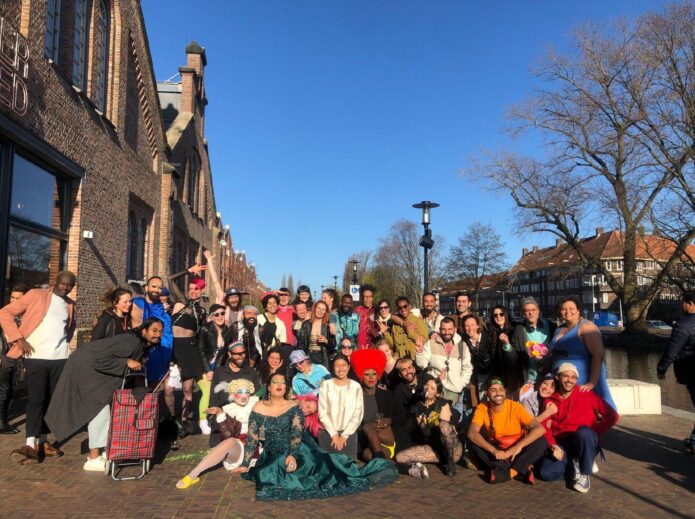
LIMBO group photo during the opening. Photo by Tino
Enabling and Obstructing Flow
Our current context is marked by precarity and trying to stay afloat in a reality of constant change and insecurity. For those who do not have the privilege of going with the flow of daily reality, it may feel like a strong, overwhelming, exhausting force, almost impossible to change. In LIMBO, we try to create havens to pause and meet one another, catch a breath, enjoy the water, in an attempt to find relief in the present by focusing on finding our own (creative) flow. We form relations by sharing stories and creativity, because ‘[i]t is time to turn to sympoietic worldings, […] where ordinary stories, ordinary becoming “involved in each other’s lives”, propose ways to stay with the trouble in order to nurture well-being on a damaged planet.’²⁸ We are contaminated by thoughts and stories and (potentially) transformed through these unexpected encounters, knowing that ‘all of the players are symbionts to each other, in diverse kinds of relationalities and with varying degrees of openness to attachments and assemblages.’²⁹ In the process, we look at the river, we question and challenge its course to see where there is room for change. We reflect on conventions in research and challenge dominant assumptions about refugees who are oftentimes perceived as victims. However, as Ahmed argues, when one points out the barriers in the river that others do not seem to notice, one becomes a barrier. Then again, sometimes we need to obstruct the flow in order to change it. Eventually the river may become wider or flow more gently in the margins. Perhaps, through interconnected efforts, the river will slowly and slightly change its course in order to include everyone.
1. Raben, Remco. ‘On genocide and mass violence in colonial Indonesia.’ Journal of Genocide Research, Vol. 14, No. 3-4 (2012): pp. 485-502.
2. Pattynama, Pamela. ‘Assimilation and masquerade: Self-constructions of Indo-Dutch women.’ European Journal of Women’s Studies, Vol. 7, No. 3 (2000): p. 284.
3. See for instance: Hulster, Daan de. ‘Pinda genoemd worden was normaal, het werd als onderdanig geaccepteerd’ AD. 19 June 2020. <https://www. ad.nl/waterweg/pinda-genoemd- worden-was-normaal- het-werd-als-onderdanig- geaccepteerd~afc2df5a/?referrer= https%3A%2F%2Fwww. google.com%2F>.
4. Ashley, Florence. ‘Accounting for research fatigue in research ethics.’ Bioethics, No. 35 (2021): p. 272.
5. For more information on the Institute for Societal Resilience, see https://www. resilience-institute.nl/; I use the term ‘queer refugees’ as an umbrella term to include people that identify as LGBTQIA+ and have a refugee or forced migration experience.
6. See https://engagedscholarshipnarrativesofchange. org/.
7. For more in-depth reading about the challenges queer refugees face, see for instance: Holle, Fabian, Maria Charlotte Rast, Halleh Ghorashi. ‘Exilic (Art) Narratives of Queer Refugees Challenging Dominant Hegemonies.’ Frontiers in Sociology, Vol. 6 (2021).
8. Turner, Victor. The Ritual Process: Structure and Anti-Structure. Chicago: Aldine Publishing Co., 1969: p. 94.
9. Manjikian, Lalai. Refugee Narratives In Montreal: Negotiating Everyday Social Exclusion And Inclusion (Doctoral dissertation, McGill University, 2014); Ghorashi, Halleh, Marije de Boer, Floor ten Holder. ‘Unexpected agency on the threshold: asylum seekers narrating from an asylum seeker centre.’ Current Sociology, Vol. 66, No. 3 (2018): pp. 373–391.
10. Bauman, Zygmunt. Liquid modernity. Cambridge: Polity Press, 2000: p. 207.
11. Muñoz, José Esteban. Cruising Utopia: The Then and There of Queer Futurity. New York and London: New York University Press, 2009.
12. Butler, Judith. Gender Trouble: Feminism and the Subversion of Identity. New York: Routledge, 1990.
13. Anzaldúa, Gloria Evangelina. Borderlands/La Frontera: The New Mestiza. San Francisco: Spinsters/Aunt Lute, 1987: p. 84.
14. Haraway, Donna. Staying With The Trouble: Making Kin In The Chthulucene. Durham: Duke University Press, 2016: p. 58.
15. Gilbert, Scott F., Jan Sapp, Alfred I. Tauber. ‘A Symbiotic View Of Life: We Have Never Been Individuals.’ The Quarterly Review of Biology, Vol. 87, No. 4 (2012): p. 336.
16. Tsing, Anna Lowenhaupt. The Mushroom at the End of the World: On the Possibility of Life in Capitalist Ruins. Princeton: Princeton University Press, 2015: p. 27.
17. Deleuze, Gilles, Félix Guattari. A Thousand Plateaus: Capitalism and Schizophrenia. Minneapolis: University of Minnesota Press, 1987.
18. O’Neill, Maggie. ‘Transnational refugees: the transformative role of art?’ Forum Qualitative Sozialforschung/Forum: Qualitative Social Research, Vol. 9, No. 2 (2008): p. 9.
19. Ghorashi, Halleh. ‘Routed connections in late modern times.’ In: Vieten, Ulrike M. (ed). Revisiting Iris Marion Young on normalisation, inclusion and democracy. London: Palgrave Pivot, 2014: pp. 49-66.
20. Ibid.: p. 55.
21. Tsing 2015 (see note 17).
22. Bauman 2000 (see note 11).
23. Ahmed, Sara. On Being Included. Racism and Diversity in Institutional Life. Durham: Duke University Press, 2012: p. 185.
24. Ghorashi 2014: p. 50 (see note 20).
25 Cairo, Aminata. Holding Space: A Storytelling Approach to Trampling Diversity and Inclusion. Aminata Cairo Consultancy, 2021.
26. There is an ongoing discussion about the figure of Black Pete being racist because of the blackface makeup and stereotypical behaviors attributed to this character. Black Pete is a servant of Saint Nicholas in the Dutch holiday tradition Sinterklaas, which is similar to Santa Claus.
27. Ahmed 2012: p. 176 (see note 24).
28. Haraway 2016: p. 76 (see note 15).
29. Ibid.: p. 60.
This interview was originally published in Errant Journal Issue #4: States of Statelessness, edited by Irene de Craen. Framer Framed is a founding partner and co-publisher of Errant Journal.
Community & Learning / Art & Care / Diaspora / Art and Activism / Migration / Queer / Social Practice /
Exhibitions
Presentation: Moving Love
The project aims to widen the focus of queer stories, which often centre on fear and precarity, by sharing accounts of hope and love
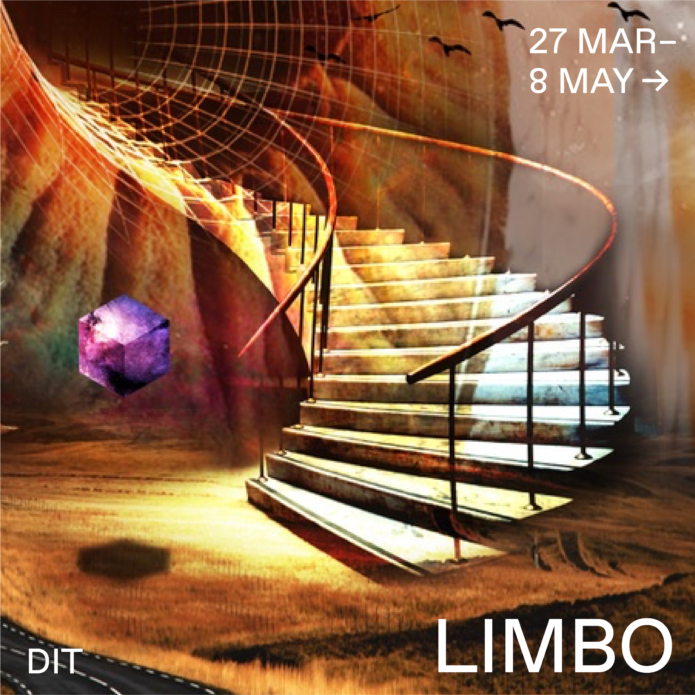
Presentation: LIMBO - queer exilic narratives
The final presentation of 'LIMBO: Engaged scholarship and queer exilic narratives'
Agenda
Workshop series: Moving Love Think Tank Sessions
As part of the presentation Moving Love, this workshop series invites participants into conversation to explore the multiple perspectives that shape and are shaped by the asylum system
Launch: LIMBO Booklet
The launch of the second LIMBO booklet with an afternoon of art, food, music, rhythm dance and celebration
LIMBO: Engaged scholarship and queer exilic narratives
A creative workshop series for queer, refugee and migrant community
Network
Fabian Holle
Researcher
Magazine
Action Research / Art & Care / Community & Learning / Queer / Workshop /
Queer / Community & Learning /
“Ever tried? Ever failed? No matter. Try again. Fail again. Fail better”
Art and Activism / Community & Learning / Migration / Queer / Social Practice /