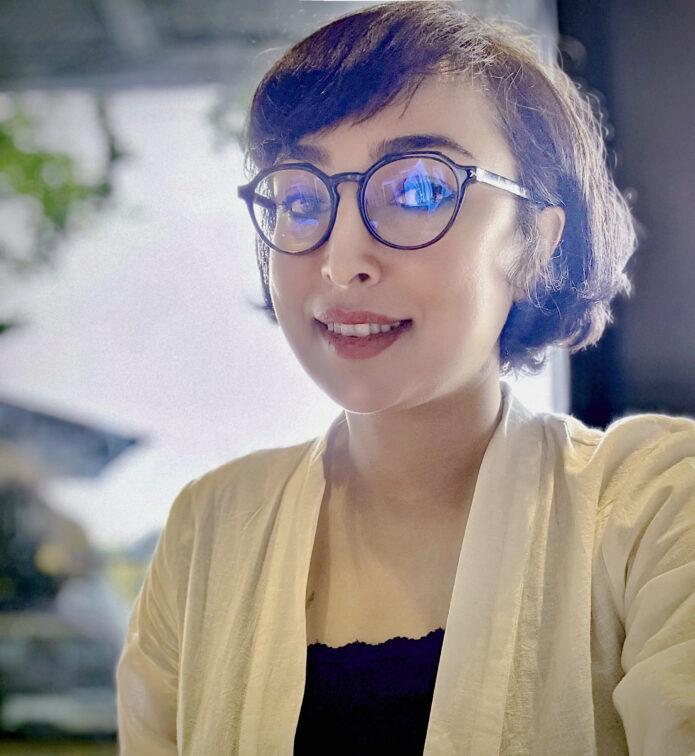
Crisis of History #3 – Beyond History (2015). Foto: Michiel Landeweerd / Framer Framed
 Woorden van de curatoren: Elham Puriya Mehr en Robert Kluijver over Crisis of History #3
Beyond History, the final part of the Crisis of History series, challenges normative historical frameworks in its exploration of the post-history landscape in the Middle East. Curators Elham Puriya Mehr and Robert Kluijver talk about how the artists attempt to go “beyond history” by sharing more personal accounts, creating new associations, and letting go of established historical and cultural emblems.
Texts by Elham Puriya Mehr and Robert Kluijver
We live in an era marked by a multiplicity of narratives, whose only common feature is the fact of being discursive. Although these narratives proliferate and metamorphose, they remain within the framework of the historical metanarrative. Local narratives seem to be in search of a kind of pluralistic state, in which the apparently incompatible worlds co-exist; a situation which seems to be possible. The structure of these local narratives is very similar, but their contents depend on the geographical context and are bound by historical definitions; these historical and geographical boundaries seem to be the prerequisite for their status as ‘historical narrative’. Therefore we face a paradoxical situation: the disintegration of history inside history.
Iranian contemporary art consists of micro-narratives that talk about a historical doubt. In most of contemporary Iranian works of art, history is depicted as a heavy object and its meta-narratives are skeptically redefined; these metanarratives are mostly born out of Iranian modernism. Constitutionalism, nationalism, Tudeh Party, fundamentalism, etc., have become historicized in a manner and have let theoretical and practical history find their way into our lived experience.
The amount of exhibitions in relation to Iranian history within the last few years provides good evidence for this claim. As if a group revision of history is being realized in the form of exhibitions. However, going beyond this seems to be unlikely now; possibly the only way to approach ‘beyond history’ is collecting the micro-narratives which look at this from different points of view. All artists of this exhibition have approached the concept of ‘beyond history’ from a different angle. Through their works of art they pose this question: “Is ‘beyond history’ another utopia or it is the reality in which we live?”. This exhibition tries to collect various narratives in a non-framed space; to proliferate concepts and create a different discursive experience from contemporary uncertainty.
Elham Puriya Mehr, 2015.
With their back against the present, the artists in this exhibition investigate the landscapes outside the historical narrative; what they see is in a past, in a present or in a future, not in the past, present or future. To move beyond history one must start by giving up the definite article in relation to collective experience of time.
Indeed, ‘beyond history’ may well be the state we are living in, rather than some kind of utopia. This is not a state we must reach by some kind of revolutionary struggle against ‘The System’, but by flicking a switch in our mind. It is not a minor operation, because by erasing ‘the great narrative of History’, we are pulling the rug under many certitudes that have organized the vision of the world that we were taught at school.
To be clear: by suggesting to erase the narrative of history, I do not suggest to erase history, or advocate any kind of hostile attitude towards the past. No need to pulverize public museum collections, as Malevich advocated and Islamic State radicals do. I am simply suggesting to free the field of historical interpretation to more narratives, other ways of connecting the dots of the past, leading to other futures.
Maybe it is time to proclaim, as Nietzsche did about God, that ‘History is Dead’. This is preferable over Fukuyama’s ideological assertion ‘The End of History’ which assumes that Western history has reached its climax, its final and definitive state of bliss, some kind of neo-conservative Nirvana. Fukuyama’s History reigns supreme, unchallenged, whereas it seems urgent to abolish it altogether.
The artists participating in Beyond History: Exercise of Imagination can no longer find comfort in the tired imagined identities of the past. They spearhead research into a history which has no role for nationalism or such vague catch-all concepts such as ‘the Middle East’ or ‘the Islamic World’; or a history written by the forgotten or vanquished actors of the past. They imagine a history that calls for a new type of politics.
Robert Kluijver, 2015.
The exhibition is supported by the Amsterdam Fund for the Arts, the Mondriaan Funds, Stichting Doen and the VSB Foundation.
Curatorial Text / Innovatief erfgoed / Institutionele kritiek / Iran / Midden-Oosten /
Exposities
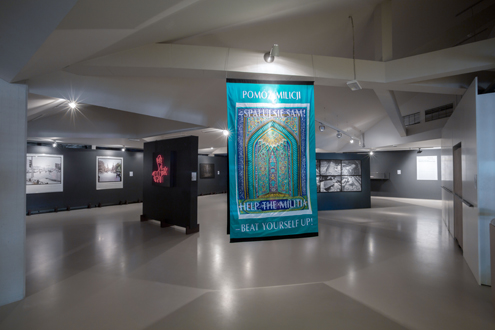
Expositie: Crisis of History #3 - Beyond History
Het derde en laatste deel van het drieluik met hedendaagse kunst uit het Midden-Oosten, Iran en de diaspora. Samengesteld door Robert Kluiver en Elham Puriyamehr
Agenda
Programma rond de expositie Crisis of History #3
Gedurende de expositie Crisis of History #3 - Beyond History, is er elke dinsdagavond een verdiepend publieksprogramma met films, lezingen en rondleidingen.
Netwerk
Robert Kluijver
Freelance cultureel producent