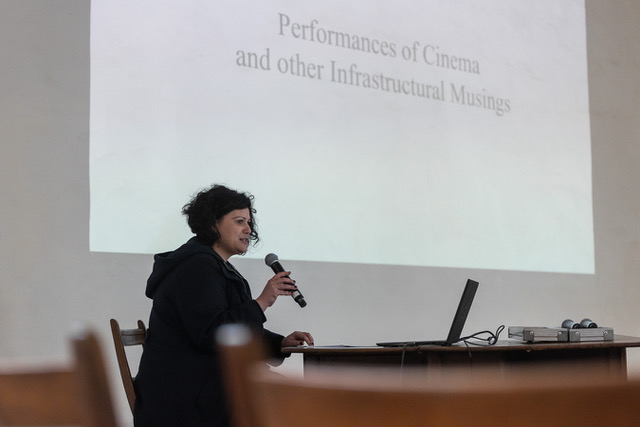
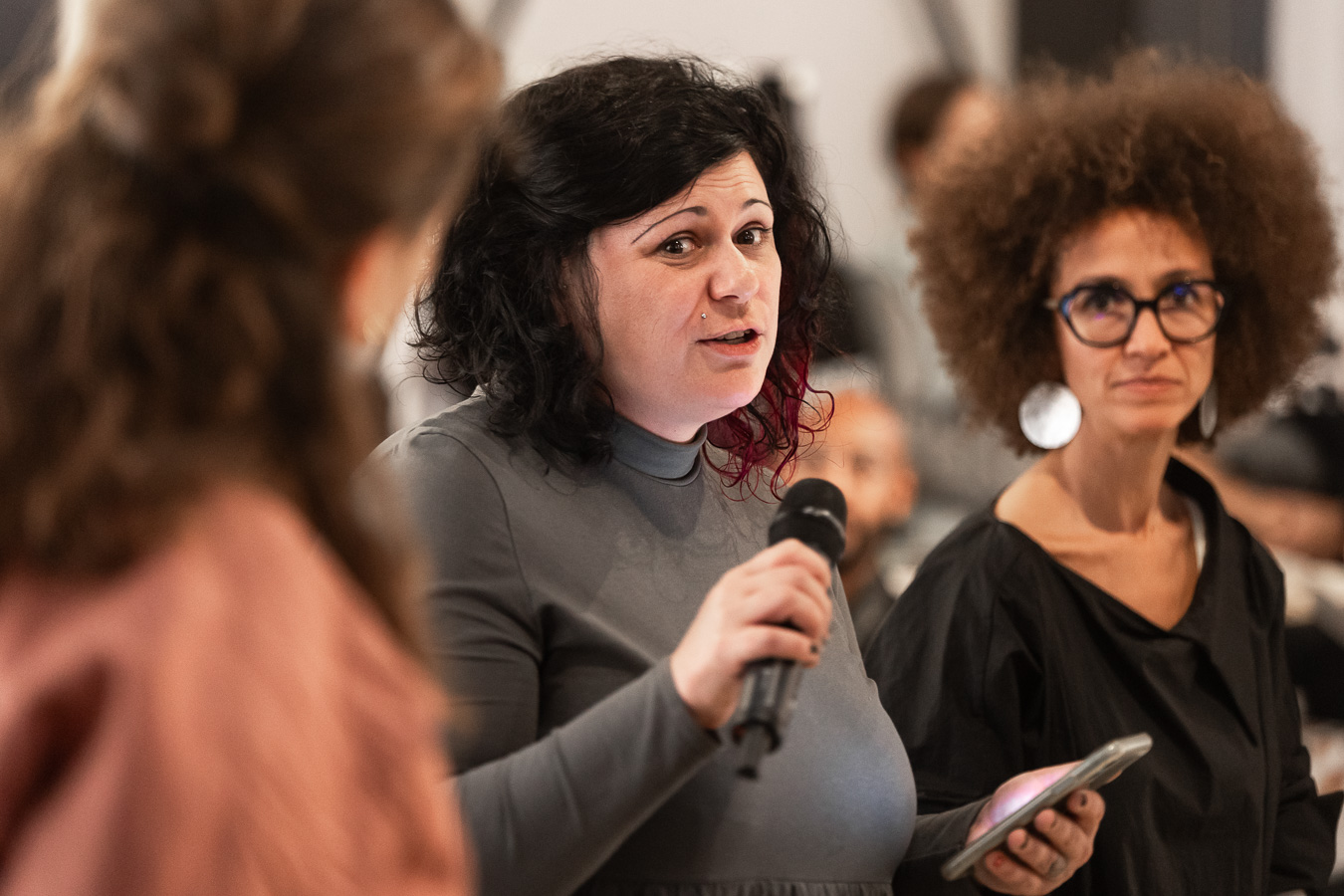
 Megan Hoetger and Samia Henni at the opening of Performing Colonial Toxicity (2023) at Framer Framed. Photo: Maarten Nauw / Framer Framed
 Woord van de curator: Megan Hoetger on the exhibition Performing Colonial Toxicity
Samia Henni’s exhibition Performing Colonial Toxicity, sheds light on the obscured history of French nuclear colonialism in the Algerian Sahara, and emphasizes the urgent need for a public reckoning. In her curatorial statement, Megan Hoetger clarifies the exhibition’s central message – an unwavering refusal to remain silent and a demand for reparative justice.
Text by Megan Hoetger
Between 1960 and 1966, the French colonial regime detonated four atmospheric atomic bombs, thirteen underground nuclear bombs and conducted other nuclear experiments in the Algerian Sahara, whose natural resources were being extracted. This secret nuclear weapons programme occurred during and after the Algerian Revolution, or the Algerian War of Independence (1954–62). The resulting toxification of the Sahara spread radioactive fallout across Algeria, North, Central and West Africa, and the Mediterranean (including southern Europe), causing irreversible and still on-going contaminations of living bodies, cells and particles, as well as natural and built environments. Over fifty years later, the archives of the French nuclear programme remain closed, and historical details and continuing impacts remain largely unknown.
The exhibition Performing Colonial Toxicity (2023-2024) is an expansive research project through which architectural historian and exhibition maker Samia Henni exposes this suppressed history of French colonial violence and its ongoing impacts. The project sets the stage for pressing political conversations on the nature of the ‘post-’ in postcolonial state infrastructures, as well as the (im)possibilities for a project of reparative justice in a context like that of the French toxification of the Algerian Sahara, where the extent of damage to human and non-human bodies, built and natural environments is yet to be made fully comprehendible. Henni’s project amplifies and extends the call of Bruno Barrillot, co founder of the anti-nuclear NGO Observatoire des armemants to ‘OPEN THE FILES’. Only then can the exigent next steps follow of cleaning/decontaminating the irradiated sites and paying reparations to the Algerian and French peoples whose individual, familial and community lives remain devastatingly affected. In the absence of the archives’ opening, Performing Colonial Toxicity takes the French state to task, meticulously culling together information and putting it into public circulation.
The project unfolds across three different platforms, namely: an open access digital database – the Testimony Translation Project – where the long process of digitalising and translating over seven hundred pages of written and oral testimonies from French and Algerian victims of the nuclear blasts has begun; a publication – Colonial Toxicity: Rehearsing French Radioactive Architecture and Landscape in the Sahara – which presents the archival materials in a printed visual repository of over six hundred pages conceived in the spirit of Aby Warburg’s Bilderatlas (image spreads from which are included in this handout); and the eponymously titled exhibition to which this essay serves as a kind of introduction. As a curator of performance in its expanded forms, my task in introducing Henni’s exhibition is to offer visitors a few points of entry into the acts of ‘performing’ that the installation sets into motion. I start by mapping out certain aspects of performance and performativity operative in Henni’s research practice and, from there, move more specifically into a discussion of some of the elements within the audio-visual assemblages presented in the exhibition space.
Performance and Performativity
I first encountered Henni’s work in 2017 when I was introduced to her book Architecture of Counterrevolution: The French Army in Northern Algeria, 1954-1962. In that ground-breaking study, she delivered an incisive infrastructural analysis of the building and spatial planning policies through which the French colonial regime forcefully attempted to ‘re-organise’ (read: annihilate) the everyday lives of Algerian populations. Though written from the position of architectural history, it was immediately clear to me that Henni’s work holds methodological importance for performance studies, pushing the field toward its radical potential to speak back to conventions of historical remembering.
Through her practice of ‘reading against the grain’, Henni offers a mode of deep archival research that traces the concrete and particular ways in which embodied experiences – and especially ‘social performances’, or the daily rituals that give rhythm to psychic and material life – are viscously designed and implemented through colonial policies and technologies of organisation that can seem rather abstract.
To quote from Henni’s introduction to Architecture of Counterrevolution, her approach reveals ‘the politico-socio-economic meanings of laws, maps, structures, infrastructures, shelters, housing, and other buildings, [disclosing] how these elements (and their broad network of actors) embody what the psychiatrist and author Frantz Fanon – best known for his 1961 book The Wretched of the Earth – called the “psychology of colonialism”.’ Henni’s work thus offers a method of going into the historical construction of (colonial) conditions of possibility for social performances, rather than turning to theory – itself a form of abstraction – to speculate on the effects/affects of colonial regimes of control. This is not to say that the speculative does not also figure into Henni’s practice. In Performing Colonial Toxicity, it, in fact, figures rather prominently. When the archives are closed, as in the case of the French nuclear detonation programme in the Algerian Sahara, speculation becomes a critical tool for the historian, opening up space to imagine and infer into the gaps and absences. In Henni’s project, the speculative generatively intersects with the prefigurative force of a manifesto, urgently reminding us of the political force of performative speech acts. If the classic example of such a speech act is the ‘I do’ of a marriage ceremony, then we might imagine here, in Henni’s work, the speech act centres around something like ‘I refuse’. I refuse to forget, to stay silent, to look away. This enunciative gesture of refusal, which is supported by Henni’s emphasis on naming (eg. naming ‘jerboasite’ as a thing in the world), asserts an anti-colonial demand for a form of reparative justice, which is, at once, still yet to come and already existing through the very utterance of the demand itself.
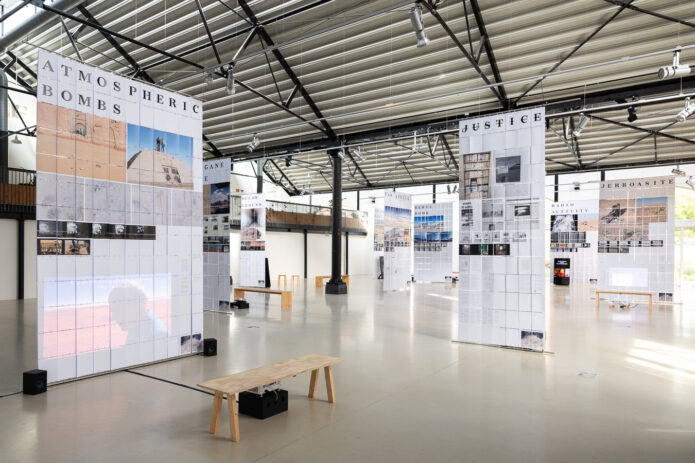
Performing Colonial Toxicity (2023). Foto: Maarten Nauw / Framer Framed
Spatialising the Archive
One could, then, think of Henni’s exhibition as a manifesto written across space wherein the performative gesture of the ‘I refuse’ takes on an architectural scale, echoing and extending it across a multiplicity of stories and materials. Somewhere between oral history and investigative reportage, the thirteen audio-visual assemblages that comprise the installation – what Henni refers to as ‘stations’ – propose a form of spatial language, which is neither fully visual nor fully auditory. It moves the eye both up and down and side-to-side, engaging the whole body in the act of reading. The syntax of this spatial language resembles that of sedimentary layers, suggesting that engagement with the stories and with the materials is a kind of excavation process into which visitors are invited. And, though there are no pre-defined routes through the installation, there is a kind of entrance stage that triangulates some key introductory coordinates: the question of justice, the business of the global nuclear market (including weapons, energy and uranium extraction), and the anthropogenic form of ‘jerboasite’. These coordinates haunt the other ten stations. Each station brings together maps, photographs, film stills, documents and testimonies with either archival film footage or with excerpts from interviews conducted by Henni. The embedding of moving image materials into the still image-scapes activates the stations, each one becoming a stage for the co imbricated elements of this ongoing history. This is bolstered by the statements of the eight scholars, scientists, artists and activists that Henni interviews, including: Larbi Benchiha, Patrice Bouveret, Roland Desbordes, Bruno Hadjih, Penelope Harvey, Gabrielle Hecht, Jill Jarvis and Roxanne Panchasi. Each interviewee contributes particular kinds of knowledge about the manifold violences of French colonial toxicity in the Sahara, from environmental and biological impacts to historical consequences and erasures. For instance, physicist Roland Desbordes, who collected samples of everything from fused sand to camel excrement, unfolds the temporality of nuclear (half-) life and the ways in which radioactivity performs in the body. Elsewhere, literary scholar Jill Jarvis puts forth propositions regarding an-archiving and counter-archiving practices, pushing visitors to centre the question of what is not there. Jarvis’s words change the way one sees the maps, photographs, film stills, documents and testimonies – in fact, all of the interviews ask us, in one way or another, to think carefully about the ethical and juridical relations of speaking to the visual.
Speaking in Henni’s installation, though, is disconnected from sound. Instead, the interviewees’ words appear in the form of written subtitles. This is a crucial detail, which carries with it symbolic and experiential meaning. Instead of words per se, visitors feel voices by other means: through the whistling tenor of the Saharan winds that connect between the thirteen stations, and through the eruptions of human and mechanical utterances that punctuate Henni’s spatial language. These sonic intensities enter the visitors’ bodies, a visceral reminder of how the memories of people and the environment itself can inhabit us. In the liminal space of a yet-to-come reparative justice, they powerfully perform the refusal to stay silent.
Megan Hoetger, 2025.
Performing Colonial Toxicity (2023) is supported by Ministry of Education, Culture, and Science (MinOCW), AfK (Amsterdam Fund for the Arts), Stadsdeel Oost, Mondriaan Fund, the public fund for visual art and cultural heritage, SAHA Foundation, PPO Werktuig, Amarte Fund and in collaboration with the TextielLab, the Textiel Museum’s professional workshop.
Curatorial Text / Ecologie / Het levende archief / Koloniale geschiedenis /
Agenda
Finissage: Performing Colonial Toxicity
Finissageprogramma voor de tentoonstelling Performing Colonial Toxicity inclusief een boekpresentatie van Samia Henni's nieuwste publicatie.
Performing Colonial Toxicity: The Testimony Translation Project
Rondleiding over de vertalingen van de getuigenissen
Opening: Performing Colonial Toxicity
Een tentoonstelling van onderzoeker Samia Henni over de verborgen geschiedenis van het Franse nucleaire kolonialisme in de Algerijnse Sahara
Netwerk

Samia Henni
Architectuurhistoricus, Tentoonstellingsmaker