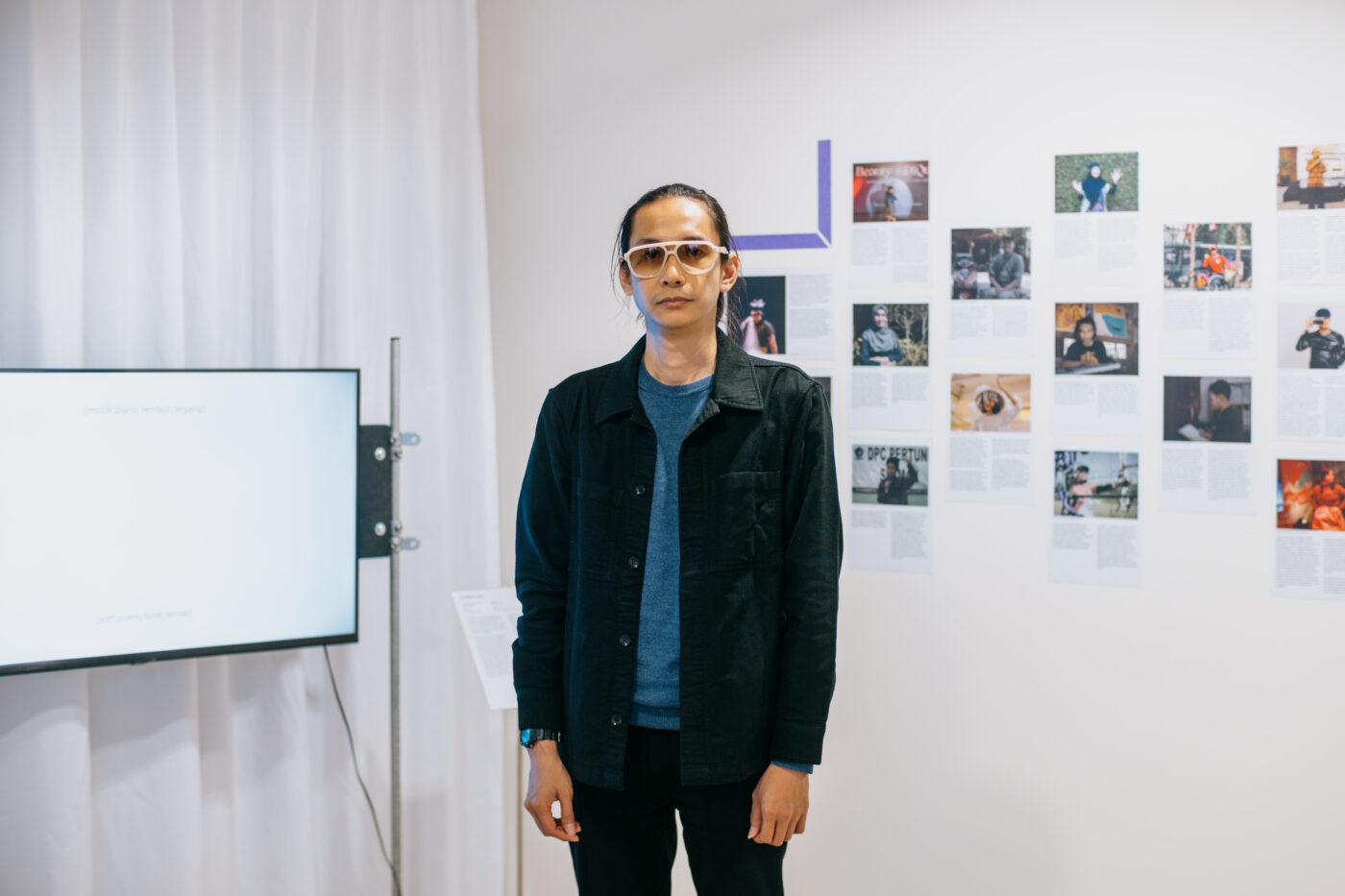
 Jay Afrisando, a medium-skin-toned male with bunned hair, standing in Framer Frameds project space in a serious pose with his arms down. He wears black pants, a blue shirt, a black jacket and tinted glasses. Photo: © Ben Yau
 Interview met kunstenaar Jay Afrisando – KITLV-Framer Framed Residency 2025-26
When colonial archives codify a ‘normal’ bodymind that marginalises disabled/difabel communities, the response is a counterarchive.
Composer, multimedia artist and current Atelier KITLV-Framer Framed resident, Jay Afrisando discusses accessibility and colonialism in pre- and post-independence Indonesia. “Knowing how we’re living in a fragile world, the most important thing my research and artistic practice aims at is structural change.”
Interview conducted by Iris Eikelenboom
March 2026
Iris Eikelenboom (IE): Firstly, I wanted to congratulate you on being selected as the new artist in residence for the Atelier KITLV-Framer Framed Residency Programme. In this interview, I would like to ask you some questions about your previous work as a researcher, composer and multimedia artist, and the research you intend to conduct as an artist in residence.
Jay Afrisando (JA): Thank you for inviting me to this interview, Iris. To begin with, I still call myself a ‘composer’ and ‘multimedia artist’ to date, because the public is more familiar with those terms and indications when they hear them: that I make music and multimedia art. And it is still true. In reality, though, it is more complex than the general understanding those terms convey. Since 2018, I’ve focused on aural diversity, disability, accessibility, and decolonizing the arts. My work is particularly rooted in and embraces diversity and ethics of hearing-listening, including my neurodivergent and other people’s hearing-listening. So that means any media and approaches used in my work will emerge from the ways we hear-listen. For example, the multifaceted performance [opera captions] reimagines what captions, as “actors,” can do beyond functioning as communication conveyors and sound interpreters in audio-visual media, and celebrates the lives of captions that have been both cherished and hated. Captions, as many people know, are an accessibility element used by Deaf, hard-of-hearing, neurodivergent, and other temporarily-disabled listeners. Embodied Music Club envisions a future music and listening club where touchable graphic notations, audio, and sound captions centre the bodymind in music-making. Or the In Conversation exhibition, where the outcomes of all the artworks were determined by the conversations and the various bodymind characteristics, not solely by the outcomes. All my works are rooted in hearing-listening, especially acknowledging its diversity, regardless of the materials used to present the artistic ideas. And based on what I’ve witnessed so far, audiences and visitors seemed to dive into their experiences without necessarily questioning the (anti)disciplinarity that the artworks may induce.
In this residency, I continue to take a similar approach. In the current project, I investigate how Dutch colonialism may affect disabled people* and disability perception in Indonesia before and after Indonesian independence, and their consequences for the disabled people and the architectural structures that the society believes towards them and disability, including environmental access, education, and government policies. With different collaborators, the conversations will emerge differently, and so will the outcomes.
I’m collaborating with Indonesian disabled communities in Yogyakarta, including Bawayang Production, Teater Braille, and SAPDA (Sentra Advokasi Perempuan, Difabel dan Anak/Centre for Advocacy of Women, Disabled and Children), not only to investigate the KITLV colonial archives but also to ‘respond’ to the ‘call’ of KITLV and Framer Framed as the institutions governing the archives in the form of our own counterarchive. I wanted to collaborate with Indonesian disabled communities, who have lived experiences and the knowledge and have been impacted the most by the ableist environment constructed by the society. Although I’m an Indonesian and I had internalised ableism that caused me to do “masking,” working with those communities will bring more accurate pictures of how various disabled communities have navigated architectures not built for them.
*Anyway, since we had this conversation in English, I used the word ‘disabled people’ to indicate people who face bodily and/or systemic barriers both in the context of medical and social models of disability, which state that “disability” can emerge from a physiological condition and an inaccessible built environment where the people live. This term has been used at least in the US context, where “disabled people” have fought for disability rights and argued that the state of disability can come both from the bodymind and the disabling architecture. This term historically and culturally leans on the identity-first language to acknowledge disability as an identity that connects people to a community, a culture, and a history. In the Indonesian context, the word difabel – derived from the English word “differently abled person” – was promoted by Mansour Fakih to be used to indicate people with disability instead of the ableist word “cacat” (defect), which was used by Indonesian society in the past. This choice of word came from the social model of disability. The term has been used by the Indonesian grassroots disability communities and local legislations as an empowering language and identity. According to scholar and activist Dr. Suharto, difabel – and its counter-naming in English that Fakih also promoted, “diffability” – which “recognises broad variation of physical and mental characteristics between individuals and across populations.” This term historically and culturally leans on human variation.
In short, different cultures produce different understandings and language of disability. I will discuss more about this (including the term used in the Netherlands) on the March 26’s public programme at Framer Framed.
IE: During your KITLV-Framer Framed Residency, you will be building and expanding upon your research on disability justice in Indonesia, and the structural oppression imposed on disabled people by the Dutch colonial rule. Could you tell us a bit more about the research and artistic projects you have previously worked on?
Additionally, could you talk about how this research informs your current research as an artist in residence?
Although I’ve been conducting research on disability justice in Indonesia since 2019, I halted the research during the COVID-19 pandemic, and this is the first time I’ve finally manifested the research in a more concrete plan. During the pandemic, I shifted my focus to investigate how imperial projects have used the arts to prolong their capitalist agendas and how aural diversity and disability justice can unlearn the ableist ways of artmaking and recentre the bodymind in the arts. Ableism – and audism – in hearing-listening, artistic production, education, and technology has subjugated those who are aurally divergent (Deaf, hard-of-hearing, neurodivergent people; people having tinnitus, hyperacusis; people wearing hearing aids, cochlear implants), have chronic illnesses and other permanent disabilities, and those who are global majority (a.k.a. people of colour), women, parents, working class, and geopolitically weak. This subjugation helps succeed capitalism by classifying those who can or can’t work, creating oppressive education systems prioritising epistemic injustice, and designing architectures emphasising the Western epistemologies of ‘normal’ bodymind.
My current research has benefited significantly from my prior research, particularly in understanding how colonialism works in suppressing the lives and the rights of disabled people. One particular trait of colonialism is how disabled people had (and have) been denied access to education, language, and sovereignty to determine how they live(d) in their own terms. One prominent example is how the Netherlands, along with European countries catalysed by the “Milan Congress” (a.k.a. the Second International Congress on Education of the Deaf, where Alexander Graham Bell was one of the participants and opponents of manual/sign language education), adopted the oral (speech) over the manual (sign language) method for deaf education. In Indonesia, the first deaf school, Doofstommen Instituut (Institute of Deaf and Dumb – now SLB Negeri Cicendo), was founded by C.M. Roelfsema-Wesselink, a missionary and the wife of a Dutch otorhinolaryngologist (ID: ahli THT) in Bandung in 1930. The institute prioritised the oral method and thus suppressed sign language. Recently, I collaborated with Arief Wicaksono, a Deaf pantomimist and a member of Bawayang Production (a Yogyakarta-based Deaf artist collective), to make a collaborative poetry-music project that invites audiences to investigate the conventional boundaries of poetry and music through sign language. The Indonesian sign language (BISINDO) compositions were equipped with visual descriptions by Nels, Broto Wijayanto, Bawien Panggalih, and me, that expands its accessibility to blind audiences.
This project further connects with – and supports – my research during this residency, which interrogates access suppression brought by the Dutch colonialism and how Indonesian disabled people and allies deal with it in their own terms.
IE: In your work, you often combine sound, text and movement to create interactive sensory experiences, exploring accessibility and what our bodies and minds are capable of. I’d be interested to hear about what the process of integrating your personal (sensory) experiences as a neurodivergent person into your artistic practice has looked like for you.
Earlier, I mentioned that my creative process is rooted in diversity of hearing-listening. In that case, that means interrogating how my bodily apparatuses – ears, eyes, skin, and body cavity – attend to stimuli and how my mind processes them through memory, imagination, and continuous learning. That also means understanding how I interact with time, how I get up and down with fluctuating energy, and how I try to find the best way to communicate with myself and others. Being able to understand myself is to unmask myself – I feel liberated from following capitalist- and ableist-conforming norms I won’t be comfortable operating within. I’ve incorporated such understanding into my artistic practice, where how I work is informed by how I hear-listen and cope with my bodymind. Recently, I collaborated with oral Deaf artist Saverio Cantoni on their multilingual podcast, mixed feelings. Instead of having the conversation via a live spoken mode, to produce the podcast, we corresponded via an online collaborative writing platform to honour our aurally divergent and neurodivergent modes of processing. Then, we manifested the asynchronous conversation into recorded spoken English, German sign language, captions, and a transcription book containing a different kind of captions that convey sounds happening in our minds and visually describe our behaviours during the podcast making. In different types of _______, I made a multisensory “diary” of my tactile, aural, and visual hearing-listening experience expressed through collaborative sounds and sound captions. The diary documents and categorises my own hearing-listening that encompasses touching, sensing sound, and seeing. The [opera captions] multimodal piece I mentioned above also partly departed from my personal interaction with captions, for I occasionally rely on captions when I have difficulty processing auditory and verbal communication. Part of [opera captions] deals with why and how captions have been written to ‘perfection’ without regard to represent those who process words differently. In Time Bent, Folded, Exhausted, I collaborated with Simoné Goldschmidt-Lechner to translate our experience of neurodivergent thinking into text, visual, and multichannel sound. We imagined a world where neurodivergence is the norm; we communicated and brainstormed the project via video calls, email, chat app, and limited in-person meetings. Further, in the Cards Against Neurotypicality card game and the Ramps and Slides: Finishing a Project board game, I simulated what communicating and finishing a project feel like from neurodivergent perspectives, with contributions from Terry Perdanawati and Simoné Goldschmidt-Lechner, both of whom are also neurodivergent.
IE: Additionally, you often collaborate with aurally diverse and disabled communities, foregrounding their lived experiences with sound, hearing and listening. Could you elaborate on the importance of centring the perspectives of communities that have historically faced, and continue to face, stigmatisation and oppression?
Centring the perspectives of communities that have historically faced – and continue to face – stigmatisation and oppression will centre diversity in knowledge making, which will abolish epistemic injustice. That culprit happens in education, everyday technology, news and media outlets…basically everywhere, and that creates tacit knowledge.
Here are some tacit knowledge that has shaped our partial understanding: that the only legitimate language is spoken language, that music and sound art stem from the perfect-idealised ears and skilful making requiring painful training, that everyone can succeed while in reality systemic privileges play a key role, that sophisticated technology can solve all of our problems. Even within the awareness of diversity, disability as a human diversity trait is often left out, and the discourse of ableism – the discrimination that positions disabled bodyminds as inferior/disposable/invisible and abled bodyminds as superior – is hardly recognised as the root of every oppression. As Talila Lewis states, “it is impossible to end racism without ending ableism, and impossible to end ableism without ending racism.”
Colonial and capitalist societies simply see marginalised communities as the Other. When the Other is wiped out, such societies can carry out singularity and separation, which can make paths to wealth accumulation, land theft, and labor extraction. I’m currently having another project where I’ve been in conversation with aurally diverse artists, curators, scholars, and artworkers, and they’ve argued that diversity is a fact. Diversity brings complexity that makes our lives wonderful. When an institution (broadly defined) meaningfully incorporates diversity, its members will generate richer processes and outcomes. When an institution lacks diverse representations, more often than not it will produce policies and programming that will be inclined towards biases that such an institution represents and abandon those who historically can’t access the space such an institution provides. Diversity that the marginalised communities bring can equip an institution capabilities of tackling non-linear challenges, which mere technological and scientific approaches can’t solve.
Still, there is a limit to what disabled people and communities can do despite having the knowledge. Temporarily-non-disabled people (a term I prefer in lieu of “abled-bodied” or “normal-bodied”) should do their homework as well to meet us in a “middle moment,” a term that curator, artist, and In Transit CIC Director Celina Loh uses a lot to describe a situation where people “meet in the middle” through silent understanding. In 2025’s discussion panel at daadgalerie, artist and scholar meLé yamomo and I discussed that someone or an institution needs to step back when amplifying others. That ‘step back’ can also be interpreted as doing the necessary work to centre the marginalised voices: exercising empathy, being ready to be vulnerable, and being willing to let space for others to lead. Easy to say, but not easy to implement.
IE: You’ve recently started your research process into the collections of the Royal Institute of Southeast Asian and Caribbean Studies (KITLV) and Leiden University. If possible, I’d love to hear about what this process has been like for you so far.
My research process started with determining key topics. Researching disability and its history requires examining from multiple perspectives. One, that Dutch colonialism brought – what Jasbir Puar calls – debility, which caused disability and disabling effects to both disabled and temporarily-non-disabled people through physical and systemic violence from war, slavery, and genocide. Debility is rarely seen as a cause of disability. Two, that disability can emerge as systemic violence driven by ableism, which was grounded by colonial ways of enforcing white-centred architectures, both as physical buildings and virtual space. This condition may happen to anyone regardless of their (dis)abilities. Three, that the religious/moral model of disability, which sees disability as sins or God’s punishment, existed.
So, I read journal articles, books, and online media to specifically determine what I needed to look into. Even before starting the research process, I had an initial discussion with my research assistant, Terry Perdanawati, and several members of Bawayang Production, including Arief Wicaksono, Nels, and Broto Wijayanto. We talked about various tangents related to disability and access, and initially determined some potential research questions pertinent to the archive and the community. We checked in a few times to ensure all the research process went as planned and appropriate.
In the initial research process, when searching the archive, I used keywords that might lead me to the kind of information needed. Those keywords, as a starting point, include general terms directly related to disability (such as disability, disabled, deaf, doof, mute, invalid, invaliden, invalidengesticht, invaliditeitswet (the Disability Act), invalidenhuis, and blind) and terms indirectly related to disability yet may bring me to information about debility and disability, such as colonial education, indentured labor, objectification of humans, and local perspectives in disabled people. After browsing the archive, I temporarily conclude that the archive I tend to find can be found in colonial reports (kolonial verslag), colonial studies (kolonial stüdien), government advertisements (gouvernements advertentieblad), literature journal (de Gids), photos, and various law documents. Some of the documents brought me back to a history class in my elementary school about Dutch colonialism history, but I didn’t see that from a disability perspective, and it never occurred to me that we can see colonialism through a disability lens.
A few months ago, Terry and I visited the Netherlands – especially the Leiden University archive and Framer Framed – to physically get to know about the archive and meet various people enthusiastic about the archive. There, Emily Lee from Framer Framed and Francio Guadeloupe and Tom Hoogervorst from KITLV discussed our archival research plan, and they shared resources that helped us navigate the archive. During our visit, we also met with other KITLV team members and other researchers at KITLV to share some resources and discuss each other’s research interests, which interestingly intersected with our current research. I also got a chance to meet with meLé yamomo to exchange information and share experiences regarding navigating colonial archives. All the people we met generously gave us advice on dealing with archives. Our visit to the archive and meetings with the people confirmed our suspicion at the beginning of the research: that dealing with colonial archives partly feels like being a detective: we need to see what and how they saw, and we need to see what’s not there.
After the initial research phase, I met members of Bawayang Production, Teater Braille, and SAPDA, as well as members from other disabled communities in Yogyakarta, in person. I shared my initial research findings and had a deeper conversation with them about the state of disability and access in Indonesia, and how we respond to the archive. We found some indirect connections between the archival findings, governmental and societal responses in shaping structural (in)accessibility), and how the community members have faced systemic barriers and hacked things to support their lives and each other.
Two main threads of conversation emerged. One, despite governmental and institutional incremental actions to make architectures more accessible, things have yet to be accessible enough because disabled communities have not been included in the policy and architectural making. In that case, accessibility won’t work optimally, simply because those having the power to make things don’t have the living knowledge of what it feels to be disabled people. This condition is still similarly happening as it did during Dutch colonialism, when disabled people were treated as objects of law and regulations, not as partners or leaders who build the law and regulations.
Two, disabled communities have a strong desire to counterarchive in their own terms. We found photos of short/little persons at the KITLV archive without any context of who are in the photos, who captured the photos, and when-where-how they were documented. We felt like those bodyminds were only treated as colonial trophies. We felt there are so many stories to tell if the communities can counterarchive. One of the conclusions we made was that disabled people haven’t been treated as ordinary human beings who have the rights to participate equally in society. Once again, they are treated as objects.
Through all this process, it has become obvious to all the project collaborators – and come as no surprise – that archive lives not only in the manuscript stacks at the library, but also lives in the presence of those who read and construct further knowledge. And notably, it lives in the presence of those who experience violence, grief, anger, as well as joy and aspiration firsthand.
IE: I was also wondering if – and if so, how – you would say the way you engage with the archives is shaped by the knowledge you have gathered on accessibility through your practice.
I’d say that my knowledge in accessibility is informed by my lived experience as neurodivergent and knowledge gained through various communities, artists, and scholars, so my experience can’t be generalised here.
Most archive materials I’ve accessed at KITLV have been printed exhibits, including document scans and photos. My experience accessing the archive so far has been smooth; all document scans are searchable through keywords. Some materials include OCR text, which in some cases helps me identify a text from the scan.
This isn’t particularly negative criticism, as I know that archiving process isn’t an easy job, but one thing that bothers me a bit is that almost all materials don’t have a summary, points of interest, or at least brief information about what the journal/book tells about. In my previous response, I mentioned that all the photos I found don’t have any descriptions. It’s not only problematic, but also a bit difficult to find without the right keywords. And of course blind and low-vision readers won’t be able to access image documents because of the lack of visual descriptions. During my recent meeting with the communities in Yogyakarta, access volunteers and I tried to describe the visuals of photos. Indeed, there was access intimacy there. Still, for ease of access, visual descriptions – and summaries – will increase archival accessibility.
IE: In your project idea, you mentioned that you would like to research the entanglements of capitalism, racism and ableism, and how these and other forms of discrimination and oppression brought by colonial rule have shaped views on disability and disabled people. Could you illustrate how these views continue to impact policy-making on disability in the present day, specifically in Indonesia?
I’d say my response to this question is still in progress. I’d begin by saying that disability history in Indonesia before the 1998 reform era and 1945 Indonesian independence is underresearched, possibly since it lacks documentation and the grassroots disability movements had been suppressed. This condition is also supported by the fact that, even in the Netherlands, disability history hasn’t got proper attention from Dutch historiography. But, the trace of the medical model of disability is clear since the Dutch colonialism until the reform era. In the Vocabulary and Dialogues: English, Papiamento, Dutch compiled by W. M. Hoyer published in 1936, words like “deaf” and “blind” are grouped into the “defects and illnesses” category, along with other harmful terms such as “cripple,” “dumb,” “dwarf,” and “one-eyed,” among others. In my earlier responses, Dutch colonials established a number of segregated schools for deaf people, including Doofstommen Instituut in 1930. These schools taught pupils through oralism, and students were denied sign language as part of their native communication.
From 1947 to 1954, Suharso – who graduated from the Dutch School of Medicine for Indigenous Peoples and later served as Minister of Health in the 1950s – pioneered the medical model of disability in Indonesia. Receiving ongoing government financial support, he successfully established rehabilitation centers for disabled people and prosthetic centers for people with physical disabilities. During this time, sekolah luar biasa (a segregated special needs school – but literally meaning “school of extraordinary/special”) was also established, continuing the Dutch legacy. Instead of social inclusion, Suharso’s approach only brought social segregation and discrimination between disabled and so-called “abled-bodied” people.
During the Old and New Order Era (Orde Lama and Orde Baru), the Indonesian government implemented the medical model through stigmatising terms, such as cacat (defect), orang dalam kekurangan jasmani dan rohani (persons having physical and mental deficit), and tuna _____ (_____ loss), into legislation, which was eventually reflected on common literature. These terms were greatly influenced by the Sukarno regime with its Javanese-centric culture, which values subtlety. These terms are no longer used in legislation, but the Law number 8 in 2016 uses penyandang disabilitas, literally meaning “persons carrying disability,” which is not the grassroots communities use but is accepted as formal/legislative terminology. This move suggests that disability – or diffability – is still considered an individual burden, rather than human variation.
All these moves indicate that the extreme medical model of disability still permeates in legislation, which impacts all juridical aspects, including city planning and education. Improvement starts when grassroots disabled people are fully included within legislation making.
IE: Lastly, I’d like to ask you how you aspire to challenge/shift these views through your research and artistic practice.
Knowing how we’re living in a fragile world, the most important thing my research and artistic practice aims at is structural change. How I do that and what the scope of my work can aim at can vary, but I’ve applied some key principles to keep my work grounded in reality.
First is to keep collaborating with communities of artists, curators, and other members to ground the work in disability/diffability justice. Working “with,” instead of “for,” is a necessary move to dismantle our assumptions, regardless of whether we’re disabled or temporarily not. Doing this means that my practice tends to start with conversations, rather than predetermined outcomes. Aural diversity and disability/diffability justice teach us that our understanding of the world comes from our diverse/divergent bodyminds. That means different people will have multiple truths coming from one stimulus, so consequently lived experiences will vary.
Second is to unlearn concepts and practices stemming from ‘normal’ bodymind. That means to be aware of and rework tacit definitions, which have been crystalised through our assumptions and privileges, by posing critical questions. For example, what does it means to make an artwork? What kind of artwork can we make, and how can we expand what the arts sound, look, and feel like and what they can do? Who will this artwork benefit for? How can we ethically work with other people and nonhumans? Who determines whether these questions are relevant? These critical questions can guide us towards meaningful intention, purposes, process, and outcomes.
I’m not saying that I’ve successfully done these things. To me, aiming my practice at structural change is always in the state of in progress, as challenges and limitations can contextually operate at a different time and space. At one time, my work may direct one’s attention to the voice that can’t speak yet—and that voice may be myself. At another time, my work may focus on changing the ways the collaborators communicate to generate different, surprising, and meaningful outcomes. Someday, my work may contribute more to an anti-disciplinary paradigm, where institutional members focus on the core issue, not on the predetermined and pre-understood ways of thinking and seeing. It’s always a reminder for me to be ready to change directions of my artwork if it’s necessary.
IE: Thank you Jay. We look forward to further collaborating and exchanging ideas with you these upcoming months.
Thank you, Iris. Looking forward!
The Residency Programme
The Atelier KITLV-Framer Framed Artist Residency programme supports innovative and societally relevant projects at the intersection of art and academic research in Southeast Asian and/or Caribbean Studies, with a focus on (post)colonial theory and discourse. The programme is open to applicants who have experience and interest in developing a project exploring themes relevant to this field. The duration of the residency is twelve months.
The selected participant(s) will have access to Royal Netherlands Institute of Southeast Asian and Caribbean Studies (KITLV) and Leiden University collections and engage in dialogue with KITLV researchers and the Framer Framed team to inform and inspire their work. They will join the Framer Framed network and be supported in developing and sharing the project through a presentation and/or other discursive programmes.
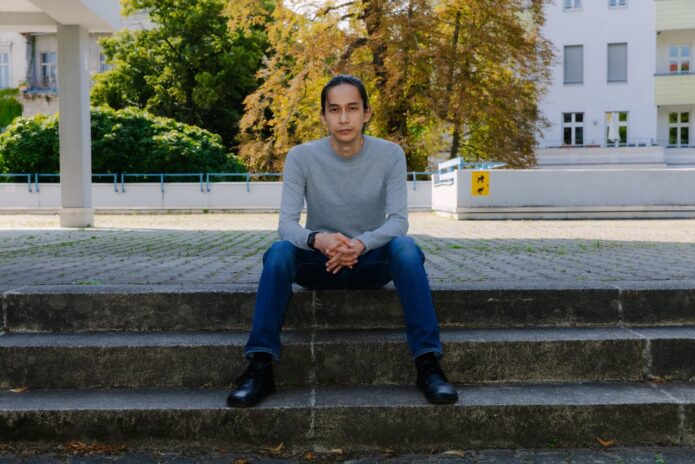
Image description: Jay Afrisando, a medium-skin-toned male with bunned hair, sits on outdoor neighborhood concrete steps in a serious pose, with his fingers clasped and arms on his thighs. He wears dark blue jeans, a light gray sweatshirt, and black shoes. Photo: © DAAD Artists-in-Berlin Program / Diana Pfammatter.
Previous artists participating in the residency programme were Theo Frids Marulitua Hutabarat, Clara Jo and Mirelle van Tulder. The outcome of their residencies have been shown, among other places, in the exhibition Sensible Past: Of Distances and the Fabrication of the Frame (2024) presented in Bandung, Indonesia.
Het levende archief / Indonesië / Koloniale geschiedenis / Residenties /
Exposities
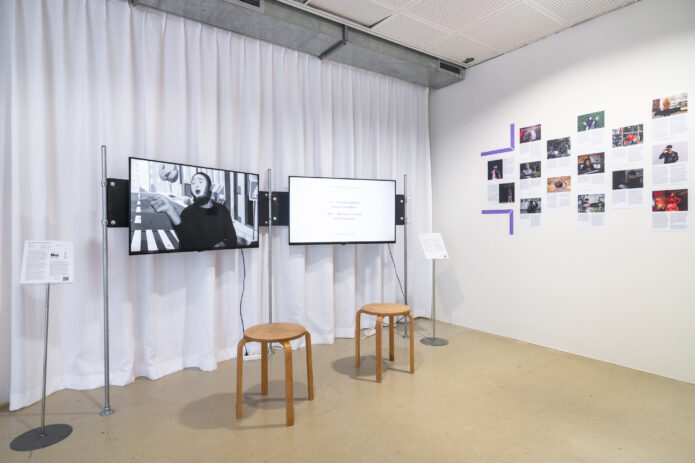
Presentatie: Menaut Waktu, Merekam Jejak - by Jay Afrisando
Deze presentatie toont het werk van Jay Afrisando in het kader van de Atelier KITLV-Framer Framed kunstenaarsresidentie
Agenda
Call and Response: Archive and Counterarchive
Panel discussion on archival research which explores the impact of Dutch colonialism on disabled/difabel people in Indonesia together.
Netwerk
Arief Wicaksono
Kunstenaar