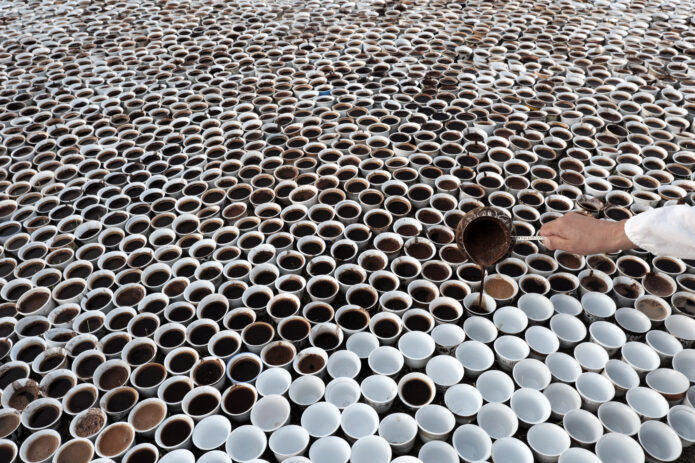
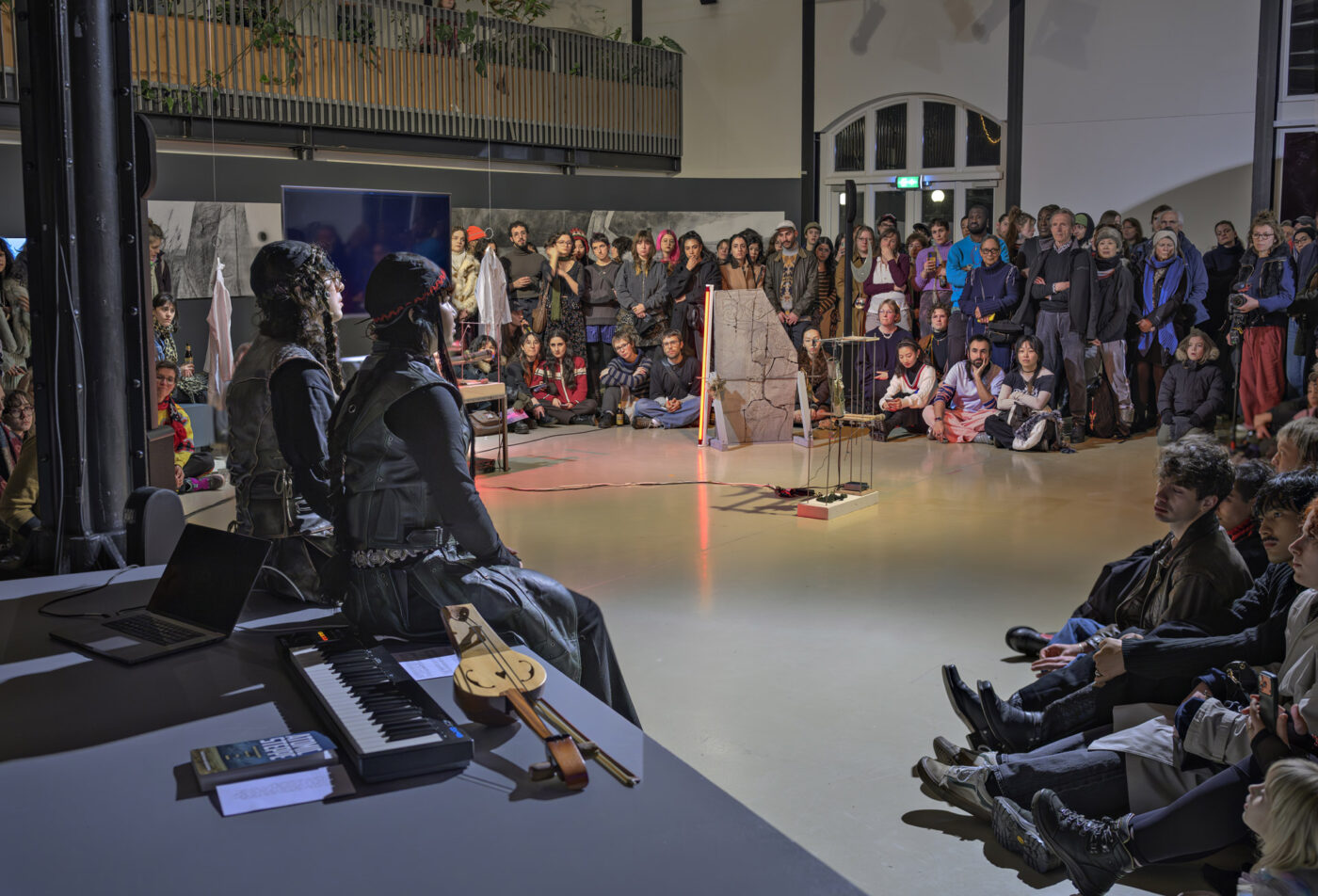
 Performance van kunstenaars-duo buulbuul in de tentoonstelling Between Fires: Irradiated Imaginations and Anti-Nuclear Solidarities (2026) samengesteld door Fabienne Rachmadiev bij Framer Framed, Amsterdam. Foto: © Marlise Steeman / Framer Framed
 Art Space to Practice Justice
An art space is often understood as a place for exhibitions, presentations and artistic showcase, often detached from the developments of the world. Yet, in a world marked by war, conflicts, displacement, violence and extreme inequalities, an art space can and should strive to operate also as a space to practice justice. While writing these lines, I accidentally typed “care” instead of “justice.” This Freudian slip, articulated and carried via the mediation of a keyboard, reveals the intricate relationship between art and justice in connection with care. And in the specific case of an art space, the question of justice becomes first and foremost a question of care. A care for the world’s struggles, care for the artist, care for the cultural workers, care for other art spaces, care for the marginalised, and through acts of care and a care-full approach, practising justice. In this practice of justice, the mere act of the representation of social issues – a trap into which one can easily fall – is unfortunately not enough. A set of words that are written down might seem void of meaning, but they need to be compasses for art institutions, words such as accountability, repair or collective imagination. These are not perfect processes, but an art space provides the freedom to create new relationships or forms of relationships and be a place where things can be tested and enacted. If justice is understood as a legal and juridical objective, in an art space it becomes a social practice rehearsed through cultural and artistic work.
The Question of Neutrality
Neutrality has become a big issue in art institutions and cultural spaces, especially in recent years, where we see a regression of progressive politics in art institutions. In an almost unthinkable statement in 2024, Rein Wolfs, Director of the Stedelijk Museum Amsterdam, expressed his regret over the institution’s past political statements in connection with the war in Ukraine and even Black Lives Matter, suggesting in hindsight that the museum should not have taken a stance on the aforementioned issues and maintain its apolitical identity. These remarks were made, unsurprisingly, during an afternoon public event pointedly titled The Museum is (A)Political! where he was questioned about the museum’s silence on the situation in Palestine .
To think of a museum as a place where justice can be practised, we need to move beyond the understanding of a museum, gallery, art or cultural space as structurally neutral. We need to question whether, under the guise of “neutrality”, art spaces actually uphold and conceal existing power structures, reproducing the same historical exclusions. Being neutral means you actively choose to move with the given status quo, giving a platform to stories that have already been told, to the epistemological reign of Western knowledge and actively denying alternative voices access to cultural resources. The idea of the neutrality of museums and art spaces dramatically devalues the potential of culture in impacting society, acknowledging the inequalities that exist and creating the conditions where different stories can be told. Practising justice begins with denying the illusion of neutrality.
Justice beyond the Juridical
The notion of justice is strongly connected with legal, political and juridical systems and processes linked with a focus on pure facts, evidence and pragmatic legal approaches. Even in transitional justice processes, which are focused on the experiences of the victims, there is little room to focus on the emotions, memories and grief, and rarely a space to practice care and repair on an emotional level beyond the juridical. Delivering justice to a community that had experienced gross human rights violations is undeniably important. But the emotional labour and surplus of trauma cannot be conveyed and respected just through statistics and numbers, it needs the act of care. Artistic practices linked to cases of injustice around the world, open up the space where these emotional dimensions can be visible, shareable and equally appreciated. What extends the culture’s contribution to issues of justice is that it is moving away from the purely factual approach. One can feel the injustice beyond statistics and facts, by visceral encounters through visual culture, storytelling, performances (that give equal importance to the embodied dimensions of injustice), sounds and the collective participation of the audience. It can create a space for justice to exist and be experienced outside a juridical or legal system, in the hope of informing it. Through these processes, the art institution becomes a place where artists can explore historical violence through their mediums, offering communities a way towards repair and care, and also inquiring into how these violences continue to shape our everyday lives.
As Lindsey Pointer and Brunilda Pali point out in their essay Advancing restorative justice through art “restorative justice needs art to ignite the restorative imagination and to advance its practice, theory and agenda.” Imagination is the main point they focus on in connection to both restorative justice and art. They highlight how transitional/restorative justice requires “the collective ability of a committed group of people to imagine a better future” and that this is a creative act in itself. Art, on the other hand, “moves beyond the limitations of language and can work in both advancing public knowledge and understanding of restorative justice” and operates as a vessel of imagination. It is there that the two practices converge and link together, in their shared drive to advance the imagination.
Through processes of imagination, we also see examples where art can utilise not only the visual language of the juridical, but also processes of law making and the tribunal. In the Court for Intergenerational Climate Crimes (CICC), a collaboration between Framer Framed Indian academic writer, lawyer and activist Radha D’Souza and Dutch artist Jonas Staal, we see a large-scale installation which transforms the art venue into a tribunal prosecuting intergenerational climate crimes. CICC hosted tribunals, prosecuting Unilever, ING, Airbus and the Dutch State for their climate crimes, holding hearings in which evidence was presented by prosecutors and witnesses relating to intergenerational climate crimes committed by corporations and states. In addition to prosecutors, witnesses and the public, the tribunal included representations of extinct animals, plants and ammonite fossils paintings, that depicted a fraction of the species lost as a result of human activities. They were surrounding the audience – acting as public jury – in the arena-like installation where the performative tribunal took place. This example demonstrates how, in the same way that art can inform justice processes, juridical environments can equally inform artistic practices, creating a convergence of art, justice, and performative trial that can lead to the concrete production of justice through imagining.
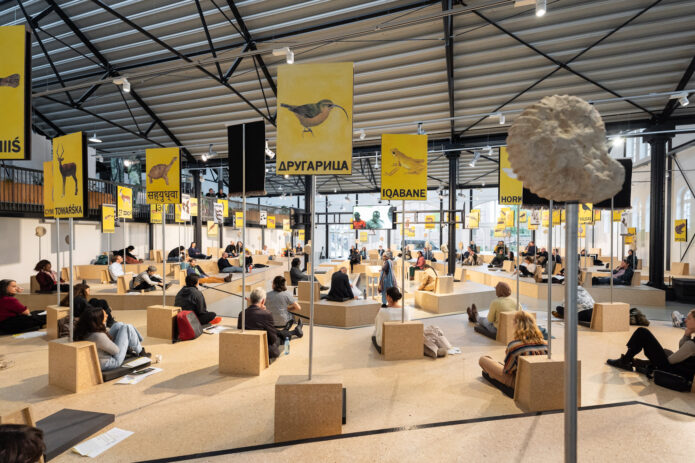
Court for Intergenerational Climate Crimes (2021-2022) by Radha D’Souza & Jonas Staal hearings at Framer Framed. Photo: © Ruben Hamelink
Representation of Justice
An easy example in understanding the limitations of representation is acknowledging the fact that an exhibition addressing the climate crisis or the mining conditions of cobalt in the Democratic Republic of Congo (DRC) does not automatically solve the climate crisis or improve the conditions for the miners in DRC. In the same way, representing justice and social inequalities inside an art institution does not automatically lead to a more equitable institution itself. There is a double challenge that exists there, in the external and internal justice of an institution.
Art spaces that are committed to justice must also look inward; into the ways they operate. Justice is not only manifested in the decision of presenting issues connected to injustices; it is not only what an institution shows but also how an institution operates. For then to practice justice, it needs to centre questions of decision-making, governance, labour, collaborator selection, accessibility, and even resource distribution. Who is shaping the programmes? Which communities are invited and are they part of the decision-making processes? How are conflicts within an institution being addressed? Justice is not just a thematic, content concern for an institution; it needs to be embedded in its function.
It furthermore extends to crucial, graspable questions about how artists and cultural workers are being compensated. Some efforts have been developed in the Dutch context to provide more practical tools for equitable cultural spaces. One example is the Fair Practice Code , which is a code of conduct developed for the arts, culture and creative industries. As stated on its website, it operates as a “moral compass” for the industry based on five values: solidarity, diversity, trust, sustainability, and transparency. Another important example is the Richtlijn Kunstenaars Honorarium, which is a guide for artists’ fees – for both artists and institutions – for non-commercial exhibitions. It includes a tangible calculator that basically computes the minimum fee per artist per exhibition, depending on the duration of the exhibition, the number of participating artists, and whether it is a new or existing work. It is not a fixed number but a starting point for an artist to negotiate. What I want to convey through these examples is that just the declarations of justice inside an art space without practical implementation of decisions that lead to a more equitable institution are just representing and not practising justice.
What ultimately defines an art institution as a space of justice is not a single programme, focus, exhibition or even a methodology being adopted. Practicing justice is a never-ending process enacted through the structures of an institution and its everyday practices. It is the recognition that art alone and the representations of injustice are not enough to solve societal problems, and the stance of “neutrality” in the context of an art space is a decision siding with silencing before the world’s struggles. An art space can become a place where justice is not only practised but rehearsed, negotiated and even challenged. Justice is an ongoing work that requires thinking critically, imaging and acting collectively within an art space.
Text Lydia Markaki
This text first appeared in Arts of the Working Class, issue#42 Global Players, addressing the theme of transitional justice as part of the Transitional Justice with Artists (TJA) Creative Europe co-operation program between AFIELD, Arts of the Working Class and Framer Framed. The issue is available for purchase on a physical copy at Framer Framed.
Institutional Critique / Art and Activism /
Network